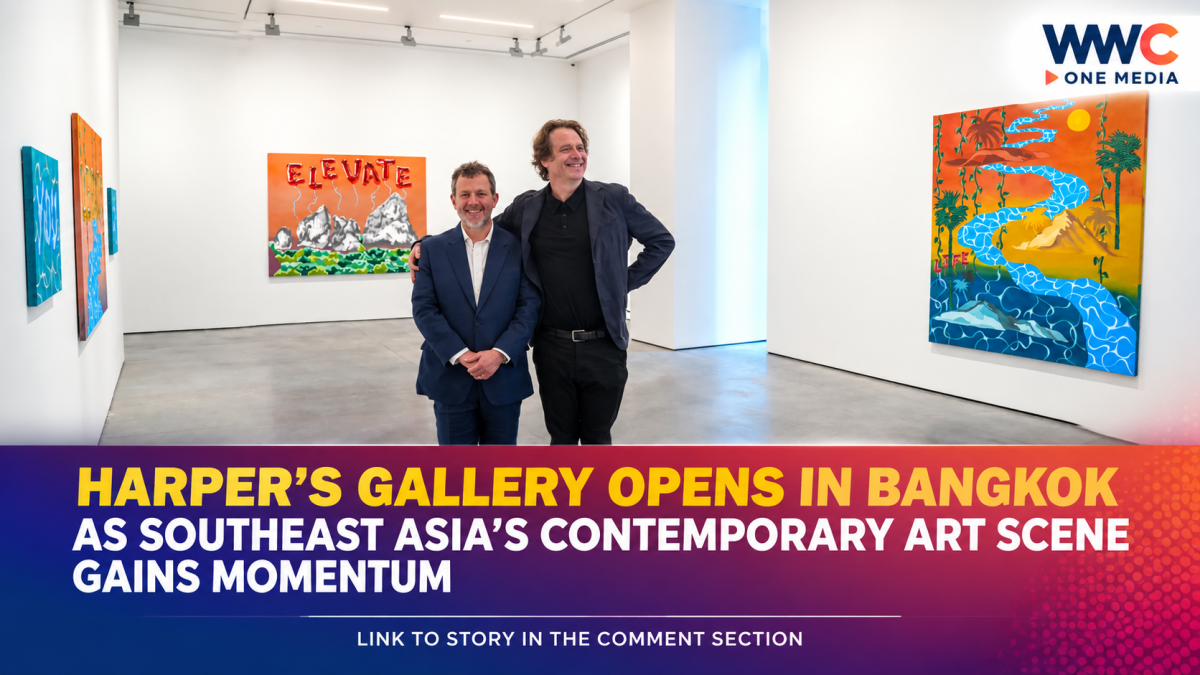
Bangkok is gaining another major contemporary art presence with the arrival of Harper’s Gallery, the New York gallery’s first international outpost and a new space designed to connect Western contemporary art with Thailand’s increasingly visible collecting scene.
Located at Siam Patumwan House, Harper’s Bangkok opened in spring 2026, marking a new chapter for the gallery founded by Harper Levine. The Bangkok location looks onto a courtyard, creating a quieter environment intended to give visitors a pause from the energy of the city before entering the exhibition space.
The gallery’s origins are closely connected to books. Levine built his career as a rare-book dealer before developing Harper’s into a contemporary art gallery, and he says years of handling art, photography and design books influenced the way he thinks about visual sequencing and presentation.
That connection between print and fine art remains part of Harper’s identity. The gallery was founded in 1997 and today operates several spaces in New York, including locations on West 22nd Street, alongside its Bangkok outpost.
For the Bangkok space, however, the goal is not simply to reproduce the New York gallery model.
Levine describes the courtyard-facing design as an intentional sanctuary. While Bangkok’s energy was part of the attraction, the gallery wanted visitors to experience a moment of calm before encountering the artwork.
The move also reflects Levine’s view that Bangkok is entering an increasingly important phase in the international contemporary art world.
He points to the city’s growing network of institutions and galleries and argues that Thai and Southeast Asian collectors are already sophisticated participants in the global art market, even though he believes the international art community has not always paid enough attention to them.
Harper’s first Bangkok exhibition featured new paintings and large-scale prints by Joel Mesler. The programme has since expanded with “Bright Lights, Big City”, a group exhibition running from Aug. 14 to Nov. 1, 2026, featuring 24 artists. The exhibition takes its title from Jay McInerney’s 1984 novel and draws a parallel between the energy of 1980s New York and Bangkok’s current creative momentum.
The decision to establish a permanent physical space is also deliberate in an era when much of the art world is experienced online.
For Levine, seeing art in person remains fundamental. He argues that digital images and social media cannot reproduce the experience of standing in front of an artwork and encountering its scale, texture and physical presence.
That philosophy fits Bangkok’s rapidly developing art ecosystem, where galleries, museums and independent cultural spaces are contributing to a wider conversation about contemporary art in Southeast Asia.
Harper’s arrival therefore comes at a moment when Bangkok is increasingly being viewed not simply as a destination for art tourism, but as a place where artists, collectors and institutions can build their own networks.
For emerging collectors, Levine also offers a less conventional message: collecting should not begin with the expectation of making money. Instead, he describes it as a creative and deeply personal experience, encouraging people to develop their own tastes rather than follow the crowd.
With its Bangkok gallery, Harper’s is betting that the city’s growing art community is ready for that kind of long-term conversation.
And as more international galleries turn their attention toward Southeast Asia, Bangkok’s next chapter may be about more than attracting global names — it could be about establishing itself as a cultural centre with a distinct identity of its own.