
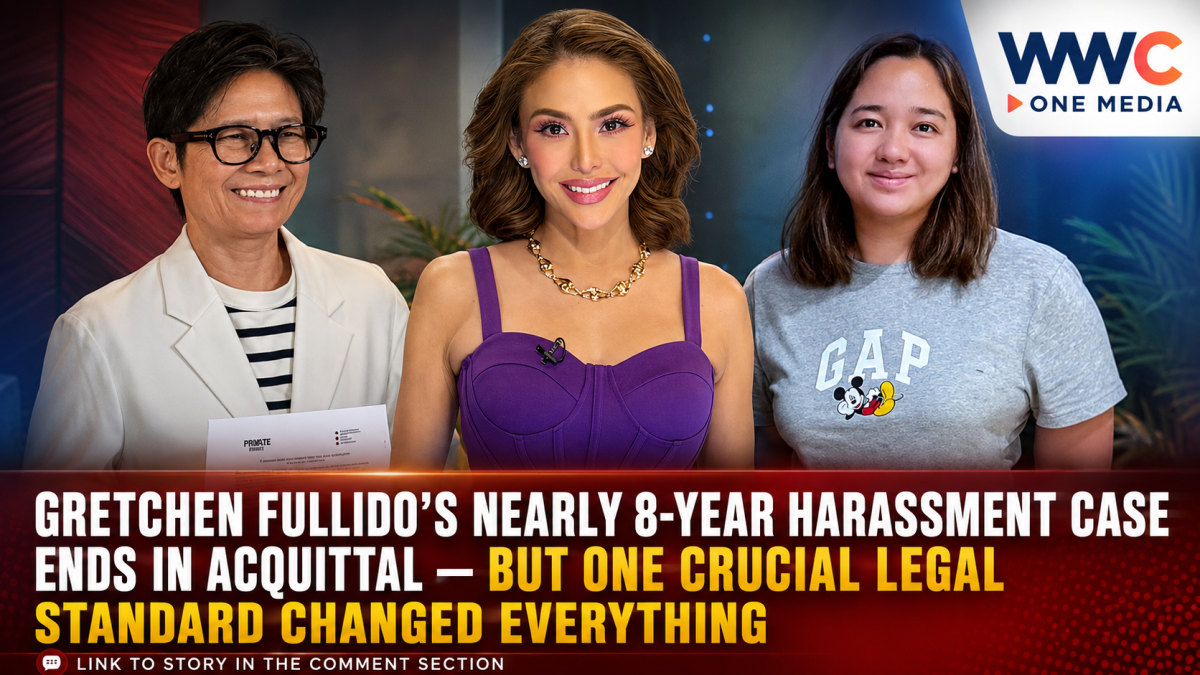
MANILA, Philippines — A legal battle that began with allegations of workplace sexual harassment inside one of the Philippines’ biggest television newsrooms has reached a decisive turning point.
The Quezon City Metropolitan Trial Court has acquitted former ABS-CBN News supervising producer Cheryl Favila and producer Maricar Asprec of the sexual-harassment charges filed by veteran television anchor and entertainment reporter Gretchen Fullido, ruling that prosecutors failed to establish their guilt beyond reasonable doubt.
In a 91-page decision promulgated on August 28, 2026, Metropolitan Trial Court Branch 32 Judge Angeli Albana-Garrido ordered Favila and Asprec acquitted of violating Republic Act No. 7877, or the Anti-Sexual Harassment Act of 1995.
The ruling brought an extraordinary legal dispute dating back almost eight years to a close at the trial-court level.
But the reason behind the acquittal is important.
The court did not frame its decision simply around whether controversial messages existed or whether workplace interactions had become inappropriate. Instead, the criminal case ultimately turned on whether prosecutors had proven every legal element required under R.A. 7877 beyond reasonable doubt.
That threshold, the court concluded, was not met.
COURT: REASONABLE DOUBT MUST FAVOR THE ACCUSED
In its ruling, the court emphasized one of the most fundamental principles of Philippine criminal law: an accused person is presumed innocent unless the prosecution proves guilt beyond reasonable doubt.
The court consequently acquitted Favila and Asprec in Criminal Case No. 19-05659-CR, finding that reasonable doubt remained over their criminal liability.
The distinction is significant.
An acquittal based on reasonable doubt means the prosecution failed to satisfy the extremely high evidentiary standard required for a criminal conviction. It should not automatically be interpreted as a judicial declaration that every allegation made by Fullido was fabricated.
R.A. 7877 specifically addresses sexual harassment committed by a person who has authority, influence or moral ascendancy over another in an employment, education or training environment.
In workplace cases, the statute covers circumstances in which sexual favors are connected to employment benefits or disadvantages, interfere with an employee’s rights, or create an intimidating, hostile or offensive working environment.
That statutory framework meant prosecutors had to prove the elements of the charged offense—not merely show that sexually oriented or uncomfortable communications had occurred.
HOW THE CASE STARTED
The controversy first erupted internally at ABS-CBN.
In November 2017, Fullido filed an administrative complaint against Favila and Asprec.
Fullido alleged that she had received messages containing sexual innuendos during a period lasting roughly three years. Her camp maintained that some of the communications amounted to implicit requests for sexual favors and that her professional life became more difficult after she rejected the alleged advances.
Favila and Asprec consistently disputed those accusations.
Their lawyers argued that the text messages presented by Fullido had been taken out of their broader conversational context and denied that the producers sexually harassed her.
The disagreement soon moved far beyond an internal newsroom dispute.
ABS-CBN’S OWN INVESTIGATION REACHED A MIXED RESULT
ABS-CBN conducted an internal investigation into Fullido’s administrative complaint.
In July 2018, the network dismissed the sexual-harassment allegation after determining there was insufficient evidence to sustain it.
But the internal proceeding did not completely clear Favila of workplace misconduct.
According to reports on the investigation, ABS-CBN found Favila liable for gross misconduct and unprofessional conduct involving sexually oriented language within a superior-subordinate relationship.
Favila later left ABS-CBN.
The complaint against Asprec was dismissed for lack of evidence.
At the time, ABS-CBN publicly said it took allegations of sexual harassment seriously and did not condone such behavior in the workplace.
FULLIDO TAKES THE CASE TO PROSECUTORS
The dispute escalated on October 5, 2018, when Fullido filed a criminal sexual-harassment complaint against Favila and Asprec before the Quezon City Prosecutor’s Office.
Her complaint centered in part on text messages she described as containing sexual innuendos.
Fullido maintained that even without an explicit demand for sex, certain exchanges could constitute implicit requests for sexual favors and contribute to a hostile or offensive workplace.
Favila offered a sharply different interpretation.
Speaking to the Philippine Daily Inquirer during the early stages of the controversy, she denied sexually harassing Fullido and argued that messages at the center of the dispute had been presented without their complete context.
Government prosecutors eventually pursued the case.
In June 2019, the Inquirer reported that Favila and Asprec had been indicted for violation of R.A. 7877 and would face trial over Fullido’s allegations.
That criminal case would remain unresolved for years.
THE CASE ALSO TRIGGERED SEPARATE LIBEL BATTLES
Fullido’s original legal action extended beyond Favila and Asprec.
She also pursued libel complaints involving ABS-CBN personalities and executives, including veteran journalist Ces Drilon, former reporter Marie Lozano, and news executive Venancio Borromeo, arising from statements made during the controversy.
Some of those cases were subsequently dismissed or ended in acquittal.
The Quezon City Prosecutor’s Office junked Fullido’s libel complaint against Drilon in 2019.
In another related case, a Quezon City Regional Trial Court acquitted Lozano of libel in December 2025 after finding that the prosecution had failed to establish guilt beyond reasonable doubt.
Those separate proceedings underscore how what began as an internal workplace complaint evolved into years of intertwined administrative and criminal litigation.
WHAT R.A. 7877 REQUIRES
The latest acquittal also highlights an important distinction between conduct that may be inappropriate under workplace rules and conduct that satisfies the elements of a criminal offense.
Under R.A. 7877, workplace sexual harassment involves a person who possesses authority, influence or moral ascendancy over another and demands, requests or otherwise requires a sexual favor under circumstances covered by the law.
The statute also addresses situations in which such conduct affects employment opportunities or rights or creates an intimidating, hostile or offensive environment.
Because Favila and Asprec were being prosecuted criminally, however, the government carried the additional burden of proving the required elements beyond reasonable doubt.
The Quezon City court found that the evidence did not reach that threshold.
NEARLY EIGHT YEARS LATER
The August 28 ruling therefore closes a major chapter in a dispute that became one of the Philippine broadcast industry’s most closely watched workplace-harassment controversies.
Fullido first took the issue to ABS-CBN management in 2017 and brought her criminal complaint to Quezon City prosecutors in October 2018.
Almost eight years after the criminal complaint was filed, the trial court has now ruled in favor of Favila and Asprec.
As of Philstar.com’s August 29 report, neither Fullido nor her lawyer, Atty. Lorna Kapunan, had publicly addressed the acquittal.
Any subsequent statement from Fullido’s camp could become the next significant development in the case.
For now, however, the operative legal result is clear:
Cheryl Favila and Maricar Asprec have been acquitted of workplace sexual harassment under R.A. 7877 because the prosecution failed to prove the criminal charge beyond reasonable doubt.
And after nearly eight years of litigation, that evidentiary standard—not the noise surrounding one of Philippine television’s most controversial newsroom disputes—ultimately determined the verdict.



Leave a Reply