
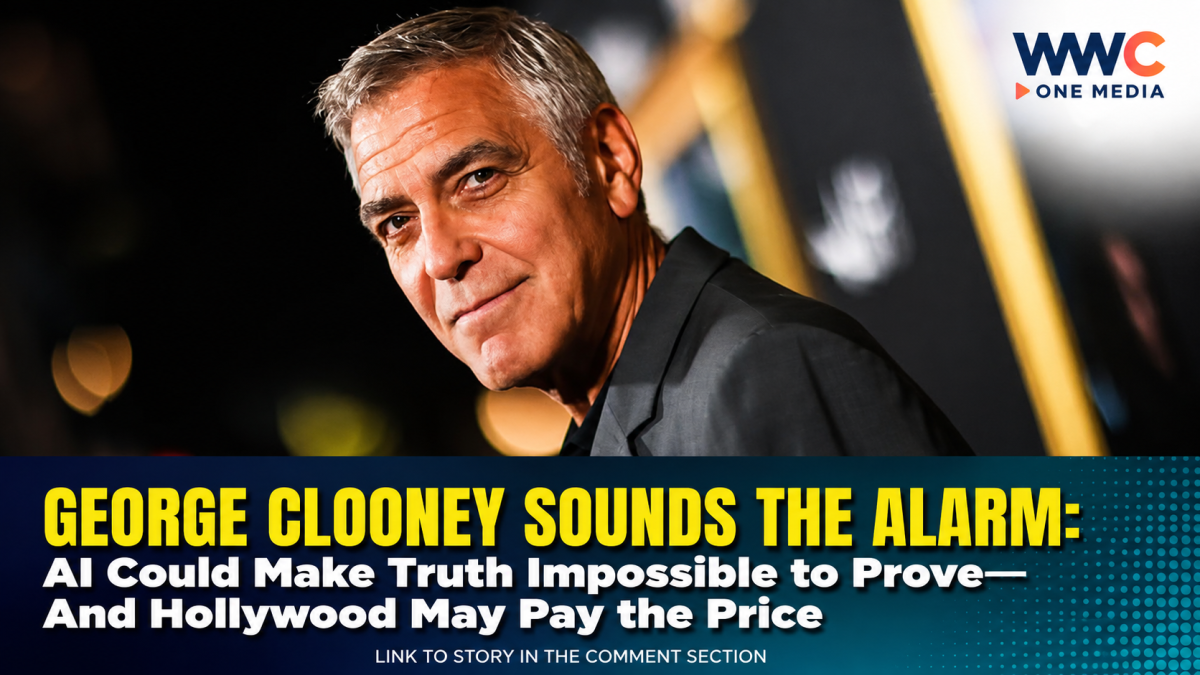
VENICE, Italy — George Clooney used the spotlight of the 2026 Venice Film Festival to deliver a warning that reaches far beyond Hollywood: as artificial intelligence becomes more powerful, society could face a future where people can no longer confidently tell what is real from what has been manufactured.
The Oscar-winning actor, filmmaker and political activist made the remarks on Wednesday while in Venice to receive the Golden Lion for Lifetime Achievement at the 83rd Venice International Film Festival.
Clooney said the rapid development of AI-generated content and deepfake technology is creating a dangerous information problem—not simply because fake material can look real, but because genuine evidence could eventually be dismissed as fake.
That, he suggested, could be even more damaging.
The “fake” problem could become a “real” problem
Clooney’s concern centers on what happens when manipulated videos, images and audio become nearly indistinguishable from authentic material.
He warned that once audiences become accustomed to questioning everything they see, the public may begin rejecting genuine evidence simply because it is possible to claim that it was generated or altered by AI.
For journalism, the consequences could be severe.
A fabricated video could spread rapidly before journalists have time to verify it. But even after authentic footage is independently confirmed, people could still dismiss it as an AI creation.
That creates what Clooney described as a kind of erosion of trust: the danger is no longer only convincing people of something that never happened, but also making people doubt something that actually did.
Clooney says Hollywood is facing another AI disruption
The actor also warned that AI could dramatically reshape employment in the entertainment industry.
He pointed specifically to visual-effects work and other areas where increasingly sophisticated AI systems could automate tasks that currently require large teams of professionals.
Clooney said AI will likely become an increasingly important part of filmmaking, but argued that the industry is not fully prepared for the consequences.
His comments come as Hollywood continues to wrestle with the use of generative AI, digital likenesses and automation.
The issue has become particularly sensitive for performers and creative workers because AI can potentially reproduce aspects of a person’s appearance, voice or performance without requiring the same traditional production process.
Clooney also joked about the possibility of his digital likeness being used commercially after his death—a humorous remark that underscored a serious question: Who controls an actor’s digital identity when that actor is no longer able to give consent?
Deepfakes could become a crisis for journalism
Clooney’s warning also connects Hollywood’s AI debate to a much larger problem facing news organizations.
The proliferation of convincing synthetic media could make verification increasingly difficult for journalists, governments and ordinary citizens.
The challenge is especially serious during wars, elections, political crises and other breaking events, when false information can travel around the world within minutes.
Clooney said he had recently spoken with AI experts and remained unconvinced that current safeguards are advancing quickly enough to keep pace with the technology.
The concern is not theoretical. AI-generated images, audio and video are already capable of producing increasingly convincing impersonations, while detection and verification systems must constantly adapt to new methods of manipulation.
Clooney also raises concerns about who controls the news
The actor broadened his warning to include the ownership of major media organizations.
He expressed concern that some of the world’s most influential information platforms are controlled by extremely wealthy individuals, arguing that concentrated ownership raises questions about media independence and the diversity of information available to the public.
Clooney nevertheless said he remains optimistic that journalism will find a way forward.
His comments carry particular weight because journalism has been central to his career as a filmmaker. His 2005 film “Good Night, and Good Luck” examined television journalist Edward R. Murrow’s confrontation with political pressure during the McCarthy era.
That film, which premiered at Venice, became an example of Clooney’s longstanding interest in the relationship between journalism, political power and public accountability.
Media consolidation is another warning sign
Clooney also questioned the financial logic and potential employment consequences of major media mergers, pointing to Paramount’s proposed acquisition of Warner Bros. as an example.
He argued that large corporate combinations can frequently result in job losses, while their long-term financial benefits are not always obvious.
His concerns reflect a broader transformation taking place across the entertainment and media industries, where traditional studios, streaming platforms, technology companies and digital distributors increasingly compete for audiences and control over intellectual property.
Why Clooney’s warning matters now
Clooney’s comments arrive at a critical moment for both Hollywood and journalism.
AI is simultaneously being promoted as a tool that could make filmmaking faster and more accessible while raising difficult questions about employment, copyright, consent, authenticity and human creativity.
At the same time, news organizations are confronting an information environment in which manipulated content can spread faster than traditional verification processes.
The result could be a paradox:
The better AI becomes at creating believable fiction, the harder it may become to prove what is actually true.
And for journalists, that could fundamentally change the way evidence is gathered, authenticated and presented to the public.
The 2026 Venice Film Festival, which runs through September 12, is traditionally one of the major launching points of the international film awards season. Clooney’s Golden Lion recognition therefore arrives at a festival celebrating cinema’s past while confronting some of the biggest technological and business questions shaping its future.
For Clooney, the issue ultimately goes beyond movies.
It is about whether audiences can continue to trust what they see—and whether, in an age of increasingly convincing AI, the truth will still be recognizable when it matters most.
WWC ONE MEDIA MJE




Leave a Reply