
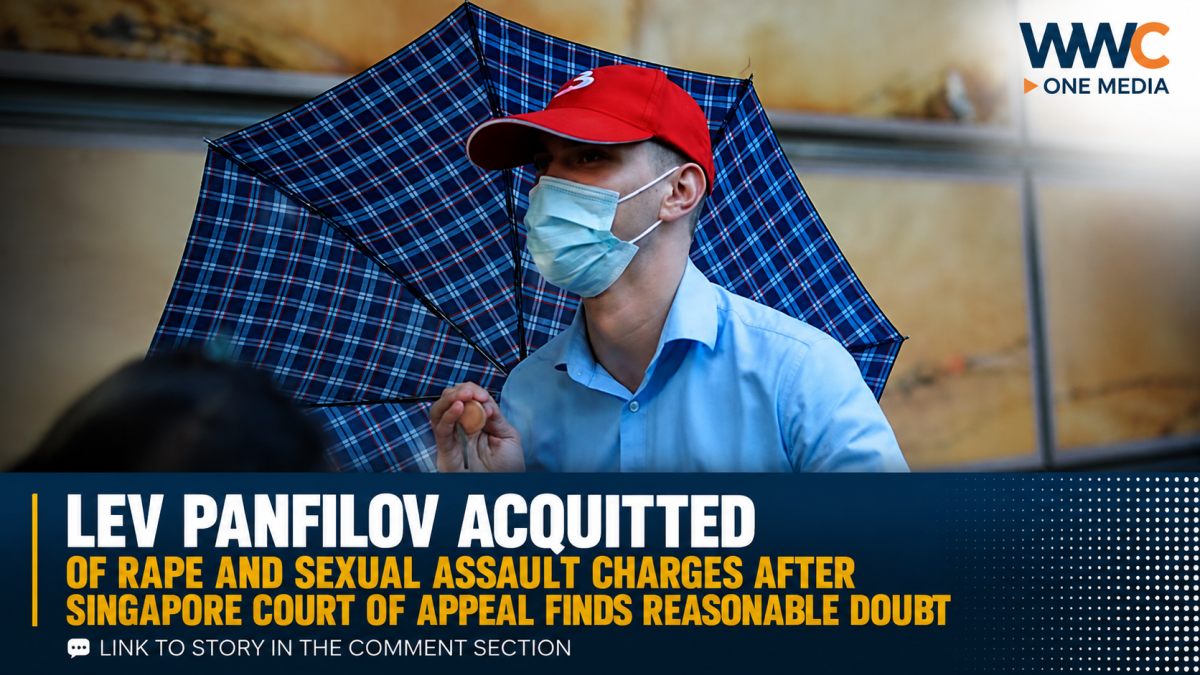
SINGAPORE — September 2, 2026 — A major legal reversal has cleared former Wah!Banana scriptwriter-actor and TikToker Lev Panfilov of four sexual-offence convictions after Singapore’s Court of Appeal found that inconsistencies in the complainant’s evidence created reasonable doubt in the prosecution’s case.
The three-judge Court of Appeal on Wednesday allowed Panfilov’s appeal and acquitted him of all four charges: two counts of rape, one count of sexual assault by penetration and one count of outrage of modesty.
Panfilov, 30, is a Russian national and Singapore permanent resident. He had previously been sentenced to 11½ years’ imprisonment and 12 strokes of the cane after the High Court convicted him in May 2025. The caning had not been carried out.
From an 11½-Year Sentence to Complete Acquittal
The case began with a sexual encounter on January 12, 2021, after Panfilov and the woman met through Tinder.
They had first met at a restaurant in Robertson Quay before going to Panfilov’s condominium, where the woman said she had agreed to continue discussing scriptwriting.
Panfilov did not dispute that sexual activity occurred. His position throughout the proceedings was that the encounter was consensual.
The woman alleged that she had been sexually assaulted and raped.
Because there were no eyewitnesses to the encounter, the case ultimately became heavily dependent on the credibility and reliability of the two accounts.
At the original trial, High Court Justice Pang Khang Chau found the complainant to be an “unusually convincing” witness and convicted Panfilov on all four charges.
The judge also found significant inconsistencies in Panfilov’s own accounts and concluded that he was not a credible witness.
The Court of Appeal reached a different conclusion.
Why the Appeal Court Overturned the Convictions
Justice Sushil Nair, delivering the decision on behalf of the three-judge panel, said several issues with the complainant’s evidence became significant when considered collectively.
The court concluded that those issues created reasonable doubt and that her evidence did not meet the unusually convincing standard required in this type of case.
1. The Question of Whether She Screamed
One of the central inconsistencies concerned what happened during the alleged assault.
The woman told a doctor that she had screamed and that Panfilov attempted to silence her.
However, during the trial, she said she had wanted to scream but did not actually scream.
The Court of Appeal accepted the doctor’s contemporaneous medical notes and regarded the discrepancy as material because it concerned an important part of the alleged assault.
The issue was particularly relevant because other people were reportedly present in the flat at the time, yet there was no evidence that they heard a disturbance.
The judges nevertheless acknowledged that victims of sexual assault can respond in different ways, including freezing, and did not treat the absence of a scream as determinative by itself. Instead, it was considered alongside the other issues in the evidence.
2. Doubts Over the Blood-Stained Underwear
Another major issue involved a pair of blood-stained underwear introduced as physical evidence.
The complainant said she had noticed blood on the underwear after returning home and placed it in her laundry basket.
Six days later, she retrieved it when preparing to go to KK Women’s and Children’s Hospital.
The appeal judges found unresolved questions about both the source of the blood and whether the underwear produced in court was definitely the pair worn during the encounter.
The court noted that the woman had her period during the intervening period and that the medical evidence did not establish that the blood came from an injury sustained during the alleged assault.
This became particularly important because the underwear was relied upon as physical evidence supporting the allegation of a violent assault.
The Court of Appeal concluded that the uncertainty surrounding the exhibit went to the heart of the prosecution’s case.
3. A Doctor’s Memo Became Another Point of Doubt
The judges also examined the complainant’s visit to a clinic several days after the incident.
According to the court’s account, she had sought a doctor’s memo concerning her injuries and their possible cause, potentially so she could approach Panfilov’s family.
When the doctor declined to provide such a memo without a police report, the woman allegedly asked for the consultation records to be removed.
The Court of Appeal found it difficult to reconcile this with her later inability to remember making the request.
Again, the court did not treat this issue in isolation.
It considered it together with the other inconsistencies affecting the prosecution’s case.
The Court Also Examined What Happened After Panfilov Left the Room
The judges identified another difficulty involving the sequence of events inside the bedroom.
The woman testified that she had tried to leave or break free before being pushed onto the bed.
At one point, Panfilov left the room to go to the bathroom.
The appeal judges said the woman’s remaining on the bed, fully dressed, during that gap was difficult to reconcile with parts of her account.
Justice Nair stressed that this did not mean a sexual-assault victim must behave in a particular way. But in the context of the complainant’s specific testimony, the judges considered the sequence inconsistent with her account and more consistent with Panfilov’s position that the encounter was consensual.
The Legal Standard Was Crucial
This was not simply a case of the appeal judges choosing one person’s story over another.
Because the prosecution’s case depended heavily on the complainant’s testimony, the court examined whether that testimony met Singapore’s established “unusually convincing” standard applicable in this type of evidential situation.
The standard does not replace the prosecution’s obligation to prove guilt beyond reasonable doubt.
The Court of Appeal concluded that the combined inconsistencies meant the prosecution had not overcome reasonable doubt.
That distinction is important.
An acquittal means Panfilov is not legally guilty of the charges. It does not establish that the court has determined the allegations were fabricated.
The Court of Appeal’s decision was specifically that the prosecution had not proved its case to the required standard.
What Happened to the Original Conviction?
Panfilov had originally faced four charges:
- Two counts of rape
- One count of sexual assault by penetration
- One count of outrage of modesty
The High Court convicted him and imposed a global sentence of 11 years and six months’ imprisonment and 12 strokes of the cane.
After the Court of Appeal overturned the convictions, the outstanding charge of obstruction of justice was also discharged in a manner amounting to an acquittal, according to CNA.
The prosecution’s separate appeal against the sentence consequently became moot and was dismissed.
The Case Drew Intense Scrutiny
Panfilov’s case attracted considerable public attention because of his background as a former actor and scriptwriter with Wah!Banana, as well as his presence on TikTok and social media.
But the appeal itself focused on evidence and legal standards rather than his public profile.
The hearing in August 2026 lasted for several hours, with Panfilov’s lawyers arguing that the complainant’s evidence contained material inconsistencies.
The Court of Appeal reserved judgment at that time before delivering its decision on September 2.
A Dramatic Turn in a Case That Began Five Years Ago
The timeline is striking:
January 2021: Sexual encounter takes place.
May 2023: Trial proceedings begin.
March 2025: High Court finds Panfilov guilty.
May 2025: He receives an 11½-year sentence and 12 strokes of the cane.
August 2026: Court of Appeal hears his challenge and reserves judgment.
September 2, 2026: Court of Appeal overturns the convictions and acquits him of all four sexual-offence charges.
The reversal represents one of the most significant developments in the case since the original conviction.
The Bigger Question for Singapore’s Justice System
The case is likely to generate discussion beyond Panfilov himself.
It highlights the extraordinary difficulty of sexual-offence cases where there are no eyewitnesses and little independent corroborating evidence.
It also illustrates why appellate courts can reach a different conclusion from a trial judge after reviewing the evidence as a whole.
For victims of sexual assault, the case should not be interpreted as a reason to avoid reporting crimes. For defendants, it demonstrates the importance of the prosecution meeting the criminal standard of proof.
Ultimately, the Court of Appeal’s ruling rests on one fundamental principle:
A criminal conviction cannot stand where the evidence leaves reasonable doubt.
And in Panfilov’s case, the highest court reviewing the appeal concluded that threshold had not been met.
Accuracy & legal note
This report was cross-checked against AsiaOne, CNA, The Straits Times, Mothership and Singapore’s published High Court judgment. The Court of Appeal decision reported on September 2, 2026 is the controlling development: Panfilov’s four sexual-offence convictions were overturned and he was acquitted. The allegations made by the complainant are presented as allegations, not established facts. Likewise, the Court of Appeal’s finding of reasonable doubt should not be described as a judicial finding that the complainant deliberately fabricated the allegations.
WWC ONE MEDIA J.M.D




Leave a Reply