
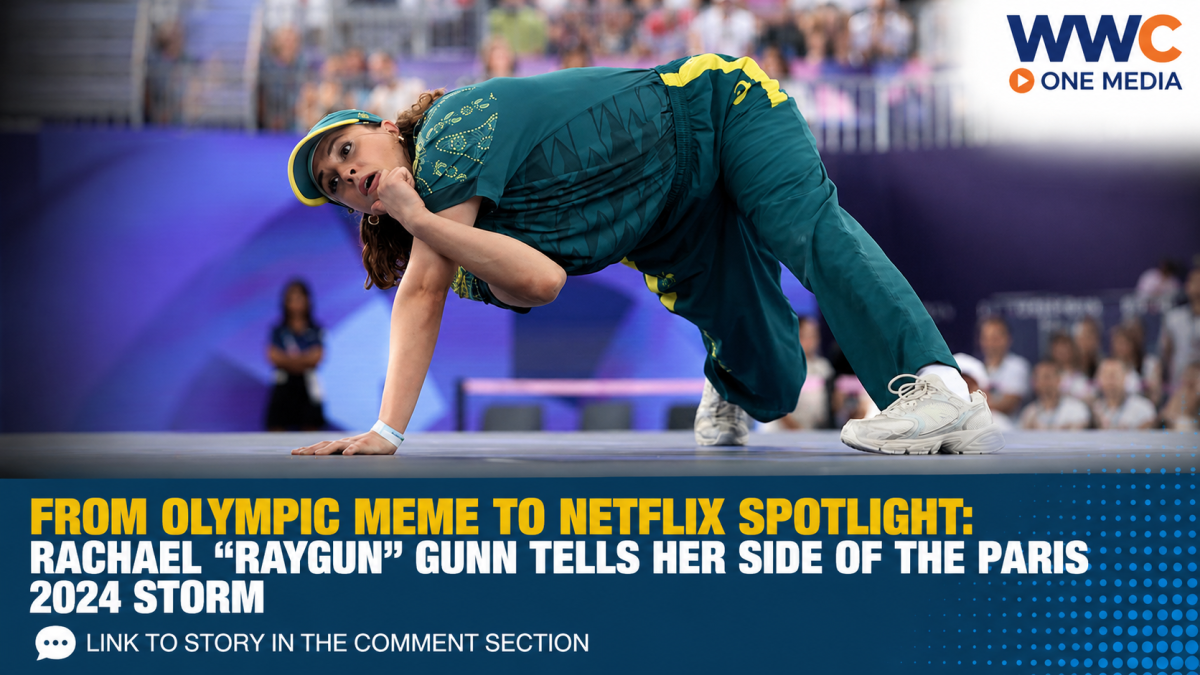
Raygun Is Back — This Time, She Wants to Tell the Story Herself
Two years after becoming one of the most recognizable — and controversial — figures of the Paris Olympics, Australian breaker Rachael Gunn, better known as Raygun, is back in the spotlight.
But this time, the story is being told largely from her perspective.
Netflix’s new documentary, “Untold Raygun: Breaking Badly,” explores Gunn’s unlikely journey to the 2024 Paris Olympics, her instantly viral performance, the avalanche of memes and criticism that followed, and the personal impact of becoming a global internet sensation almost overnight.
The documentary is now streaming on Netflix and forms part of the latest installment of the platform’s Untold sports documentary series.


5
“The Whole World Could Laugh at Me”
One of the most striking moments in the documentary comes from Gunn’s recollection of a conversation with her therapist shortly before the Olympics.
She said she was worried about what could happen if her Olympic appearance went badly.
Her fear was simple: the entire world might laugh at her.
That fear became reality on a scale few athletes could have anticipated.
Gunn’s unusual movements — including her kangaroo-inspired routine and a move resembling the sprinkler — rapidly spread across social media after her Olympic appearance. The clips became memes, television comedy material and a worldwide cultural talking point.
What began as online humor, however, eventually became something much more painful for Gunn.
She describes feeling overwhelmed by the criticism and the sudden loss of privacy, saying in the documentary that her life felt as though it was “crumbling” around her.
She Didn’t Win a Battle — But She Won the Internet
Gunn competed in the women’s breaking competition at Paris 2024, where breaking made its Olympic debut.
She lost all three of her round-robin battles and received no votes from the judges in those matchups. Yet the performance became arguably one of the most talked-about moments of the entire Games.
The contrast was extraordinary.
While Japanese breaker Ami Yuasa, known as B-Girl Ami, won the first-ever Olympic gold medal in women’s breaking, Gunn became internationally famous for a performance that did not produce a competitive victory.
Her Olympic appearance ultimately became bigger online than her actual competition results.
But How Did Raygun Qualify?
That question became one of the biggest controversies surrounding Gunn.
Social media users questioned whether she had legitimately earned her place at the Games, with some even spreading claims that her husband had influenced the selection process.
Those claims were investigated and rejected.
The Australian Olympic Committee said Gunn qualified through the official Oceania qualifying process, and its records show she won the Oceania Breaking Championships qualification event in Sydney in 2023.
An Australian Associated Press fact-check also found the claim that Gunn’s husband was a judge involved in her Olympic selection process to be false.
That distinction is crucial because the controversy surrounding Gunn’s Olympic selection generated substantial misinformation after her performance went viral.
The Backlash Went Far Beyond Memes
The online reaction wasn’t limited to jokes.
Gunn said the tone changed as the viral attention continued.
The documentary examines the conspiracy theories and misinformation that circulated online, as well as the emotional consequences of the backlash. Netflix describes the film as following Gunn’s “rise, fall, and reinvention” after her Olympic performance became a global phenomenon.
The Australian Olympic Committee also publicly defended Gunn against false claims and said she had been selected through a transparent and independent qualification and nomination process.
Raygun Has Left Academia and Found a New Direction
Gunn was not simply an athlete when she arrived in Paris.
She holds a PhD in cultural studies and had worked as an academic and researcher, with her research focusing partly on breaking and dance culture.
Since the Olympics, however, her professional life has changed.
She is no longer a university lecturer and has moved toward public speaking, education and performance work. Her website describes her as a speaker, educator and performer.
The transformation reflects the strange trajectory of her post-Olympic fame: an athlete who became globally famous not because she won, but because the internet couldn’t stop talking about her.
The Documentary Is Also Being Critiqued
While Gunn’s personal story has attracted sympathy, the Netflix documentary has not escaped criticism.
Some reviewers argue that the film focuses heavily on Gunn’s personal experience while giving less attention to the broader history and culture of breaking, an art form rooted in Black and Latino communities in the Bronx.
The Guardian, for example, argued that the documentary does not fully confront the wider cultural implications of Gunn becoming the defining image many people associate with breaking’s Olympic debut.
Australian broadcaster ABC also reported that the documentary has divided critics, with some praising its attempt to explain Gunn’s experience while questioning whether it sufficiently addresses the wider controversy surrounding her Olympic appearance.
That debate makes the documentary more than a simple comeback story.
It is also a look at how quickly an athlete can become a global meme — and what happens when the joke follows them long after the competition ends.
Breaking’s Olympic Future Is Already Different
There is another unusual chapter to Gunn’s Olympic story.
Breaking was included at the Paris 2024 Games but will not be part of the Los Angeles 2028 Olympic program. The decision to leave it out was made independently of Gunn’s Paris performance.
That means Paris remains the only Olympic Games where breaking has appeared so far.
And Gunn, despite becoming synonymous with one of the most viral Olympic performances in recent memory, insists there is more to her story than a collection of internet memes.
As the documentary’s central message makes clear, she doesn’t want to be remembered only as “Raygun,” the Olympic meme.
She wants people to see the person behind it.
WWC ONE MEDIA J.M.D


Leave a Reply