
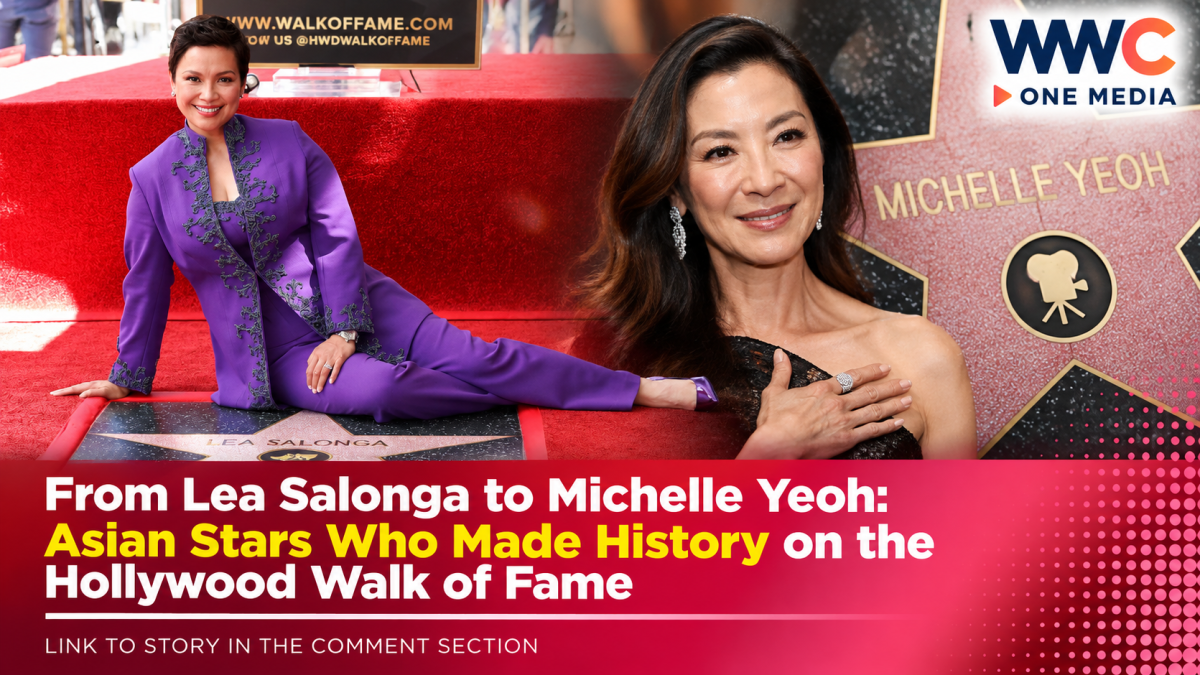
HOLLYWOOD, California — Lea Salonga has added another historic milestone to a career that has taken her from the Philippines to Broadway, London’s West End and Hollywood.
The acclaimed Filipina singer and actress received the 2,855th star on the Hollywood Walk of Fame on Sept. 4, becoming the first Filipina woman and the first Philippine-born artist to receive the prestigious honour. Her star, awarded in the Live Performance category, places her alongside a select group of Asian entertainers whose work helped reshape Hollywood and expand representation on the global stage.
Salonga’s recognition is more than a personal achievement.
It is also a moment of celebration for Asian artists whose careers have broken barriers across film, television, music and theatre.
Lea Salonga: A Historic Star for the Philippines
For generations of fans, Lea Salonga’s voice has been impossible to forget.
She became an international theatre sensation after originating the role of Kim in Miss Saigon, a performance that earned her a Tony Award and made her the first Asian woman to win the honour in an acting category.
She later became known worldwide as the singing voice behind two of Disney’s most beloved characters: Princess Jasmine in Aladdin and Mulan.
Her career has also included major performances in Les Misérables, where she made history as the first Asian actress to play both Éponine and Fantine on Broadway.
At her Hollywood Walk of Fame ceremony, Salonga was joined by fellow stars including Ming-Na Wen, Darren Criss, Brandy and H.E.R.
The ceremony became an emotional celebration of her decades-long career and her influence on artists who followed in her footsteps.
Anna May Wong: Hollywood’s First Chinese-American Film Star
Long before modern conversations about Asian representation in Hollywood, Anna May Wong was breaking barriers.
Wong became one of the original Hollywood Walk of Fame honourees in 1960 and is widely recognised as Hollywood’s first Chinese-American movie star.
Her career unfolded during an era when Asian performers faced severe discrimination and were frequently denied leading roles because of racist casting practices and production restrictions.
Despite those barriers, Wong built an international career and became a pioneering figure for generations of Asian and Asian-American actors.
Her star remains a reminder that Asian representation in Hollywood did not begin with modern blockbusters.
The struggle for recognition began decades earlier.
Sessue Hayakawa: The Silent-Era Heartthrob Who Defied Hollywood
Another early Asian Hollywood trailblazer was Sessue Hayakawa.
Also honoured with a Walk of Fame star in 1960, the Japanese actor became one of the highest-paid leading men of the silent-film era.
At a time when Hollywood rarely portrayed Asian men as romantic leads, Hayakawa built an international following and challenged the industry’s racial stereotypes.
His career later earned renewed recognition when he received an Academy Award nomination for The Bridge on the River Kwai.
Hayakawa’s success demonstrated that Asian performers could become international stars even during one of Hollywood’s most exclusionary periods.
George Takei: Breaking Television Stereotypes
George Takei earned his Hollywood Walk of Fame star in 1986 for his work in television.
He became internationally famous as Hikaru Sulu in the original Star Trek, where his character represented something rare for Asian actors at the time: a respected professional working as an equal alongside the rest of the crew.
For many viewers, Sulu offered a different image of an Asian character on American television.
Takei later built a second career as an author, activist and outspoken advocate for civil rights.
Bruce Lee: The Icon Who Changed Action Cinema Forever
Few Asian stars have had a global cultural impact comparable to Bruce Lee.
Lee received his Hollywood Walk of Fame star posthumously in 1993, two decades after his death.
Through films including Enter the Dragon and Fist of Fury, he transformed how Asian men were portrayed on screen.
He combined martial arts mastery with charisma, philosophy and screen presence, creating a new kind of action hero.
His influence continues to shape Hollywood, martial arts and popular culture around the world.
Jackie Chan: Taking Hong Kong Action to Hollywood
Jackie Chan received his Hollywood Walk of Fame star in 2002 after building one of the most distinctive careers in international cinema.
Chan became famous for combining martial arts with physical comedy and extraordinary stunt work.
His success in Hong Kong cinema eventually led to major Hollywood franchises, including Rush Hour, helping introduce a new generation of Western audiences to his unique style of action filmmaking.
Unlike many traditional Hollywood action stars, Chan built his reputation on choreography, creativity and often performing his own dangerous stunts.
Lucy Liu: Ending a 59-Year Gap
When Lucy Liu received her Hollywood Walk of Fame star in 2019, the moment carried particular significance.
Her induction came 59 years after Anna May Wong became one of the original Asian-American actresses honoured on the Walk of Fame.
Liu had already built a successful career through films including Charlie’s Angels and Kill Bill, as well as her television role in Elementary.
Her star was also placed beside Anna May Wong’s, creating a powerful symbolic connection between two generations of Asian-American actresses who helped change Hollywood.
James Hong: Recognition After Nearly Seven Decades
For veteran actor James Hong, recognition came after one of the most remarkable careers in Hollywood history.
Hong received his star in 2022 at the age of 93 following a grassroots campaign supported by fellow actors and fans.
His career has included hundreds of credits across film and television, ranging from Blade Runner to the Oscar-winning Everything Everywhere All at Once.
His induction became a major moment for Asian-American representation and demonstrated the power of public support in recognising performers who had spent decades contributing to Hollywood.
Ming-Na Wen: From Mulan to Star Wars and Marvel
Ming-Na Wen received her Hollywood Walk of Fame star in 2023, recognising a career that spans animation, television and blockbuster franchises.
She provided the speaking voice for Disney’s Mulan and became a familiar face through projects including The Joy Luck Club, ER, Agents of S.H.I.E.L.D. and The Mandalorian.
Her presence at Lea Salonga’s Walk of Fame ceremony also created a special connection between the two women who helped bring Disney’s Mulan to life — Wen as the character’s speaking voice and Salonga as her singing voice.
Michelle Yeoh: From Hong Kong Action Star to Oscar History
Michelle Yeoh represents another extraordinary chapter in Asian achievement in Hollywood.
Her career took her from Hong Kong action cinema to international films including Crouching Tiger, Hidden Dragon, Crazy Rich Asians and Everything Everywhere All at Once.
In 2023, Yeoh became the first Malaysian and the first Asian performer to win the Academy Award for Best Actress.
Her Hollywood Walk of Fame recognition further cemented a career that has challenged expectations about what roles Asian actresses can play on the global stage.
More Than Stars on a Sidewalk
The Hollywood Walk of Fame is one of the entertainment industry’s most visible symbols of success.
But for Asian performers, these stars often represent something larger.
Each name reflects years — and sometimes decades — of breaking through casting barriers, challenging stereotypes and proving that talent from Asia and Asian communities belongs at the centre of global entertainment.
From Anna May Wong’s fight against discrimination during Hollywood’s early years to Bruce Lee’s reinvention of the action hero, from Jackie Chan’s global success to Michelle Yeoh’s Oscar triumph, the journey has been long.
Now Lea Salonga has added a powerful new chapter.
Her star represents a historic moment for the Philippines, Southeast Asia and the global theatre community.
It also serves as a reminder to a new generation of artists that Hollywood’s most famous sidewalk is slowly becoming more representative of the world watching its films and shows.
For Lea Salonga, the star is a celebration of an extraordinary career. For millions of Filipinos and Asian artists around the world, it is also proof that the voices once heard only from the margins are now impossible to ignore.
WWC ONE MEDIA J.M.D




Leave a Reply