
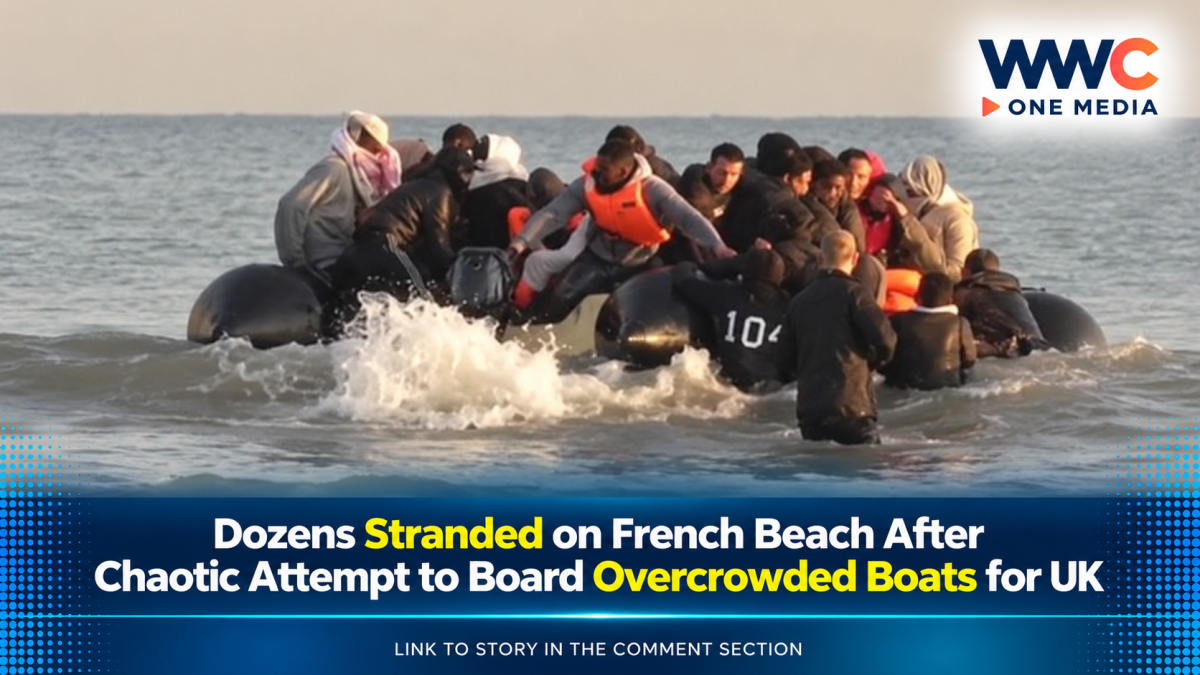
NORTHERN FRANCE — Dozens of migrants were left behind on a French beach after a chaotic attempt to board overcrowded dinghies bound for Britain, highlighting the continuing dangers and desperation surrounding crossings of the English Channel.
The incident unfolded on Sunday morning, Sept. 6, when groups of migrants gathered along the northern French coast and attempted to board small inflatable boats heading toward the United Kingdom.
Video footage showed migrants rushing into the water and trying to climb aboard already crowded dinghies. Some managed to secure places, while others were left stranded on the beach after the boats moved away. French police officers and patrol vessels monitored the attempted crossings.
Desperate Rush to Board
The scenes underscored a tactic increasingly associated with Channel crossings, in which migrants attempt to board inflatable boats after they have already entered the water.
Rather than launching from a single beach with all passengers already aboard, smugglers may use boats to pick up people waiting along the coastline.
The practice can create chaotic situations as large groups rush through shallow water to reach the vessel.
On Sunday, several migrants attempted to board overcrowded dinghies, but not everyone was able to get on before the boats moved away from the shore. Dozens were left behind following the failed attempt.
Police and Patrol Boats Watch From Shore and Sea
French authorities monitored the situation from both land and water.
Reuters video reporting showed police officers on foot and patrol boats observing the migrants as they attempted to reach the dinghies.
One speedboat was also seen attempting to block the departure of the inflatable vessels, according to the Reuters footage.
The operation highlighted the continuing challenge facing French authorities along the northern coastline, where migrants and smuggling networks frequently adapt their methods to evade enforcement and reach boats before they leave French waters.
Overcrowded Dinghies Remain a Major Danger
The English Channel is one of the world’s busiest shipping routes, and the use of small, overloaded inflatable boats has made migrant crossings particularly dangerous.
The vessels are often packed with large numbers of people and can face rough weather, strong currents, mechanical problems and the risk of deflation or capsizing.
Recent incidents have again demonstrated the deadly consequences of overcrowding.
French authorities have carried out multiple rescue operations involving migrants attempting to cross the Channel this year, while deaths have continued to fuel concerns about the increasingly dangerous methods used by smuggling networks.
New Tactics Are Making Crossings Harder to Stop
The struggle to board boats away from the beach reflects a changing pattern in Channel crossings.
Instead of gathering everyone at a launch point before a boat enters the water, some groups attempt to use what authorities and prosecutors have described as “taxi boats” — vessels that move offshore or along shallow coastal waters before picking up passengers.
The tactic can make enforcement more complicated and create dangerous moments as people wade or swim toward overcrowded vessels.
In one previous 2026 incident, French officials said migrants were trying to board a “taxi boat” when a fatal crossing attempt unfolded. The boat continued its journey with other passengers after some migrants were unable to board.
Political Pressure Grows on Both Sides of the Channel
The latest attempted crossing comes amid continuing political pressure in both Britain and France over irregular migration.
The UK and French governments have pursued closer cooperation to reduce small-boat crossings, while political debate over border security has intensified.
Recent reporting has indicated that the number of crossings has declined compared with the previous year, but smugglers have continued adapting their tactics, including increasing the number of people carried on individual boats and changing launch locations.
The issue has also sparked protests and political tension in Britain, where anti-immigration demonstrations have targeted areas connected to migrant arrivals and Channel traffic.
Those Left Behind Face an Uncertain Future
For the migrants unable to board Sunday’s boats, being left behind did not necessarily mean the end of their journey.
Many migrants attempting the Channel crossing make repeated efforts after previous failures.
But every new attempt can bring additional risks.
The route is relatively short compared with other international migration journeys, yet its dangers are significant because of cold water, heavy maritime traffic, unpredictable weather and the fragile nature of the boats used.
For many of those standing on the French beach, Sunday ended without a crossing.
But the scenes of people racing through the surf toward already overloaded dinghies offered another stark picture of the human desperation driving one of Europe’s most politically charged migration crises.
As some boats disappeared toward the horizon, dozens were left standing on the French shore — a reminder that behind the political arguments over borders and migration are people still willing to risk everything for a chance to reach Britain.
WWC ONE MEDIA J.M.D




Leave a Reply