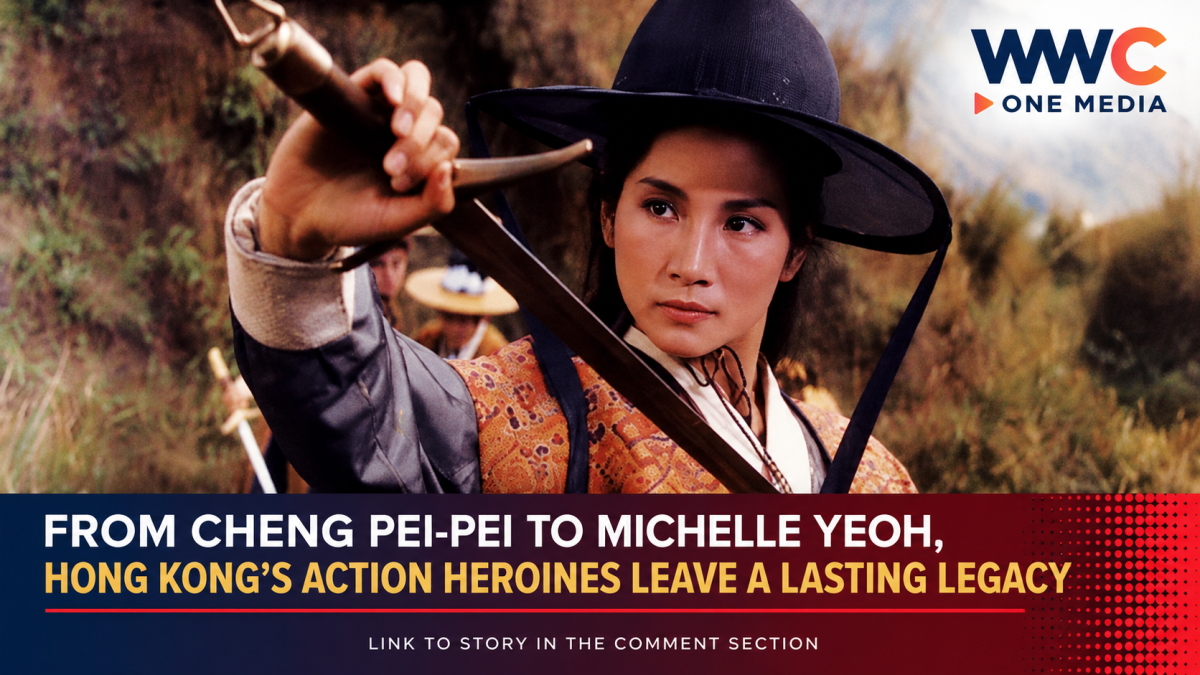
Hong Kong cinema has a long history of putting women at the centre of martial arts and action films, decades before female action stars became a major presence in Hollywood.
Among the earliest and most influential figures was Cheng Pei-pei, who rose to fame with Shaw Brothers Studio in the 1960s. Her breakthrough came in King Hu’s 1966 wuxia classic Come Drink with Me, in which she played the skilled swordswoman Golden Swallow. The role established her as one of the era’s leading female martial arts stars.
Cheng combined her background in dance with demanding action performances and became known for performing many of her own stunts. She went on to star in numerous wuxia productions and became one of Hong Kong cinema’s biggest female stars.
Her influence extended to later generations of actresses, including Angela Mao, Brigitte Lin, Maggie Cheung, Zhang Ziyi and Michelle Yeoh. Hong Kong’s martial arts industry developed a tradition in which women could serve as fighters, heroes and central characters rather than simply supporting male stars.
Yeoh emerged as one of the most prominent successors to that tradition during the 1980s. After beginning her film career in Hong Kong, she took on leading roles in action movies including Yes, Madam in 1985 and later appeared in Police Story 3: Super Cop, Tai Chi Master and Wing Chun. She became known for combining athletic action sequences with a graceful screen presence.
Her international profile expanded with the James Bond film Tomorrow Never Dies in 1997 and Ang Lee’s Crouching Tiger, Hidden Dragon in 2000. The latter reunited Yeoh with Cheng, who played the assassin Jade Fox.
Yeoh later moved between Hong Kong, Asian and Hollywood productions, appearing in films such as Crazy Rich Asians, Shang-Chi and the Legend of the Ten Rings and Everything Everywhere All at Once. Her performance in Everything Everywhere All at Once earned her the Academy Award for Best Actress in 2023, making her the first Asian woman to win the award.
Cheng’s legacy has also continued to receive recognition in Hong Kong. The Hong Kong Film Archive has organised a retrospective celebrating her career, highlighting films from her Shaw Brothers period and later work across Hong Kong, Taiwan and international productions.
From Cheng’s swordplay in the 1960s to Yeoh’s international action career, the two generations illustrate how Hong Kong cinema helped establish female martial arts stars as major figures in their own right. Their careers have also helped carry Hong Kong’s distinctive action-film tradition to audiences far beyond the city.