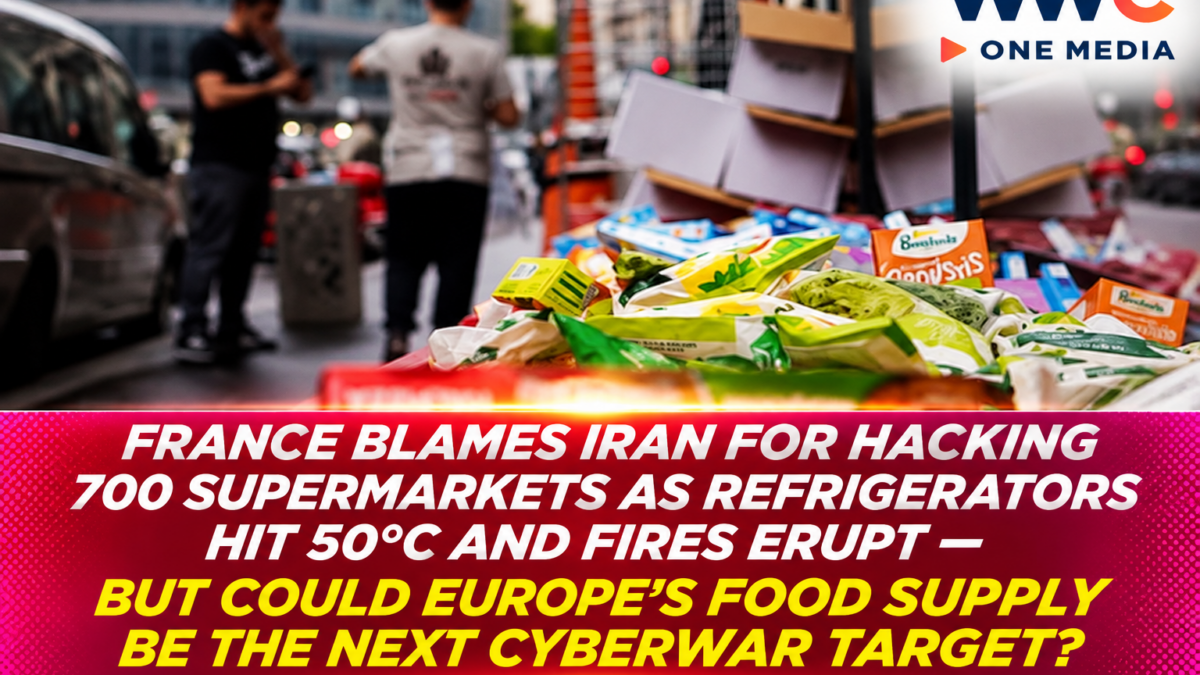
PARIS, FRANCE / WASHINGTON, D.C. — November 10, 2026 — A cyberattack that turned ordinary supermarket refrigerators into instruments of sabotage has sparked a major diplomatic confrontation between France and Iran, with French authorities accusing hackers linked to Tehran’s powerful Islamic Revolutionary Guard Corps of disrupting hundreds of food retailers.
The attack sent temperatures inside commercial refrigeration systems soaring, spoiled enormous quantities of food and reportedly triggered fires in several establishments.
Approximately 700 supermarket locations were affected in France during the October attack, according to French authorities.
Some refrigerated units reportedly reached temperatures of 50°C, or 122°F, forcing employees to dispose of meat, frozen products and other perishable goods.
The financial damage could reach tens of millions of euros.
But what initially appeared to be an unusual attack on supermarket equipment has developed into a much wider cybersecurity and national-security concern.
French investigators now attribute the operation to a cyber unit associated with Iran’s Revolutionary Guards.
France has summoned Iran’s ambassador, opened a criminal investigation and threatened further European sanctions.
Meanwhile, investigators are examining similar refrigeration disruptions across Europe and separate incidents involving food-storage equipment at American military facilities.
The developments raise an alarming question: If hackers can remotely sabotage the refrigerators protecting food supplies, what other essential infrastructure could be vulnerable to the same tactics?
France Officially Accuses Iran’s Revolutionary Guards of Cyber Sabotage
French authorities escalated the controversy on November 9 when they publicly accused an Iranian Revolutionary Guard-linked cyber operation of orchestrating the attacks.
France’s national cybersecurity agency, ANSSI, identified a group known as Shahid Kaveh as responsible for the refrigeration campaign.
The unit is described by French officials as having connections to Iran’s Islamic Revolutionary Guard Corps, or IRGC.
The announcement followed a Reuters investigation revealing that French officials privately suspected Iranian state-backed hackers.
France’s Foreign Minister Jean-Noël Barrot subsequently confirmed that the Iranian ambassador had been summoned to the Foreign Ministry.
Paris also announced plans to pursue European sanctions against individuals responsible for the operation.
French prosecutors opened a judicial investigation into suspected organized cybercrime allegedly conducted in the interests of a foreign government.
Authorities are seeking international arrest warrants for suspects identified during the investigation.
However, Iran’s responsibility remains an attribution by French authorities rather than a finding established by a completed criminal trial.
Iran’s mission to the United Nations did not respond to Reuters’ requests for comment.
Tehran has historically denied involvement in malicious cyber operations attributed to it.
How Hackers Turned Supermarket Refrigerators Into a National Crisis
The main attack took place around October 11–12, 2026.
Unlike conventional cyberattacks that steal personal information or lock computer files, this operation targeted equipment responsible for maintaining safe refrigeration temperatures.
Attackers allegedly manipulated the computerized systems controlling commercial refrigerators and freezers.
Instead of maintaining the low temperatures needed to preserve perishable products, affected equipment began heating.
The consequences were immediate.
At some locations, temperatures reportedly rose to 50°C for approximately six hours.
Supermarket employees discovered refrigerated and frozen food that could no longer be safely sold.
Workers were forced to remove affected products, including meat and ice cream, and dispose of them.
Some refrigeration units became so hot that fires reportedly broke out.
The incidents demonstrate a dangerous difference between ordinary information theft and cyberattacks against physical equipment.
When hackers manipulate systems controlling machines, the consequences can move beyond lost data into damaged property, food contamination risks and public-safety concerns.
In this case, the attackers allegedly transformed equipment designed to protect food into a source of commercial disruption.
Hundreds of Stores Hit as Losses Mount Into the Millions
The scale of the disruption was unusually large.
French authorities reported that approximately 700 supermarket locations were affected, representing a substantial portion of the country’s retail food network.
The Intermarché supermarket chain was among the businesses reporting serious losses.
According to the Associated Press, the company estimated damage amounting to tens of millions of euros in a single day.
Other affected businesses faced the costs of disposing of products, repairing equipment and restoring normal operations.
The financial consequences were not limited to the value of spoiled merchandise.
Refrigeration problems can also interrupt deliveries, disrupt stock availability and require businesses to conduct safety inspections.
Food retailers must ensure that temperature-sensitive products remain within appropriate storage conditions.
When refrigeration temperatures rise far beyond safe limits, affected goods may have to be discarded even if they appear normal.
Such disruptions can be especially costly for retailers handling fresh meat, dairy products and frozen foods.
However, the full national financial impact has not yet been independently established.
The figures reported by retailers should be treated as estimates rather than a completed accounting of every loss.
Who Is Shahid Kaveh, the Group Accused of Carrying Out the Attack?
French intelligence and cybersecurity agencies identified Shahid Kaveh as an Iranian Revolutionary Guard-affiliated cyber unit.
According to Reuters, investigators associated the group with other cyber operations and online identities.
The French investigation named three alleged associates: Hamid Reza Lashgarian, Mahdi Lashgarian and Reza Salarvand.
Authorities said the operation involved infrastructure and techniques previously associated with the group.
Investigators also identified traces of Farsi in elements of the attack infrastructure.
Other evidence included internet infrastructure connected to Iran and similarities with earlier malicious operations.
France reported that the group had used online identities that presented themselves as independent hacking activists.
Among the names associated with the broader network were CyberAveng3rs and Cyber Isnaad Front.
Such identities can complicate attribution because hackers may attempt to conceal their organizational affiliations or disguise politically motivated activity as independent cybercrime.
Nevertheless, language traces and internet addresses alone do not conclusively prove who ordered an attack.
French officials say their attribution relies on a combination of technical indicators, operational similarities and intelligence findings.
The underlying evidence has not all been independently examined in public.
Second Wave Targets More Than 100 European Establishments
The French supermarket incidents were followed by additional cybersecurity disruptions in November.
Reuters reported that more than 100 establishments across Europe were affected by another wave of attacks involving refrigeration systems.
Businesses in several countries, including Belgium, Sweden and other European markets, reported problems with commercial freezers and refrigerators.
These events have increased concerns that similar vulnerabilities may exist across multiple refrigeration networks.
The fact that attacks occurred in different countries raises important questions about the equipment and software used by affected businesses.
Some commercial refrigeration systems are managed through network-connected controls that allow operators to monitor temperatures remotely.
Those capabilities can improve efficiency and simplify maintenance.
But they also create potential vulnerabilities if equipment is improperly secured.
The European incidents have prompted investigators to examine whether attackers exploited common weaknesses in older systems.
However, not every reported refrigeration disruption has been conclusively attributed to the same group.
The existence of similar incidents does not automatically prove they were coordinated by one government or hacking organization.
French Blood Banks Also Faced a Dangerous Cyber Threat
The investigation became even more serious when refrigeration systems used by French blood banks were targeted.
According to Reuters and the Associated Press, attackers attempted to manipulate temperatures inside equipment used to store blood products.
Staff were forced to take precautions, including transferring some supplies to alternative cold-storage facilities.
French authorities said a potentially damaging temperature manipulation attempt was stopped before blood products were harmed.
That distinction is important.
The available reporting does not establish that contaminated blood reached patients or that the incident caused injuries.
Nevertheless, the attempted disruption illustrates why attacks on refrigeration systems can pose risks beyond retail commerce.
Hospitals, laboratories, blood banks and pharmaceutical supply chains rely on carefully controlled temperatures.
If those systems malfunction, medical supplies may become unusable.
The issue raises broader questions about how healthcare providers protect their operational equipment from unauthorized digital access.
Cybersecurity is no longer confined to protecting patient records and payment systems.
It also involves keeping physical systems functioning safely.
Could the Same Hackers Have Targeted US Military Bases?
American military investigators are examining separate refrigeration incidents that occurred in August 2026.
According to Reuters, refrigerators at at least six US military commissaries experienced serious malfunctions.
Military commissaries are retail facilities serving eligible military personnel and their families.
The Pentagon is treating the disruptions as suspected cyber incidents and investigating what happened.
A person familiar with the investigation told Reuters that Iran was among the suspects being considered.
However, the inquiry remains open.
Reuters could not independently establish whether the American incidents were connected to the French supermarket attacks or the later European disruptions.
The Pentagon also has not publicly released technical evidence demonstrating that Iranian operatives caused the commissary failures.
The Defense Department said it was aware of speculation concerning a possible cyberattack but could not provide additional information while investigators continued their work.
For now, there are three distinct matters:
The French government has publicly attributed its October attacks to an Iranian-linked cyber unit.
European authorities are investigating subsequent refrigeration disruptions in other countries.
And the Pentagon is separately examining suspected attacks involving American military food-storage equipment.
A coordinated transatlantic operation remains a possibility under investigation, not an established conclusion.
Why Commercial Refrigerators Were So Easy to Attack
One of the most troubling aspects of the investigation is that the attacks may not have required especially sophisticated methods.
Cybersecurity experts told Reuters that some affected refrigeration systems were outdated or used obsolete firmware.
Firmware is the software embedded in equipment that controls its essential functions.
Older devices may no longer receive regular security updates.
That can leave known weaknesses uncorrected for years.
Commercial refrigeration equipment is often designed for long service lives, and replacement can be expensive.
As a result, businesses may continue using systems that perform adequately from an operational perspective but lack modern cybersecurity protection.
Some refrigeration controllers also support remote access for monitoring and maintenance.
If those connections are exposed or inadequately protected, attackers may be able to interfere with operations.
The specific intrusion methods used in the French campaign have not all been publicly detailed.
However, the incident illustrates why organizations need to assess the security of equipment beyond conventional computers and servers.
A business may have strong protections for customer data while still operating vulnerable temperature controllers, cameras, building systems or industrial devices.
Britain’s Cybersecurity Chief Warned the Threat Could Be Much Bigger
The French attacks followed warnings from the United Kingdom’s cybersecurity authorities about the growing threat to essential services.
Richard Horne, head of Britain’s National Cyber Security Centre, previously warned that refrigeration attacks could be an early indication of more serious infrastructure disruptions.
The concern is that increasingly interconnected industrial and commercial systems create opportunities for cybercriminals and state-backed attackers.
These vulnerabilities can affect equipment used for food storage, transportation, manufacturing and other essential operations.
In earlier reporting, WWC ONE MEDIA examined the UK cybersecurity chief’s warning that supermarket refrigerator hacks could be an early sign of wider threats to critical infrastructure.
The warning highlighted how attacks on relatively ordinary commercial systems can reveal broader weaknesses.
If businesses fail to secure aging connected devices, even modest vulnerabilities could create costly disruptions.
However, the risk of future attacks should not be confused with evidence that every critical infrastructure system is currently compromised.
The appropriate response is stronger protection and monitoring, not the assumption that widespread failure is inevitable.
Cyberwarfare Becomes Another Front in the US-Iran Conflict
The refrigeration attacks come amid the ongoing conflict involving Iran and the United States.
Since the war began in February 2026, several incidents of suspected cyber sabotage have affected civilian and commercial infrastructure.
Reuters cited earlier disruptions involving the Los Angeles transit system in March, American water-treatment facilities in July and ships bound for the United States in August.
The incidents illustrate how geopolitical conflict can extend beyond conventional military operations.
Cyberattacks allow adversaries to disrupt services and impose economic costs without necessarily launching missiles or deploying conventional armed forces.
For businesses, that can create risks unrelated to their direct involvement in international politics.
A supermarket in France may have no role in Middle Eastern foreign policy.
Yet its equipment can become a target if attackers seek to create economic disruption or political pressure.
In related reporting, WWC ONE MEDIA examined how Iran’s escalating confrontation with the United States threatened maritime trade, energy markets and international commerce.
The latest cybersecurity allegations suggest that physical trade disruptions and digital sabotage may become parallel risks during geopolitical conflicts.
However, each incident must be independently investigated before responsibility is assigned.
France Threatens New Sanctions Against Iran
The French government has promised that the refrigerator attacks will have diplomatic and potentially economic consequences.
Foreign Minister Jean-Noël Barrot said France would seek European Union sanctions against individuals and organizations responsible.
Paris also warned that other measures could be considered.
The sanctions process will depend on European procedures and decisions by the relevant authorities.
The French announcement does not mean that every proposed measure has already been enacted.
The escalation adds another source of tension to an already difficult international relationship.
Iran faces pressure over its military activities, regional security and cyber operations.
For European governments, the refrigeration attacks create an additional reason to strengthen cooperation on cyber defense.
The issue may also increase scrutiny of international technology supply chains and equipment used by companies providing essential services.
Cybersecurity investigators will need to examine not only the perpetrators but also the weaknesses that allowed such widespread disruption.
Why the Philippines Should Pay Attention
Although the confirmed French incidents occurred thousands of kilometers away, the vulnerabilities they exposed are relevant to businesses worldwide.
The Philippines has extensive food distribution, logistics, retail and healthcare sectors that depend on refrigeration.
Supermarkets, cold-storage warehouses, food manufacturers and pharmaceutical distributors use temperature-controlled equipment to preserve products.
Some facilities rely on connected monitoring and automation systems.
A serious refrigeration failure can result in spoiled food, damaged inventory, interrupted business operations and potential public-health risks.
That does not mean Philippine businesses have been targeted by the same campaign.
There is no verified evidence in the reviewed reporting that the attacks attributed to Shahid Kaveh have affected Philippine refrigeration networks.
However, the French case demonstrates why companies should evaluate the cybersecurity of operational technology, not just their office networks and customer databases.
For Philippine businesses, the relevant concerns include equipment maintenance, network access, security updates and continuity planning.
The goal is to prevent avoidable disruptions before vulnerabilities are exploited.
Cybersecurity Risks Extend Beyond Hacked Equipment
The refrigerator attacks are different from conventional data breaches, but both illustrate the expanding range of digital threats facing modern organizations.
In Singapore, multiple businesses have recently reported incidents involving unauthorized access to customer information.
Healthcare provider Doctor Anywhere and telecommunications company M1 disclosed separate cybersecurity breaches in November.
As WWC ONE MEDIA reported on the Doctor Anywhere and M1 incidents, those events raised concerns about the security of sensitive personal information.
The incidents are not linked to the French refrigeration campaign.
Their relevance lies in the different consequences of cyber vulnerabilities.
A data breach may expose private information.
An operational technology attack can directly interfere with physical equipment.
Both require appropriate safeguards, but the technical priorities and potential impacts differ.
In another incident, WWC ONE MEDIA examined the MoneySmart data breach affecting customers in Singapore and Hong Kong.
That case involved unauthorized access to customer information rather than industrial equipment sabotage.
Together, the incidents demonstrate why cybersecurity planning must address both digital information and physical business operations.
What Businesses Can Do to Protect Refrigeration Systems
The French incident offers several lessons for organizations operating network-connected equipment.
First, identify exposed systems.
Businesses should understand which refrigeration controllers, monitoring devices and maintenance connections are accessible over networks.
Second, maintain equipment security.
Manufacturers and operators should apply supported security updates and replace devices that can no longer be adequately protected.
Third, restrict remote access.
Only authorized personnel should be able to control critical equipment.
Fourth, separate operational networks.
Companies should avoid unnecessarily exposing industrial control equipment to ordinary office networks or public internet connections.
Fifth, maintain independent monitoring.
Temperature alarms, manual checks and alternative monitoring arrangements may help detect unusual conditions quickly.
Sixth, prepare emergency procedures.
Food retailers, blood banks and pharmaceutical distributors should have clear processes for responding to refrigeration failures and protecting temperature-sensitive products.
No single measure can eliminate all risk.
However, multiple layers of protection can make it harder for attackers to gain access and reduce the damage caused by a successful intrusion.
What Happens Next in the French Investigation?
Several developments will determine whether the refrigerator attacks lead to a wider international confrontation.
The first involves France’s criminal investigation.
Authorities will continue gathering evidence and pursuing suspects linked to the alleged Shahid Kaveh operation.
The second concerns the proposed sanctions.
European governments will need to determine whether additional restrictions should be imposed and who should be targeted.
The third involves the attacks reported outside France.
Investigators will examine whether the incidents share technical characteristics or were coordinated.
The fourth concerns the American military facilities.
The Pentagon must establish what caused the commissary refrigeration failures and whether any foreign actors were involved.
Finally, governments and private companies will be under pressure to address weaknesses in connected equipment.
The long-term impact may depend as much on improving cybersecurity practices as on identifying the people responsible for the original attacks.
The Bigger Picture: Cyberwarfare Is Moving From Computer Screens to Everyday Infrastructure
The French refrigerator attacks demonstrate how cyber sabotage can disrupt activities that millions of people take for granted.
Refrigerators preserve food.
Cold-storage facilities support supply chains.
Medical refrigeration protects temperature-sensitive supplies.
When connected controls are compromised, the consequences can become physical, financial and potentially dangerous.
France has publicly accused an Iranian Revolutionary Guard-linked unit of carrying out the October campaign.
The government has launched an investigation and threatened further sanctions.
Similar incidents in other European countries and separate suspected attacks at American military facilities have heightened international concern.
Yet important questions remain unanswered.
The exact relationship between the different incidents has not been established.
The full financial cost is still being assessed.
And the potential consequences of France’s diplomatic response remain uncertain.
For businesses, the warning is immediate: cybersecurity weaknesses in aging equipment can create risks far beyond stolen passwords or leaked data.
For governments, the challenge is ensuring that essential services remain resilient during periods of geopolitical conflict.
Hackers have already demonstrated that ordinary supermarket refrigerators can become targets of digital sabotage. But as France confronts Iran over the attacks and investigators examine possible incidents at US military bases, could the next cyberattack threaten something far more critical than spoiled food?