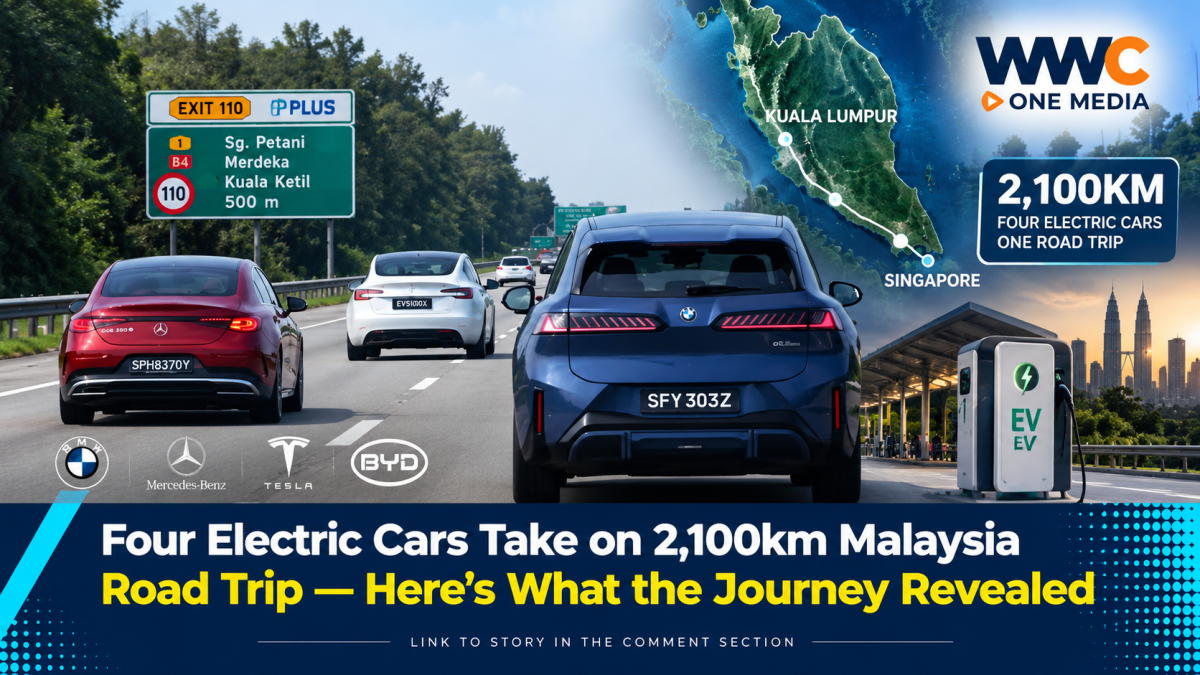
MELAKA, Malaysia — A 2,100km road trip across Peninsular Malaysia has put four long-range electric vehicles through one of the toughest real-world tests for modern EVs: can they travel hundreds of kilometres across highways, mountains and less-developed charging corridors without constant charging anxiety?
The four-day journey by The Straits Times involved a BMW iX3 50 xDrive, Mercedes-Benz CLA 250+, Volvo ES90 Ultra and Tesla Model 3 Long Range RWD. The convoy travelled through parts of Malaysia where EV charging infrastructure is still developing, including the East Coast and East-West Highway.
The experiment showed that today’s EVs are far more capable of long-distance travel than they were just a few years ago—but it also highlighted why battery range alone does not determine how easy an electric road trip will be.
From 1,500km in 2022 to More Than 2,100km in 2026
The latest journey follows an earlier Straits Times EV road trip in 2022 covering about 1,500km to Penang and back.
At the time, long-distance electric driving was considered feasible but charging remained a major inconvenience.
Four years later, the publication found that EV technology had moved forward significantly. Cars capable of more than 600km on paper are now available, although real-world highway range can be lower because of speed, terrain, weather and other driving conditions.
For the 2026 experiment, the team deliberately selected four vehicles with Singapore-tested ranges above 600km.
The route covered more than 2,100km per car between Aug. 24 and 28, including mountainous sections and long highway stretches.
The Biggest Challenge Wasn’t the Battery
One of the most revealing sections came on the East-West Highway between Dungun and Alor Setar.
The four EVs managed almost 550km without a charging stop, despite crossing mountainous terrain with elevations reaching around 1,000 metres.
That result demonstrated how improved battery capacity and efficiency are changing the long-distance EV experience.
But the following leg presented a different problem.
The drive from Alor Setar to Melaka was roughly 600km, including a stop in Ipoh. Higher highway speeds increased energy consumption, prompting the drivers to make a precautionary charging stop at AC Hotel Ipoh.
The lesson was clear: an EV that can theoretically travel 600km does not necessarily have the same usable range when driven quickly over long distances.
One Unexpected Charging Stop Changed the Equation
The final stretch from Melaka to Desaru was supposed to be relatively easy at around 300km.
But charging decisions earlier in the journey created a problem for two vehicles.
The Volvo ES90, which left Melaka with roughly 60% battery, risked arriving in Desaru without enough energy for the additional trip to a lunch destination and back to the hotel.
The convoy therefore stopped at a Petronas station in Desaru, where a Gentari Go fast charger provided the Volvo with enough energy in about 10 minutes to continue the journey.
That quick top-up effectively demonstrated why fast-charging availability can matter as much as battery size during a long road trip.
The Tesla Won the Real-World Range Test
Interestingly, the vehicle with the smallest battery in the group emerged as the range leader based on the trip’s tested consumption.
The Tesla Model 3 Long Range RWD, with an 84kWh battery, recorded an estimated tested range of 632km.
The Mercedes-Benz CLA 250+ followed at 624km, while the BMW iX3 50 xDrive recorded 607km and the Volvo ES90 recorded 561km.
The figures were calculated using the vehicles’ observed energy consumption during the trip—not simply their official laboratory range figures.
Road-Trip Results
| EV | Battery | Tested range |
|---|---|---|
| Tesla Model 3 Long Range RWD | 84kWh | 632km |
| Mercedes-Benz CLA 250+ | 85.5kWh | 624km |
| BMW iX3 50 xDrive | 108.7kWh | 607km |
| Volvo ES90 Ultra | 92kWh | 561km |
The BMW was the most powerful vehicle in the group and the only all-wheel-drive model, yet its larger battery did not automatically translate into the lowest energy consumption.
That reinforces a key point about EVs: battery capacity is only one part of the range equation.
Malaysia’s Charging Network Is Expanding
The road trip also comes as Malaysia continues developing its public EV charging infrastructure.
Singapore’s Land Transport Authority says drivers crossing into Malaysia can use a growing network of charging options, while Malaysian networks include operators such as Gentari, JomCharge and chargEV.
Current charging guides also show fast-charging locations along major routes and at highway rest areas, although coverage remains less uniform than conventional petrol stations.
That distinction matters.
Petrol stations are generally quick to find and refuelling usually takes only minutes. EV drivers, by contrast, must consider charger location, connector compatibility, charging speed, availability and the number of vehicles using a site.
The four-car convoy found that many charging locations had only a small number of connectors, meaning several EVs arriving together could create additional waiting time.
Hotel Charging Could Become a Major Advantage
One of the goals of the experiment was to see whether the cars could rely mainly on charging at hotels rather than stopping frequently at roadside charging stations.
That strategy worked reasonably well where overnight charging was available.
Slow hotel chargers can be particularly useful because vehicles remain parked for hours, allowing drivers to begin the next day with a substantially replenished battery.
Fast chargers, meanwhile, become more important when an EV needs an additional boost between destinations.
The experience suggests that destination charging could be just as important as highway fast charging as EV adoption increases.
Singapore Is Also Preparing for More EVs
The experiment comes as Singapore continues building its own EV ecosystem.
The Ministry of Transport says Singapore aims to deploy 60,000 EV charging points by 2030 and is transitioning toward cleaner-energy vehicles.
Singapore’s Land Transport Authority also says all new car registrations will have to be cleaner-energy models from 2030, including electric, hybrid and hydrogen fuel-cell vehicles.
That means cross-border EV trips such as this one are likely to become increasingly relevant as more Singapore motorists consider driving electric vehicles beyond the island.
The Real EV Road-Trip Lesson
The 2,100km journey does not show that charging concerns have disappeared completely.
Instead, it shows that range anxiety is becoming more manageable when the vehicle, route and charging plan match the journey.
A modern EV capable of roughly 600km of real-world range can cover significant distances between charging stops. But multiple cars travelling together can create additional charging delays, while high speeds, mountainous terrain and unexpected detours can quickly reduce the available range.
For drivers planning long-distance journeys, the practical question is therefore shifting from “Can an EV make the trip?” to “How many charging stops will the trip require, and where will they happen?”
For this particular convoy, the answer was encouraging: the four EVs completed more than 2,100km across Peninsular Malaysia, proving that long-distance electric travel is increasingly practical—even as charging infrastructure continues to catch up with the technology.
The road trip may have started as a test of EV range, but it ultimately revealed something bigger: the future of electric road travel will depend not just on bigger batteries, but on smarter charging networks and better trip planning.