
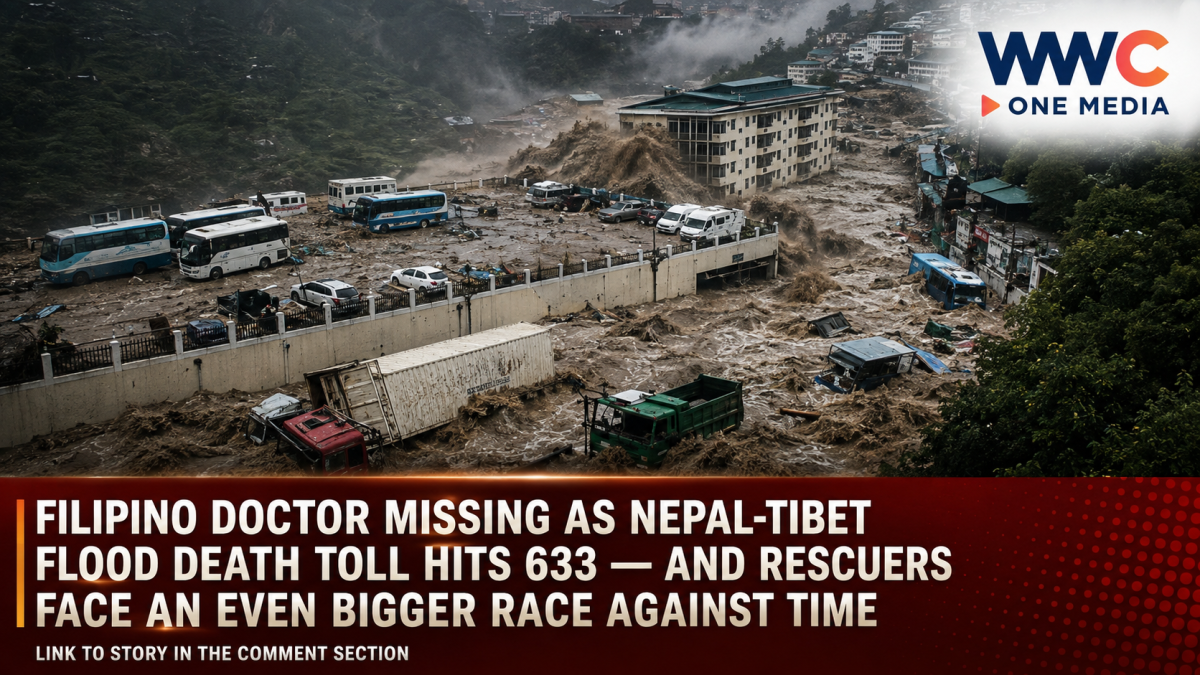
KATHMANDU/MANILA — What began as a catastrophic wall of ice, rock, mud and water tearing through the Himalayas has become an increasingly desperate international search for nearly 3,000 missing people — including a Filipino doctor whose family is still waiting for confirmation that he survived.
The death toll from the devastating Aug. 26 flash floods along the Nepal-China border has surged to 633, according to the latest figures reported Saturday, Aug. 29.
Nepalese authorities have confirmed 626 deaths and 2,426 people missing, while authorities in China’s Tibet Autonomous Region have reported seven deaths and 554 missing, bringing the combined number of unaccounted-for people to nearly 3,000. Hundreds of foreigners are among them.
That is a dramatic increase from the more than 390 deaths and 1,400-plus missing initially reported after the disaster — figures carried by OneNews and other international outlets as rescue teams first entered devastated communities.
For one family in the Philippines, however, the disaster is no longer just another massive overseas tragedy.
It has a name.
Dr. Juan Carlos Manalo, a 30-year-old Filipino physician from Tarlac City, is among those officially listed as missing.
Filipino doctor’s last known journey
Manalo had traveled as part of a pilgrimage connected with the India-based Isha Foundation and was participating in a Kailashyatra journey toward Mount Kailash, one of Asia’s most sacred pilgrimage destinations.
According to his family, his last confirmed direct communication with them came on Aug. 25 at 1:21 p.m. Philippine time, when he sent a “good morning” message to their family group chat.
His group’s last reported location was around the Gyirong border immigration area, one of the places devastated when the torrent struck the Nepal-Tibet frontier.
Manalo’s sister, Chiara, said the family later learned that a friend may have received another message from him on the morning of Aug. 26, but the family was still trying to independently verify that communication.
The Philippine Embassy in New Delhi, which has jurisdiction over Nepal, has confirmed that a Filipino was included in the Nepalese government’s list of missing persons. Philippine officials have been coordinating with authorities in Nepal while waiting for definitive information on Manalo’s whereabouts.
The uncertainty has left his family clinging to hope as rescuers comb through a disaster zone stretching across remote Himalayan valleys.
A flood that arrived with terrifying speed
Scientists and officials say the disaster appears to have been triggered by a massive glacier or ice-rock collapse high in the Himalayas.
The International Centre for Integrated Mountain Development, or ICIMOD, said evidence indicates an ice-rock avalanche temporarily obstructed the Lhende River system before a huge surge raced downstream through Nepal’s Bhote Koshi and Trishuli river corridors.
The force was extraordinary.
Earlier measurements cited by scientists showed the Trishuli River rising by as much as nine meters in about 30 minutes, giving communities downstream little time to escape. Initial reports of a possible earthquake were later reassessed, with the seismic signal linked instead to the massive collapse itself.
The resulting torrent carried ice, boulders, mud and debris through settlements, destroying buildings, bridges, roads and power facilities.
Gyirong Port — a crucial Nepal-China border crossing — was among the worst-hit locations. Surveillance footage showed enormous torrents engulfing structures as people attempted to run from the approaching debris.
More than 100 feared trapped in tunnel
Rescuers are confronting another potentially deadly challenge at the Upper Trishuli-1 Hydropower Project in Nepal’s Rasuwa district, where authorities believe more than 100 people could be trapped inside a tunnel filled with thick mud.
Nepali Army officials said rescuers have used ropes and baskets to reach difficult areas, but deposits of mud measuring roughly 1.2 to 1.5 meters deep have complicated access. Helicopter landing sites are also limited in the mountainous terrain.
By Saturday, more than 3,700 people had been rescued in Nepal, but bad weather repeatedly interrupted operations. Rain and fog temporarily forced authorities to halt some search missions, while helicopters resumed evacuations when conditions improved.
As time passes, the operation is becoming increasingly grim.
Reuters reported that some bodies recovered three days after the flood were already too badly decomposed for visual identification. Nepalese authorities said DNA samples would be collected before unidentified remains were buried because of health concerns.
Another flood threat has not completely disappeared
The original disaster also created new dangers upstream.
Authorities have been closely monitoring lakes formed or altered by the collapse, raising fears that another sudden release of water could hit communities already devastated by the first flood.
Chinese authorities said Saturday that the danger from one lake had declined as water gradually drained and its level fell. But Nepal continues monitoring two upstream lakes, and officials have warned that flood risks will remain until they drain sufficiently.
It is another reason rescuers cannot simply race into every disaster zone.
The landscape itself remains unstable.
Humanitarian crisis grows
Beyond the death toll, the scale of the humanitarian emergency is widening.
Reuters reported that the Red Cross estimated more than 90,000 people were directly affected and urgently needed humanitarian assistance.
UNICEF separately said at least 17,000 children in Nepal had already been affected, with homes, schools, health facilities, water systems and communications infrastructure damaged or destroyed. The agency has launched a $17.2-million emergency appeal to support affected children and families.
Nepal is now also confronting an enormous rebuilding bill.
Finance Minister Swarnim Wagle told Reuters that preliminary reconstruction costs could reach $4 billion to $5 billion, although authorities are still assessing the full damage.
Why the Himalayan threat matters far beyond Nepal
The disaster has again drawn attention to the growing instability of the Hindu Kush Himalayan cryosphere — the vast system of glaciers, snow and permafrost stretching across some of Asia’s highest mountains.
ICIMOD says glaciers in the region are losing mass at an accelerating rate, snow patterns are changing and permafrost is deteriorating. Those changes can intensify hazards including avalanches, debris flows, landslides and glacial-lake outburst floods.
That broader climate trend does not by itself prove that climate change caused this particular collapse, and scientists will need further analysis to establish the precise chain of events.
But the Himalayan region is becoming increasingly vulnerable to cascading disasters in which one event — an ice collapse, avalanche or landslide — can trigger another and send destruction far downstream.
For the thousands of families still searching for relatives, however, the scientific investigation comes second to a far more immediate question.
Who survived?
In Kathmandu, families have gathered around hospitals and relief centers searching missing-person lists and photographs of unidentified victims. AP reported that roughly 1,600 missing-person cases had been registered at one hospital help desk alone as relatives arrived from across Nepal.
And thousands of kilometers away, one Filipino family is waiting for the same answer.
For the Manalos, until authorities can confirm where Juan Carlos is, every rescue helicopter, every newly released survivor list and every piece of information from the destroyed Gyirong border zone offers another possibility.
Days after the flood, their search — like that of thousands of other families — is not over.



Leave a Reply