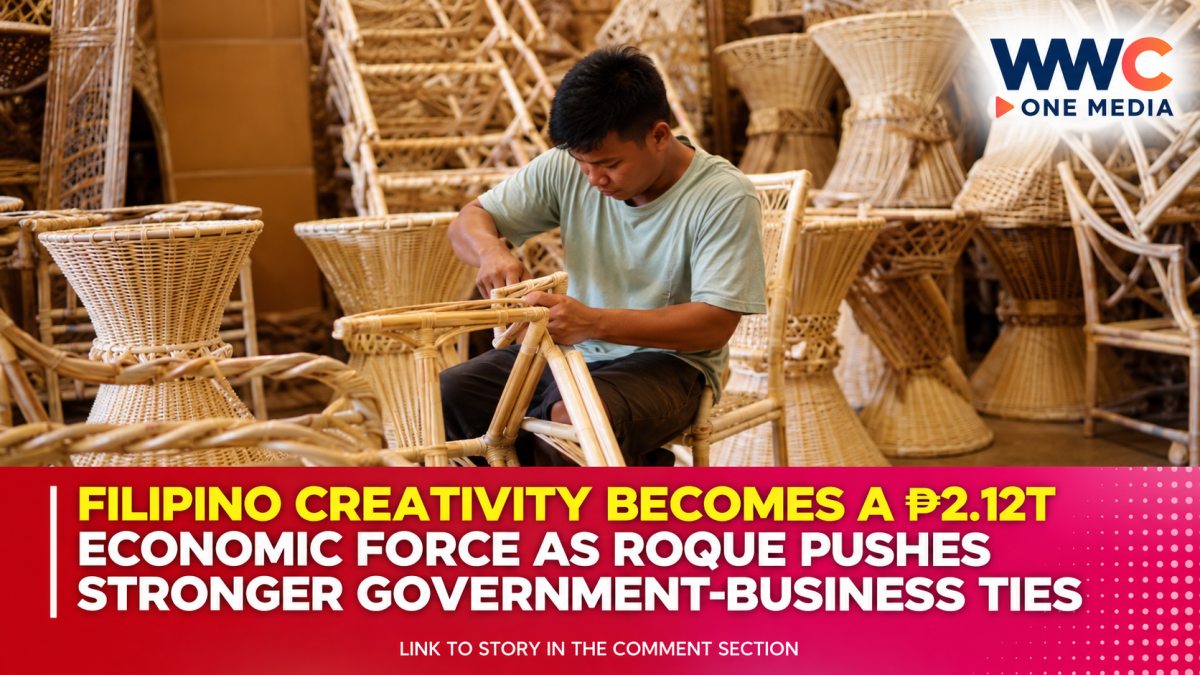
MANILA, Philippines — The Philippines’ creative economy has grown into a ₱2.12-trillion industry, and Trade and Industry Secretary Ma. Cristina Roque is calling for deeper cooperation between government and the private sector to turn Filipino creativity into bigger business, export and investment opportunities.
For more Philippines creative-economy and industry coverage, see our Philippines hub and Business desk.
The sector contributed 7.6% of Philippine gross domestic product (GDP) in 2025, expanding 6.9% year-on-year, according to Philippine Statistics Authority data cited by the Department of Trade and Industry (DTI).
Roque made the call as the Philippines opened the ASEAN Creative Industries Expo by Malikhaing Pinoy at SMX Convention Center Aura in Taguig on Sept. 18, where creative enterprises and stakeholders from across Southeast Asia gathered to explore new markets and partnerships.
The DTI chief said the government can provide support, but businesses and creative-sector stakeholders must clearly identify the barriers they face so policymakers can respond more effectively.
“Our creative industries generate a cultural currency that draws the world to our shores,” Roque said, describing creativity as increasingly important not only to Filipino identity but also to trade and tourism.
From culture to big business
The latest numbers show why the government is putting greater emphasis on the sector.
The Philippine creative economy generated approximately ₱320 billion in creative-goods exports and ₱427 billion in creative-services exports, according to figures presented by the DTI. Digital interactive industries such as game development and animation are also emerging as major growth areas.
The sector covers a broad range of activities, including audiovisual media, digital interactive media, creative services, design, publishing, performing arts, visual arts and traditional cultural expressions.
It also includes industries built around intellectual property—an increasingly important source of value as Filipino creators compete in global markets.
The government’s strategy therefore goes beyond simply producing creative content. It seeks to help Filipino creators and companies own, commercialize, distribute and scale the intellectual property they develop.
That issue is also at the center of the Philippines’ 2026 ASEAN chairship.
The bigger challenge: turning talent into ownership
A recent ASEAN creative-economy study led by Isla Lipana & Co./PwC Philippines found that Southeast Asia already has significant creative output, but businesses can face difficulties moving beyond production into ownership, commercialization, distribution and international scaling.
The study examined film, animation, game development, fashion and performing arts and identified financing, intellectual property, incentives and business capabilities as areas requiring greater attention.
For the Philippines, the opportunity is particularly significant.
The country’s creative economy supported approximately 8.71 million jobs in 2025, according to PSA figures cited by Daily Tribune.
But many creative enterprises remain small businesses, microenterprises or independent freelancers. Access to financing, distribution networks and international markets can therefore become critical obstacles to scaling otherwise competitive Filipino talent.
Digital transformation is another major factor. The ASEAN study found that 67% of surveyed stakeholders identified digital transformation as the strongest driver of future growth, while 55% pointed to regional financing as an important area for cooperation.
ASEAN could become the next growth market
The Philippines is also trying to use its 2026 ASEAN chairship to create opportunities beyond the domestic market.
The DTI has backed a proposal for an ASEAN Center of Excellence for Creative Industries that would be hosted in the Philippines and focus on policy research, capacity building and market development.
Another major initiative is the proposed Digital Economy Framework Agreement (DEFA), which is intended to establish common rules for digital trade across ASEAN, including areas such as cross-border transactions, data flows and intellectual-property protection.
The agreement is targeted for signing at the 49th ASEAN Summit in November 2026, according to recent reports.
For Filipino creators and creative businesses, stronger regional digital rules could potentially make it easier to reach consumers and clients outside the Philippines.
Government-private sector partnership takes center stage
The push for greater private-sector involvement also has a legal foundation.
The Philippine Creative Industries Development Act (Republic Act No. 11904) created the Philippine Creative Industries Development Council and specifically provides for private-sector participation in developing policies, programs and strategies for the industry. The law covers nine creative domains and calls for continuing dialogue among government, businesses, creative workers and academe.
The DTI has since moved to strengthen that structure, including completing the private-sector representation of the Philippine Creative Industries Development Council earlier this year.
That framework gives the latest call from Roque a broader context: the government is attempting to build an ecosystem where creative businesses are not simply supported by government programs but are actively involved in shaping the policies affecting their industries.
The opportunity—and the unfinished business
The Philippines now has a creative economy worth more than ₱2 trillion, millions of jobs tied to the sector and hundreds of billions of pesos in creative exports.
The next challenge is whether Filipino creators and companies can capture more of the value generated by their work—from the initial creative concept to intellectual-property ownership, financing, distribution and global commercialization.
As the Philippines pushes its creative-economy agenda under the ASEAN chairship, the focus is increasingly shifting from “How much can Filipino talent create?” to “How much economic value can Filipino talent capture and scale globally?”
That could determine whether the country’s ₱2.12-trillion creative economy becomes simply a measure of existing output—or the foundation of a much larger export and digital-growth industry.