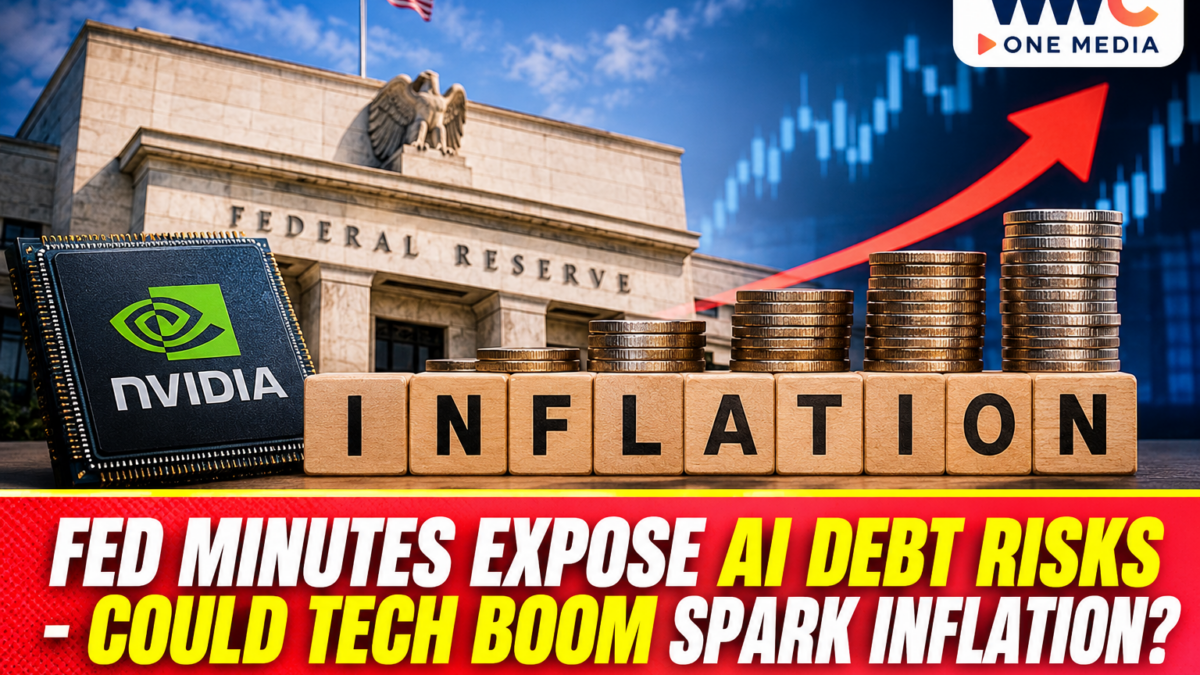
The Federal Reserve’s October meeting minutes reveal two concerns that investors cannot afford to treat separately: the financial-system exposure building around artificial intelligence and the possibility that inflation may remain too persistent for policymakers to ease monetary policy.
The minutes, released on Nov. 18, 2026, also show that the Federal Open Market Committee (FOMC) kept its benchmark interest-rate target at 3.75% to 4% in October, although two members preferred an increase. The document is important because it records not only the policy decision but also the risks officials were weighing as they assessed the economy.
The central issue is no longer simply how much companies are spending on AI. It is whether the financing behind that expansion can deliver enough returns to justify the debt, leases and infrastructure commitments accumulating across the industry.
AI Investment Is Becoming a Financial-Stability Question
The Federal Reserve’s financial-stability assessment identified the rapid growth of debt associated with the AI buildout as a potential source of vulnerability.
Staff specifically pointed to off-balance-sheet leasing commitments and circular financing arrangements among AI-related companies. These structures could amplify losses if investment returns disappoint.
The minutes did not declare that an AI financial crisis is underway. Instead, they described a possible chain of risks: disappointing returns could weaken asset valuations, expose financing weaknesses and force investors or lenders to reassess their positions.
Almost all meeting participants discussed risks associated with a scenario in which AI investment returns fell short of expectations. Many also considered the potential consequences of a decline in AI-related asset prices.
Most participants observed that AI-related debt had expanded rapidly, with much of the growth occurring through complex and opaque financing arrangements. A few raised concerns that exposure was becoming concentrated among a relatively small number of companies.
That concentration matters. When a large share of financing depends on a limited group of borrowers, projects or infrastructure operators, difficulties in one part of the market can have consequences beyond the original investment.
Why the Financing Structure Matters More Than the Spending Figure
AI infrastructure requires substantial investment in data centres, computing equipment, electricity supply and supporting networks. Companies can fund these projects through several arrangements, including conventional borrowing, private credit, leases and partnerships.
The structure can make it difficult to assess the full amount of risk carried by individual companies and their lenders.
The Federal Reserve’s concern about off-balance-sheet leasing commitments is particularly relevant. A company may rely on long-term contractual payments for facilities or equipment without presenting the entire economic burden in the same way as a conventional loan.
Circular financing arrangements raise another question: whether money moving among connected businesses creates the appearance of stronger demand or financial support than the underlying commercial activity can sustain.
These arrangements are not automatically improper. However, they can make it harder for investors to understand who ultimately carries the risk if a project fails to generate sufficient revenue.
The minutes also recorded that high-yield bonds issued to finance data-centre construction experienced a notable widening in credit spreads during the period. Wider spreads generally mean investors are demanding more compensation to lend to borrowers they consider riskier.
This is a warning about financing conditions, not proof that data-centre borrowers are already defaulting.
AI Expansion Could Also Keep Prices Elevated
The minutes reveal another side of the same investment boom: its potential effect on inflation.
Federal Reserve staff estimated that headline personal consumption expenditures inflation reached 3.6% over the 12 months through September 2026. Core PCE inflation, which excludes food and energy prices, was estimated at 3.1%.
Both measures remained above the central bank’s 2% longer-run inflation objective.
Staff attributed the higher readings largely to earlier tariff increases, higher energy inflation and upward pressure on consumer goods prices associated with the AI buildout.
Participants also discussed how demand linked to AI infrastructure was putting pressure on supplies of technology-related consumer goods. Several believed that price pressures were spreading beyond industries directly involved in data-centre construction.
The concern is straightforward: when investment demand grows faster than available supply, companies may face higher costs for equipment, electricity, construction materials and skilled labour. Some of those costs can eventually reach businesses and consumers.
A majority of participants noted that higher costs could be passed through more broadly and persistently to consumer and business prices.
There was also a counterargument. A few participants observed that expanding productive capacity and improving productivity could eventually reduce price pressures.
That distinction is important. AI investment could increase costs in the near term while delivering productivity gains over a longer period. The timing and scale of those gains remain uncertain.
The October Rate Hold Did Not End the Debate
The FOMC voted 10–2 on Oct. 28 to maintain the federal funds target range at 3.75% to 4%.
Lisa D. Cook and Beth M. Hammack voted against the decision because they preferred a 25-basis-point increase.
The minutes show that most participants supported holding rates while gathering more information. They wanted to assess the durability of AI-related investment demand, changing financing conditions and the effects of the September rate increase.
However, the discussion also showed that some policymakers believed inflation remained too high to justify waiting.
Almost all participants judged that further increases in the target range would likely be appropriate under their baseline outlooks for inflation and employment.
A couple of participants said an increase larger than 25 basis points could warrant consideration at the next meeting if incoming inflation data proved unfavourable.
This does not mean a December increase, or a larger move, has already been approved. The committee explicitly said future decisions would depend on incoming data, the evolving economic outlook and the balance of risks.
The policy disagreement also fits into the wider debate covered in WWC’s <a href=”https://wwconemedia.com/us-inflation-keeps-fed-rates-on-hold-could-jeffersons-cautious-approach-shape-december/“>examination of the October Fed hold and Philip Jefferson’s cautious approach</a>.
What the Fed’s Concerns Could Mean for Markets
The minutes describe a market environment in which investors were already reassessing the cost and potential returns of AI expansion.
During the period between meetings, equity prices initially benefited from enthusiasm surrounding AI infrastructure. Sentiment later weakened after two leading AI companies reported revenue growth below investor expectations and a major cloud-computing company disclosed capital-spending plans requiring more financing than investors had anticipated.
The minutes said these developments weighed on the valuations of large cloud-computing companies and affected AI infrastructure shares even more sharply.
Credit spreads also increased, particularly for riskier corporate borrowers. The Federal Reserve noted that higher interest rates were already weighing on equity valuations and making investors more sensitive to heavily leveraged companies.
For businesses, the combination creates a difficult environment. Projects that depend on inexpensive financing may become less attractive when borrowing costs rise and investors demand stronger evidence of future returns.
For investors, the key distinction is between companies with sustainable revenue and those whose expansion depends heavily on continued access to financing.
This is also why the Federal Reserve’s broader concerns about financial stability matter. The minutes identified hedge-fund leverage, limited dealer capacity and indirect bank exposure through nonbank financial institutions as possible channels through which market stress could spread.
The central bank nevertheless assessed the banking sector as well capitalised and able to withstand the severe scenarios considered. That is an important counterweight to the risks being discussed.
Why Philippine Businesses Should Pay Attention
The Federal Reserve sets monetary policy for the United States, not the Philippines. However, its decisions can influence international borrowing costs, bond yields, currency movements and investment flows.
A sustained rise in US interest rates may make dollar-denominated financing more expensive and affect how global investors allocate capital. Philippine companies with US-dollar obligations, imported equipment costs or exposure to international funding markets may therefore need to monitor changes in financial conditions.
AI infrastructure developments also have implications for technology suppliers, electricity demand and companies investing in digital services. If financing becomes more selective, projects dependent on large capital commitments may face tougher funding conditions.
The effects are not automatic. The peso responds to several domestic and international factors, while the Bangko Sentral ng Pilipinas makes its own monetary-policy decisions based on Philippine economic conditions.
For additional context on the local implications of US monetary policy, WWC has examined <a href=”https://wwconemedia.com/us-producer-inflation-reaches-6-5-will-the-fed-raise-rates-in-december/“>how persistent US producer-price increases could influence the Fed’s next decision</a> and <a href=”https://wwconemedia.com/fed-rate-hike-debate-why-collinss-housing-warning-matters/“>the competing pressures facing policymakers as higher rates affect housing and borrowing</a>.
What Happens Next
The FOMC’s next scheduled meeting is Dec. 8–9, 2026. Policymakers will have to assess additional inflation, employment and economic information before deciding whether another increase is justified.
The October minutes establish that further tightening remains a serious possibility, but they do not settle the next vote.
Investors will also be watching whether AI companies can demonstrate that their infrastructure spending is producing durable revenue and productivity gains. The Federal Reserve’s concern is not that artificial intelligence has no economic value. It is that the financial commitments supporting the expansion could become a vulnerability if expected returns fail to materialise.
The distinction between a productive investment boom and an overextended financing cycle may become increasingly important as the industry expands.
Frequently Asked Questions
Why is the Federal Reserve concerned about AI debt?
The Fed’s October minutes say AI-related debt has grown rapidly and that complex financing arrangements, including off-balance-sheet leases and circular financing, could amplify losses if investment returns disappoint.
Did the Federal Reserve raise interest rates in October 2026?
No. The FOMC voted 10–2 on Oct. 28 to maintain its target range at 3.75% to 4%. Two members preferred a 25-basis-point increase.
Could AI investment contribute to inflation?
Yes. Policymakers discussed how strong demand for AI-related equipment and infrastructure could strain supply, increase costs and potentially pass price pressures on to businesses and consumers.
Is the Fed certain to raise rates in December?
No. The minutes indicate that almost all participants considered further increases likely to be appropriate under their baseline outlooks, but the next decision will depend on incoming economic data and the balance of risks.
When is the next Federal Reserve meeting?
The next scheduled FOMC meeting is Dec. 8–9, 2026. The committee has not yet announced its decision for that meeting.