
ROVANIEMI, Finland — Europe’s far north was once treated as a remote frontier where climate research, fisheries and cautious cooperation mattered more than military power.
That era is disappearing with the ice.
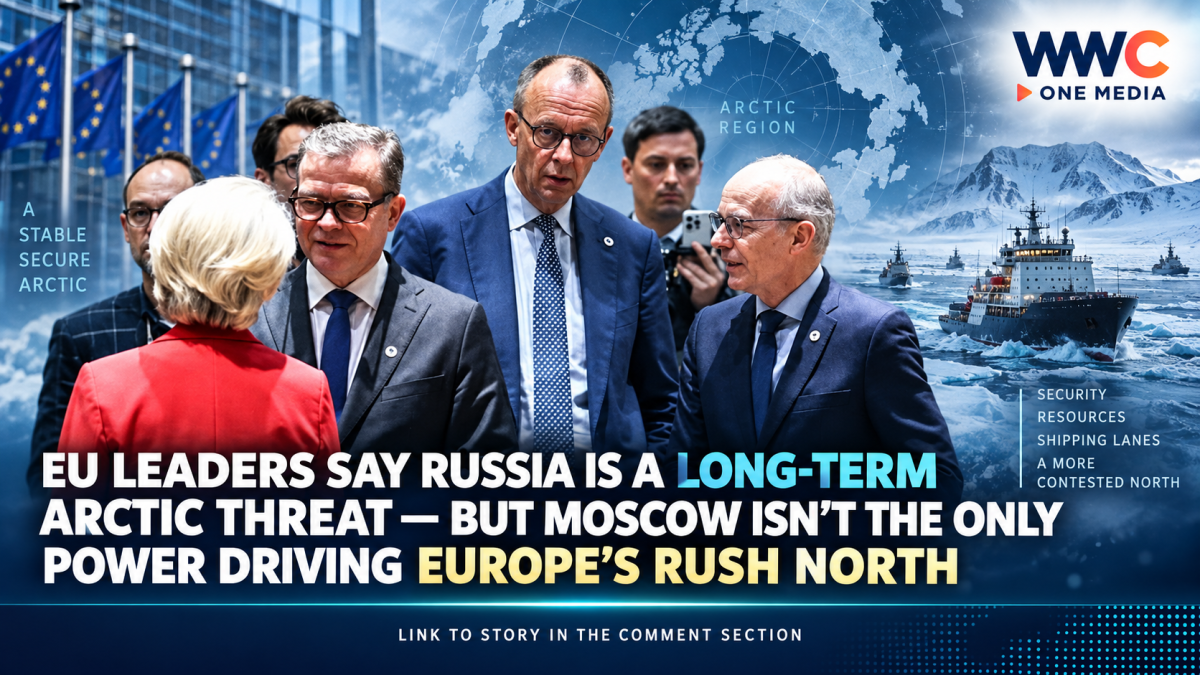
Twelve European Union countries meeting in northern Finland have called for a much more assertive EU role in the Arctic, warning that Russia represents a persistent security threat while melting sea ice, new shipping routes, critical minerals and intensifying competition among major powers transform the region into one of the world’s most important strategic frontiers.
The countries — Finland, Denmark, Estonia, France, Germany, Greece, Latvia, Lithuania, the Netherlands, Poland, Romania and Sweden — said Brussels should strengthen its Arctic engagement with sufficient resources and adapt to what they called rapidly changing geopolitical realities.
But this was not simply another declaration about Russia.
Behind the security language is a much bigger European concern:
Who controls the Arctic as it becomes easier to reach, sail through, mine and defend?
Europe’s message: the Arctic can no longer be treated as a distant northern problem
The summit was held in Rovaniemi, Finland, just south of the Arctic Circle, on September 13 and 14.
Finnish Prime Minister Petteri Orpo, who hosted the gathering, described the region as increasingly central to European security and argued that EU involvement must extend far beyond traditional environmental policy.
The official Finnish government statement identified a strikingly broad agenda:
military security,
economic security,
critical minerals,
energy,
infrastructure,
logistics,
trade routes,
security of supply,
climate change,
and sustainable development.
That list reveals how dramatically European thinking has changed.
The Arctic is no longer being viewed merely as an environmental zone whose ice is melting.
It is increasingly being treated as a strategic system connecting defense, energy, shipping, technology and industrial policy.
Russia sits at the center of Europe’s security concerns
The 12 states said Russia’s military activity, hybrid actions and strategic investment in the Arctic require stronger collective European preparedness.
German Chancellor Friedrich Merz said Moscow was increasing its capabilities in the region and using its presence for hybrid activity. He argued that the High North had received too little European attention for too long.
The concern is not surprising.
Russia possesses by far the longest Arctic coastline of any state and has spent years modernizing military bases, airfields, radar sites and other infrastructure along its northern territories.
The Arctic is strategically vital to Moscow for several reasons, including access to the Northern Sea Route, energy resources and the basing of parts of Russia’s nuclear deterrent.
NATO’s current maritime strategy describes Russia’s military buildup in the High North and Arctic as a challenge to allied security and interests.
But Russia presents the situation almost completely in reverse.
Moscow says NATO is the one militarizing the Arctic
Russian Foreign Minister Sergei Lavrov said in late August that NATO’s expanding Arctic military activity represents a direct security threat to Russia.
He criticized NATO exercises and its new Arctic posture as destabilizing and warned that increased military activity could raise the risk of incidents escalating into confrontation. Moscow has repeatedly rejected Western claims that it intends to attack NATO countries.
That competing narrative is essential context.
From NATO’s perspective, increased northern deployments are a response to Russian military modernization and the deterioration in European security following Russia’s full-scale invasion of Ukraine.
From Moscow’s perspective, NATO expansion and military infrastructure moving closer to Russia’s borders are themselves the threat.
Each side increasingly cites the other’s buildup to justify its own.
That is how once relatively insulated Arctic security can develop its own escalation cycle.
NATO has already moved faster than the EU
The EU summit should not be confused with Europe suddenly beginning Arctic defense from scratch.
NATO has already substantially reorganized its northern posture.
Today, seven of the eight Arctic states are NATO members: Canada, Denmark, Finland, Iceland, Norway, Sweden and the United States.
Russia is the only Arctic state outside the alliance.
Finland and Sweden’s accession dramatically changed the strategic map because NATO territory now extends continuously across much of Northern Europe.
In February 2026, NATO launched Arctic Sentry, designed to bring allied military activities in the region under a more coordinated operational framework.
Then in June, the alliance established multinational Forward Land Forces in Finland, further strengthening its northern flank.
So what exactly would a stronger EU role add?
Potentially quite a lot.
The EU can do things NATO was never designed to do
NATO’s core mission is collective defense.
The European Union has a much wider economic toolbox.
It can fund infrastructure.
It can regulate critical-mineral projects.
It can finance transport links.
It can coordinate industrial policy.
It can support satellite infrastructure, telecommunications and energy networks.
It can shape environmental rules and investment standards.
That distinction explains why Merz emphasized that stronger EU involvement should complement NATO rather than duplicate it.
For Europe, Arctic resilience now includes making sure roads, ports, railways and communications systems work during a crisis — not just positioning soldiers in the north.
Finland wants something very concrete: more icebreakers
One of the summit’s most interesting proposals has little to do with fighter jets.
It involves ships designed to smash through frozen seas.
Orpo argued that icebreaking capability is now a strategic European resource and suggested the possibility of joint European ownership of icebreakers.
Finland, which has deep expertise in building and operating such vessels, wants that capability incorporated into a broader European Arctic strategy.
That may sound like specialist maritime infrastructure.
It is actually fundamental to operating in the High North.
Icebreakers can keep shipping lanes open.
They support ports and energy infrastructure.
They enable civilian logistics.
And in a security crisis, they can help naval and military vessels operate in waters that would otherwise become inaccessible.
A country cannot project power into Arctic waters very effectively if its ships cannot get through the ice.
Europe also wants launch sites, military mobility and critical-mineral infrastructure
Finland’s official summit summary went even further.
Orpo suggested future European projects could include satellite-launching capacity, military mobility, cross-border transportation networks, critical infrastructure and mineral extraction and processing.
That makes the summit as much an industrial-policy meeting as a defense meeting.
The Arctic contains significant deposits of minerals used in batteries, electronics, defense systems and advanced technologies.
Europe has spent years trying to reduce strategic dependence on external suppliers for critical raw materials.
Northern Europe and Greenland could play an important role in that effort — provided mining projects can overcome environmental, economic and political hurdles.
And this is where Greenland enters the story
Russia is not Europe’s only Arctic headache.
Relations with the United States have also been tested by President Donald Trump’s repeated demands concerning Greenland, the self-governing territory within the Kingdom of Denmark.
Trump has argued that American control of Greenland is necessary for U.S. national security and has questioned Denmark’s ability to protect the enormous Arctic territory.
Greenland’s government has opposed becoming part of the United States, while Denmark has insisted that the island’s future is for Greenlanders and Danes to decide.
The dispute generated unusually serious tensions inside NATO earlier this year because Denmark and the United States are both alliance members.
After the Rovaniemi summit, Danish Prime Minister Mette Frederiksen said she was optimistic that Denmark and Washington could find a peaceful way forward and pointed to what she described as encouraging signals.
That makes Europe’s Arctic dilemma particularly unusual.
Its concerns do not come solely from an adversarial Russia.
They also involve strategic uncertainty with its most powerful ally.
Brussels is putting money behind Greenland too
European Commission President Ursula von der Leyen recently announced around €200 million in EU support over two years for Greenland.
The money is intended to support areas including climate resilience, internet connectivity, hydropower, fisheries and education.
That financial package carries obvious strategic symbolism.
Greenland is not an EU member, having left the European Community in the 1980s, but it remains politically tied to EU member Denmark.
As geopolitical interest in its minerals, geography and military significance intensifies, Brussels has strong incentives to demonstrate that European engagement is practical rather than rhetorical.
China is the third major power Europe is watching
Then there is China.
China is not an Arctic state, though Beijing has described itself as a “near-Arctic state” and has sought a larger economic and scientific role in the region.
NATO Secretary General Mark Rutte said earlier this year that China was becoming increasingly active as new northern sea lanes open and argued that the alliance needs to protect Arctic territory against growing Russian and Chinese influence.
China’s interest includes shipping, research, energy and resource investment.
As Arctic ice recedes, routes along Russia’s northern coastline can potentially shorten some journeys between Asian and European ports compared with southern routes.
That possibility becomes even more attractive when traditional maritime chokepoints are disrupted.
The Middle East crisis has unexpectedly made the Arctic more relevant
The timing of the European summit is significant.
Current disruption around the Strait of Hormuz and wider Middle Eastern shipping routes has reminded governments how vulnerable global trade can become when maritime chokepoints are threatened.
AP noted that analysts now see those disruptions as increasing interest in the Arctic’s Northeast Passage as an alternative shipping corridor.
That does not mean Arctic shipping is about to replace routes through Suez or Hormuz.
Seasonality, ice conditions, insurance, infrastructure, environmental risks and Russian control along much of the Northern Sea Route remain major constraints.
But the strategic calculation is changing.
An alternative does not need to replace the main route to become valuable.
It only needs to matter when the main route fails.
Climate change is creating the opportunity — and the danger
The fundamental transformation underneath all this geopolitics is environmental.
As Arctic ice thins and retreats, areas previously inaccessible for much of the year are becoming easier to reach.
That makes shipping, mineral extraction, military operations and infrastructure development more feasible.
But the same process threatens Arctic ecosystems and communities that are among the most vulnerable to rapid warming.
The 12-state declaration therefore stressed that future investment must account for the Arctic’s unique environment and the rights and interests of Indigenous peoples and local residents.
That creates one of Europe’s hardest policy contradictions.
The melting ice is generating the very strategic opportunities governments are rushing to exploit.
Yet the melting itself is one of the region’s greatest threats.
Security cooperation with Russia has already been badly damaged
The Arctic once stood out as an area where Western governments and Moscow continued cooperating even during broader political disagreements.
Russia’s invasion of Ukraine shattered much of that compartmentalization.
The Arctic Council, the principal intergovernmental forum for Arctic cooperation, has kept diplomatic channels open, but its political-level meetings have remained paused since 2022.
Technical and working-group cooperation has partially resumed, largely virtually.
The Council does not handle military security, but its difficulties illustrate the wider breakdown of the old Arctic model.
Scientists and officials can still cooperate on certain shared problems.
The assumption that northern geopolitics could remain largely insulated from conflict elsewhere is much harder to sustain.
The EU knows its own Arctic policy is outdated
Brussels’ most recent major Arctic policy dates to 2021.
That document emphasized three broad priorities:
peaceful cooperation,
sustainable development,
and environmental protection.
Five years later, the geopolitical environment looks dramatically different.
Russia invaded Ukraine.
Finland and Sweden joined NATO.
Military infrastructure in the High North expanded.
China increased its northern ambitions.
The Greenland dispute strained U.S.-European relations.
And critical minerals became a major strategic concern.
The European External Action Service says the EU will update its Arctic policy in 2026, explicitly incorporating priorities including security, defense, connectivity and economic security.
The Rovaniemi summit was effectively political input into that new strategy.
The European Commission is expected to present the revised policy and implementation plan this autumn.
Germany’s presence sent an important signal
Germany is not an Arctic state.
That is precisely why Chancellor Merz’s attendance mattered.
He said the region now affects Europe as a whole rather than only Nordic countries.
Energy flows, submarine cables, satellite infrastructure, trade routes and military access in the High North have consequences far beyond Finland or Norway.
The summit’s signatories reinforce that point.
Countries as geographically distant from the Arctic as Greece and Romania signed the declaration.
This is Europe reframing the Arctic from a regional northern issue into a continental strategic concern.
Europe’s problem is that geography still favors Russia
Political declarations cannot change maps.
Russia possesses an enormous Arctic coastline and decades of experience operating in the region.
It maintains extensive northern infrastructure, military installations and a powerful fleet of icebreakers.
Europe and NATO have substantial assets of their own, particularly after Finland and Sweden joined the alliance, but Western officials increasingly acknowledge that they need greater capacity to operate persistently in extreme northern conditions.
That is one reason discussions about ports, icebreakers, transport corridors and military mobility matter.
A defense commitment is only useful if forces can actually reach the area they are supposed to defend.
But Moscow faces its own Arctic vulnerabilities
Russia’s geographic advantage does not mean the region is automatically secure for Moscow.
Much of Russia’s Arctic infrastructure exists in extremely difficult climatic conditions.
Its northern economy depends heavily on energy and resource exports.
The Northern Sea Route requires expensive support infrastructure and icebreaking.
And Russia now faces an Arctic where virtually every other regional state belongs to NATO.
That strategic map would have looked very different before Finland and Sweden abandoned decades of military nonalignment.
Russia says this NATO consolidation validates its security concerns.
NATO says Russia’s behavior made that consolidation necessary.
Neither side appears likely to reverse course soon.
The risk is that every civilian project starts looking military
This is how strategic competition changes regions.
A new port can support trade — or warships.
A road can help local communities — or move troops.
A satellite ground station can support communications — or military surveillance.
An icebreaker can serve merchant shipping — or enable naval operations.
A mine can generate jobs — or supply minerals essential to weapons production.
As distrust increases, infrastructure becomes harder to classify as purely civilian.
That can intensify security dilemmas even when governments insist their own investments are defensive.
That is why the Arctic is no longer just another flank
For much of the post-Cold War period, policymakers liked to describe the Arctic as a region of exceptional cooperation.
The phrase often used was “high north, low tension.”
That idea has not disappeared completely.
The Arctic Council still exists.
Scientific cooperation continues.
Governments still have strong shared interests in search-and-rescue operations, environmental protection and safe navigation.
But the strategic environment has changed beyond recognition.
NATO is expanding its northern military posture.
Russia says those moves threaten it.
China wants greater access.
The EU is preparing a new Arctic strategy.
The United States and Denmark have had a serious disagreement over Greenland.
And melting ice is exposing resources and routes that previously mattered far less because they were so difficult to reach.
The most important phrase from the summit may be “adequate resources”
European declarations frequently promise greater ambition.
The harder question is whether governments will pay for it.
The 12 countries specifically called for Arctic engagement backed by adequate resources.
That means the next stage will be measured not in speeches but in budgets.
Will Europe jointly purchase icebreakers?
Will it fund northern railways and roads?
Will military-mobility infrastructure actually be upgraded?
Will mineral-processing projects move beyond feasibility studies?
Will satellite and communications networks receive serious investment?
Will Greenland see sustained European financing?
Those choices will determine whether the summit marked a strategic shift or merely another statement of concern.
Russia may be the immediate threat in Europe’s declaration — but the contest is much bigger
The easiest headline is that Europe wants to counter Russia in the Arctic.
That is true, but incomplete.
Europe is also trying to reduce economic vulnerabilities.
Secure critical minerals.
Protect new transport corridors.
Keep the United States engaged while becoming less strategically dependent on it.
Respond to China’s increasing presence.
Build infrastructure suited for a warming north.
And demonstrate to Greenland and other Arctic communities that European interest does not begin and end with security.
In other words, this is not simply a military race.
It is a competition over who can operate, invest, trade and endure in the Arctic over the next several decades.
Russia starts with enormous geographic advantages.
The United States has unmatched global military power and a crucial position through Alaska.
China brings economic scale and long-term ambition despite lacking Arctic territory.
Europe possesses territory, technology, capital and increasingly strong political motivation — but has often struggled to turn those assets into unified strategy.
The Rovaniemi summit is an attempt to change that.
And the biggest test is coming soon, when Brussels publishes its new Arctic plan.
Because after years of treating the High North as a distant edge of Europe, EU leaders are now confronting a very different possibility:
The Arctic may be where some of Europe’s biggest security, trade and resource questions are decided next.


Leave a Reply