
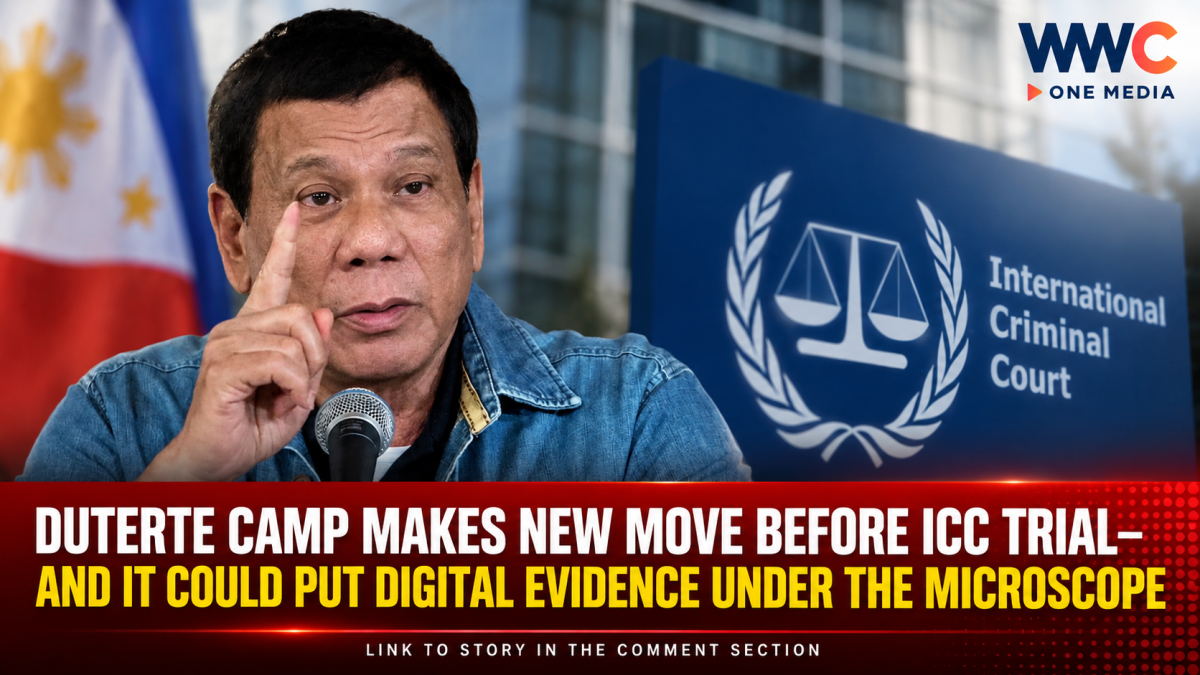
MANILA, Philippines — The legal battle surrounding former President Rodrigo Duterte’s International Criminal Court (ICC) case is taking another turn, with his defense team asking judges to impose stricter verification requirements on digital evidence before his trial begins.
Duterte’s lawyers have asked the ICC Trial Chamber III to amend its E-Court Protocol, particularly for open-source and user-generated materials that could be presented as evidence in the case.
The defense argues that simply identifying where an online file was obtained is not enough to establish whether the material is authentic, complete, or reliable.
The request comes as the defense says the amount of material disclosed by prosecutors has grown dramatically—and with the trial scheduled to begin on November 30, 2026, the lawyers are raising concerns over whether all of it can be properly examined in time.
Duterte lawyers want an “Expert Verification” requirement
At the center of the defense request is a proposed “Expert Verification” field that would identify whether a piece of open-source or user-generated evidence is supported by an expert report.
According to the defense, such a report should provide information about the material’s original source, uploader or creator when known, chain of custody, whether the item is an original or a copy, metadata and other technical information—including a hash value where applicable.
The defense also wants verification reports to explain how investigators determined whether material had been altered, edited or manipulated, as well as identify the qualifications of the person who performed the verification and the methodology used.
The lawyers argue that these safeguards would help the chamber determine the relevance and admissibility of digital evidence under Article 69(4) of the Rome Statute.
The ICC’s own public case-record system confirms that Duterte’s defense filed a “Request to Amend the E-Court Protocol in Relation to Open Source and User-Generated Material” in the case, listed as ICC-01/21-01/25-486-Red.
Defense points to problems with thousands of evidence items
The defense has also raised concerns about the physical and digital quality of some of the material it says it has received.
Among the problems cited were illegible documents, audiovisual files without transcripts or translations, duplicate materials and pages from the same document being disclosed separately under different evidence reference numbers.
Duterte’s lawyers said their review of a sample from one dataset revealed numerous duplicates and documents of poor quality, making meaningful examination more difficult despite the large volume of material.
The defense said the latest count exceeded 25,000 evidence items, compared with slightly more than 5,000 items before the confirmation hearing in February. It also said prosecutors had indicated that another 200 gigabytes of material could still be submitted.
The concern, according to the defense, is not simply the size of the disclosure but the possibility that a huge amount of unreliable or irrelevant material could overwhelm the court record.
The lawyers further pointed to what they described as an unusually challenging online information environment surrounding Duterte’s proceedings, where misinformation about the case and the events under investigation can circulate rapidly.
The request comes after another major defense challenge
The latest filing is not the only challenge Duterte’s legal team has brought before the ICC in recent days.
On August 31, the defense also filed a separate motion asking the Trial Chamber to order prosecutors to refile the document containing the charges, arguing that the current formulation does not give Duterte sufficient detail about the case he must defend against.
The defense described the prosecution’s presentation as based on non-exhaustive and illustrative incidents and argued that the charges should instead be framed around clearly defined counts and an exhaustive list of underlying acts.
The ICC’s public court records confirm that the defense filed a Rule 134(1) motion concerning the form of the charges on August 31, while the Office of the Prosecutor simultaneously submitted its list of witnesses and evidence.
That means the latest fight over digital evidence is unfolding alongside a broader dispute over how Duterte’s defense should be allowed to understand and challenge the prosecution’s case.
What the ICC has already decided about evidence
Importantly, the defense’s request for stricter verification does not mean the ICC has ruled that the prosecution’s evidence is unreliable.
The Trial Chamber previously directed that documentary, digital and physical evidence could be submitted during the trial without the court necessarily making an immediate ruling on admissibility.
Instead, the chamber said it would ultimately assess the evidence based on factors including relevance, probative value and potential prejudice as part of its overall assessment when determining Duterte’s guilt or innocence.
For particularly important evidence, however, the chamber may decide to rule on admissibility when that material is presented, after hearing arguments from the parties.
That distinction is crucial: Duterte’s lawyers are asking for stronger safeguards and verification procedures; they have not secured a ruling that the disputed materials are inadmissible.
Thousands of evidence items already disclosed
The scale of the case has become increasingly apparent in recent months.
In August, prosecutors disclosed that they had provided the defense with 6,909 evidence items between January 7 and July 31, including 2,279 classified as incriminating, 4,573 falling under Rule 77, and 57 identified as potentially exonerating.
The prosecution said the materials included evidence concerning alleged killings, the Davao Death Squad and operations connected to the drug war.
The much larger figure of more than 25,000 items now cited by Duterte’s defense reflects subsequent disclosures and illustrates why evidence management has become a major issue ahead of trial.
Duterte remains in ICC custody
Duterte has been in ICC custody since March 2025 in connection with allegations involving crimes against humanity arising from killings during his time as Davao City mayor and during his presidency.
The ICC confirmed charges against him in April 2026 following the confirmation-of-charges proceedings.
His defense has consistently rejected the prosecution’s allegations and has signaled that it intends to challenge the claim that a state policy existed behind killings associated with the anti-drug campaign.
The main trial is scheduled to begin on November 30, 2026.
The bigger question now
For Duterte’s defense, the issue is no longer simply how much evidence prosecutors have gathered—it is how that evidence was obtained, preserved, verified and presented to the court.
The proposed “Expert Verification” mechanism could therefore become an important procedural issue before the trial gets fully underway.
Whether the ICC will adopt the defense’s proposed changes—and how the chamber will ultimately weigh the massive volume of digital, documentary and other evidence—could become one of the key battles surrounding Duterte’s historic trial.
And with the November 30 opening date approaching, the fight over the evidence may be just as consequential as the evidence itself.
WWC ONE MEDIA J.M.S
Leave a Reply