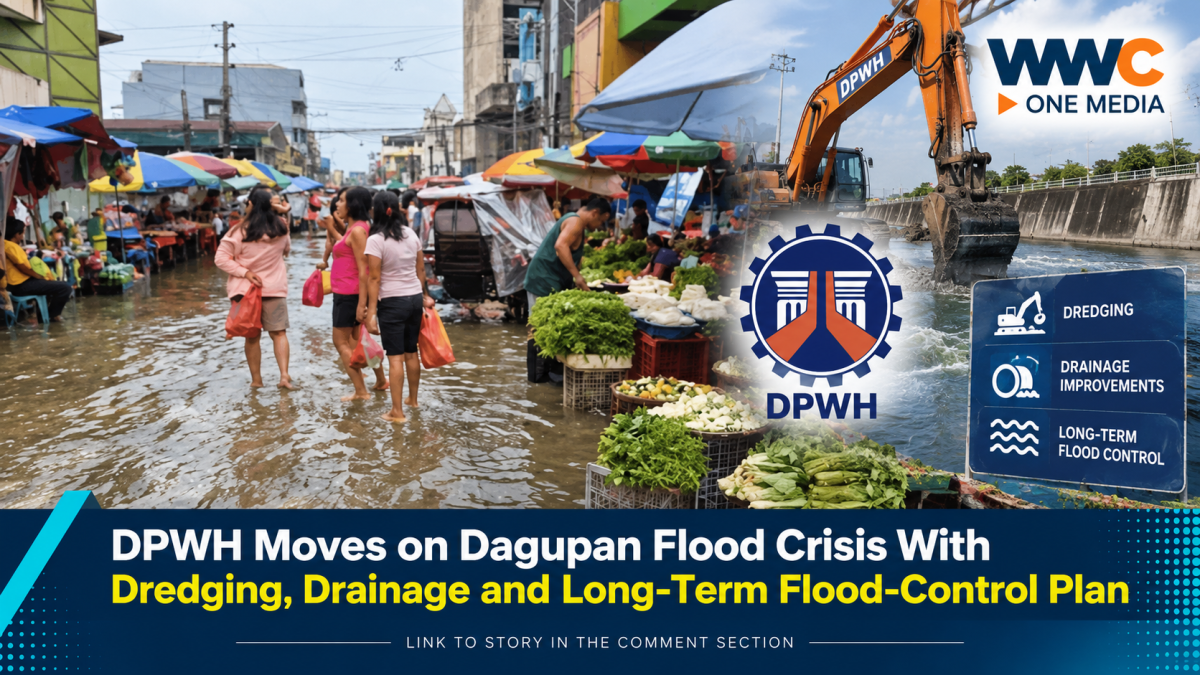
DAGUPAN CITY, Pangasinan — The Department of Public Works and Highways (DPWH) is moving forward with both immediate flood-mitigation measures and longer-term infrastructure solutions for Dagupan City, following another severe flooding episode that affected thousands of residents.
The latest plan includes clearing clogged waterways, dredging rivers, completing unfinished projects and coordinating with the city government on larger flood-control infrastructure.
The announcement comes after Dagupan experienced major flooding in August, when the city declared a state of calamity after 22,047 families, or about 90,015 people, were affected across 31 villages, according to the city disaster office figures cited by PNA.
DPWH Targets Immediate Water-Flow Improvements
DPWH officials said immediate interventions will focus on cleaning waterways and dredging rivers to improve the movement of floodwater.
The measures are intended to increase the capacity of waterways to carry water toward the sea and reduce obstructions that can worsen flooding during heavy rainfall and elevated water levels.
The department has also emphasized completing unfinished infrastructure projects rather than allowing delays to prolong existing flood risks.
DPWH Secretary Vince Dizon previously said the agency was prioritizing unfinished projects and ensuring that projects have clear timelines and adequate funding.
An Unfinished Project Became a Major Focus
One of the projects previously placed under scrutiny is the Sustainable Infrastructure Projects Alleviating Gaps (SIPAG) — Improvement of Arzadon project in Dagupan.
The project was funded under the 2024 General Appropriations Act with an original allocation of PHP25 million and a revised contract cost of approximately PHP24.05 million.
It covers about 668 meters and was originally scheduled for completion in November 2024. Implementation encountered difficulties because the project is located in a densely populated commercial area with warehouses, heavy traffic and limited routes for diverting vehicles. Elevated water levels also affected construction.
The project was subsequently targeted for completion in 2026.
Dagupan Needs More Than One Flood-Control Project
City officials have stressed that flooding in Dagupan cannot be addressed by a single infrastructure project.
Mayor Belen Fernandez said the city government has been working on drainage improvements along smaller roads so that water can move toward the main drainage system.
She also cited the need to complete roughly 9,000 linear meters of dike and identified flooding concerns in areas including West Central, Calmay, the beach area and Zamora.
The city and national government are therefore looking at a combination of measures, including drainage improvements, river dredging, dike work and other flood-control infrastructure.
Dredging Is Already Part of the Wider Strategy
Dredging has been repeatedly identified by local and national officials as an important component of Dagupan’s flood-mitigation strategy.
In September, Pangasinan Gov. Ramon Guico III said the provincial government was pushing for dredging of major rivers that have become heavily silted.
Guico said the province was coordinating with Dagupan officials on possible dredging of the Sabangan River, part of the Sinucalan-Marusay-Pantal river system between Dagupan and Binmaley that leads toward Lingayen Gulf.
Earlier city efforts also involved dredging and clearing waterways, reflecting a strategy that combines maintenance of existing waterways with larger infrastructure projects.
The City Has Faced Repeated Flooding
Dagupan’s geography makes flood management particularly challenging.
The city has historically been affected by flooding associated with heavy rainfall, river systems, drainage capacity and its low-lying environment.
The scale of the August 2026 flooding demonstrated the continuing challenge. PNA reported that 23 villages remained flooded when the city declared a state of calamity, with more than 90,000 individuals affected.
The flooding also disrupted transportation and education, with some major roads becoming difficult or impossible for light vehicles to pass and classes suspended for several consecutive days.
Why Long-Term Planning Matters
Officials are now emphasizing that emergency response alone cannot solve a recurring flood problem.
Longer-term measures under discussion include dike rehabilitation, pumping stations, drainage improvements, road upgrades and rehabilitation of waterways and outlets.
These projects require coordination between the DPWH, the Dagupan city government and the provincial government because flooding can cross administrative boundaries and involve interconnected river and drainage systems.
The DPWH has also stressed that local governments play an important role in identifying the areas where national infrastructure interventions are most urgently needed.
The Next Test Will Be Implementation
For Dagupan residents, the immediate issue is no longer simply whether flood-control projects are being proposed—it is how quickly the planned measures can be completed and whether they can improve water flow during future heavy rains.
The DPWH’s current approach combines immediate clearing and dredging with unfinished-project completion and longer-term flood-control infrastructure.
But these measures are still being implemented. Their effectiveness will ultimately depend on project completion, maintenance, coordination among agencies and the ability of the city’s drainage and river systems to handle future rainfall and water levels.
For a city that has repeatedly dealt with flooding, the latest government push marks another attempt to move from emergency response toward a more comprehensive flood-management strategy.