
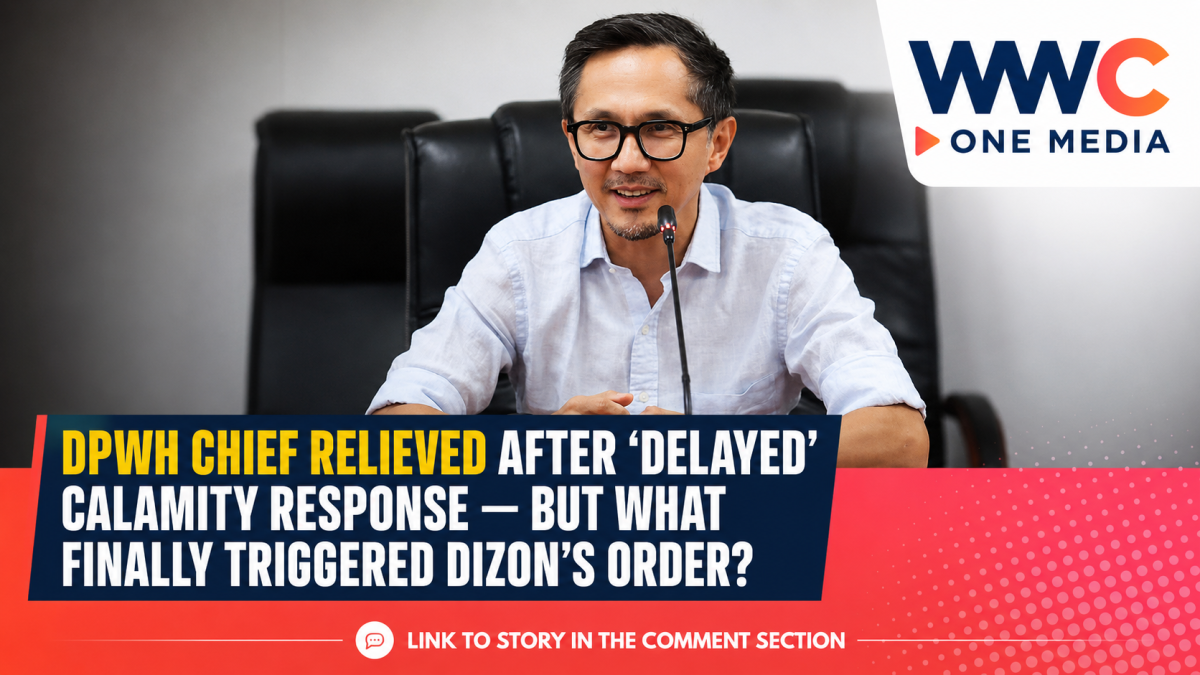
MANILA, Philippines — As severe flooding again tested government response in parts of Metro Manila, the Department of Public Works and Highways has removed a key maintenance official in Las Piñas and Muntinlupa following what the agency described as repeated reports of poor performance and slow action during calamities.
Public Works Secretary Vince Dizon ordered Engr. Loreto C. Balena Jr., maintenance chief of the DPWH Las Piñas-Muntinlupa District Engineering Office (LMDEO), relieved of his duties effective immediately.
The order was contained in a memorandum dated August 29, 2026, according to reports from the Philippine News Agency, GMA News, Inquirer and Philstar. Dizon cited repeated reports involving Balena’s “unsatisfactory performance,” “lack of urgency,” and delayed response to calamities as grounds for his removal from the position.
The development quickly drew support from Las Piñas Lone District Rep. Mark Anthony Santos, who said government officials responsible for critical infrastructure must act quickly, particularly when public safety is at risk.
Bombo Radyo reported that Santos backed the action involving Balena, arguing that officials who fail to perform their responsibilities during emergencies should be held accountable. The lawmaker emphasized the importance of rapid government response involving flood-control systems, drainage networks, roads, bridges and other infrastructure during disasters.
Balena Ordered to Turn Over Records and Pending Work
Dizon’s directive did not simply remove Balena from his maintenance-chief role.
The DPWH secretary also instructed him to conduct an inventory, complete and sign pending documents and deliverables, and formally transfer government records, papers and properties under his custody to the appropriate office.
The directive was intended to prevent disruption to government services following the leadership change.
What has not been publicly detailed in the reports reviewed, however, is the complete list of incidents behind the memo’s reference to “repeated reports.”
That distinction matters.
The official memorandum identifies performance concerns and delayed calamity response, but the publicly available reports reviewed for this article do not provide a comprehensive chronology of every complaint or incident that led to Dizon’s final decision.
Removal Comes as Las Piñas Battles Serious Flooding
The timing has placed additional attention on the DPWH’s response to flooding in southern Metro Manila.
Heavy rains from the southwest monsoon, or Habagat, flooded numerous roads across the capital region on August 29.
At Zapote Junction in Las Piñas, floodwater reached roughly knee level and the road was reported impassable to light vehicles, according to Metropolitan Manila Development Authority information carried by GMA News, Inquirer and other outlets.
The DPWH also deployed six drainage pumps to flood-prone locations in Las Piñas, including Zapote Junction and Alido, in an effort to drain accumulated water and restore road access. The equipment included mobile and motorized pumping units.
Still, GMA News specifically noted that the recent flooding in Las Piñas was not explicitly identified in the memorandum as the particular incident that caused Balena’s relief. The order instead referred more broadly to repeated reports of inadequate performance and delayed disaster response.
That nuance is important because it prevents the flooding at one location from being presented as the confirmed sole reason for the personnel action.
Flooding Was Part of a Much Wider Emergency
The Las Piñas situation unfolded during a broader weather emergency affecting several parts of Luzon.
The Office of Civil Defense said on August 30 that 429 areas across four regions — Ilocos Region, Central Luzon, Calabarzon and Metro Manila — remained flooded as a result of Habagat rains.
Malacañang, meanwhile, said President Ferdinand Marcos Jr. was monitoring the situation and had instructed government agencies to respond quickly to communities affected by the heavy rainfall.
Philstar and Radyo Pilipinas reported that the personnel action involving Balena was also described by the DPWH as consistent with the administration’s broader push for stronger accountability and discipline within the public works agency.
Rep. Santos: Public Office Comes With Accountability
For Santos, the issue extends beyond one official.
The Las Piñas lawmaker said agencies responsible for infrastructure and public safety cannot afford sluggish action during emergencies, when delayed responses can affect motorists, commuters and communities already dealing with rising floodwaters.
His message was straightforward: government positions carry responsibility, and officials must be held accountable when they fail to perform their duties adequately.
But there is another side that remains important to the developing story.
Balena’s response has not yet been widely reported. GMA News said it had contacted him for comment and would update its report once a response was received. As of the report reviewed for this article, his explanation or rebuttal was not included.
That means the allegations concerning his performance should continue to be described as the DPWH’s stated grounds for relieving him, rather than as independently established misconduct.
The Bigger Question for DPWH
Balena’s removal may satisfy calls for immediate accountability, but it also opens a larger question for the agency.
Will removing individual officials translate into faster drainage clearing, better flood-control maintenance and more responsive disaster operations on the ground?
For residents, the ultimate measure will not be the number of officials removed from office.
It will be whether roads remain passable, pumps operate when they are needed, drainage systems are maintained before storms arrive, and government personnel respond before flooding becomes a crisis.
The action against Balena sends a clear warning inside the DPWH: delayed emergency response can carry consequences.
What remains to be seen is whether that warning produces measurable improvements the next time the rains come.

Leave a Reply