
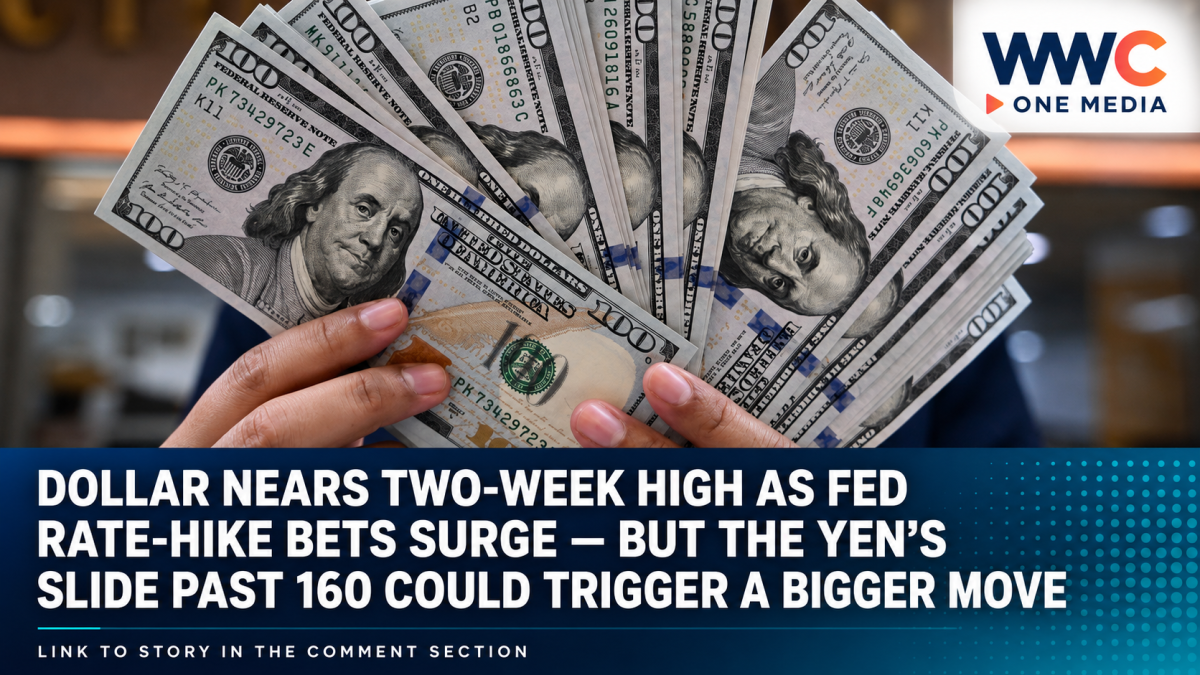
HONG KONG — The U.S. dollar is back on the offensive after Federal Reserve Chair Kevin Warsh delivered a hawkish message that forced financial markets to rethink the possibility of another interest-rate hike — and the consequences are already being felt across global currencies.
The dollar held close to a two-week high on Monday, August 31, after investors sharply increased bets that the Federal Reserve could raise rates as early as September.
But the bigger warning sign may be unfolding in Japan.
The yen weakened beyond the closely watched 160-per-dollar level, putting traders back on alert for possible intervention by Japanese authorities — and potentially reopening one of the most sensitive battles in the global currency market.
Warsh changes the conversation on interest rates
The market shift followed Warsh’s first major Jackson Hole address as Federal Reserve chair.
Warsh made clear that bringing inflation back to the Fed’s 2% target remains a central priority, arguing that policymakers must see convincing evidence that underlying inflation is moving toward that goal at a sufficient pace.
If that confidence does not emerge, he indicated the central bank still has policy work ahead of it.
The message mattered because investors had been debating whether weakening parts of the U.S. labor market might keep the Fed from tightening monetary policy again.
Warsh instead emphasized that the broader economy remains resilient while inflation is still running well above target.
According to the Federal Reserve, the 12-month increase in its preferred Personal Consumption Expenditures price index currently stands at 3.7%, while the six-month rate is running at 4.1%.
Warsh also pointed to a U.S. unemployment rate of 4.1%, describing labor-market conditions as broadly stable and consistent with full employment.
That combination — persistent inflation and a labor market that has not collapsed — gives the Fed considerably more room to contemplate higher rates.
September rate-hike odds jump to 57%
Markets reacted quickly.
The implied probability of a Federal Reserve rate increase at the September meeting climbed to roughly 57%, according to market pricing cited by Reuters.
The yield on the interest-rate-sensitive two-year U.S. Treasury note also rose to around 4.33%, its highest level in more than a month.
That matters for currencies because higher U.S. interest rates typically make dollar-denominated assets more attractive to global investors.
The dollar index, which measures the greenback against six major currencies, was around 99.6 on Monday after jumping approximately 0.6% on Friday, when it reached its strongest level since August 17.
The index was nevertheless heading toward a second consecutive monthly decline, showing just how dramatically expectations have shifted during August.
MarketWatch also reported a sharp change in sentiment following Warsh’s speech, with expectations for a September hike rising from roughly 40% to 57%.
U.S. stock futures weakened as investors digested the possibility that borrowing costs could remain higher — or rise further — for businesses and consumers.
Yen falls through 160 — and intervention fears return
Japan may now face the most immediate consequences of the stronger dollar.
The yen traded around 160.01 per dollar, once again crossing the psychologically important 160 level.
There is no official exchange rate at which Japan is automatically required to intervene. But moves beyond 160 have become politically and financially sensitive because a weaker yen raises the cost of imported fuel, food and other goods for Japanese households and companies.
The renewed slide is especially significant because the currency has already surrendered much of the improvement generated by intervention in July.
Japan’s underlying problem has not disappeared.
Interest rates in the United States remain substantially higher than in Japan, encouraging investors to hold dollar assets instead of yen.
That rate gap can continue putting downward pressure on Japan’s currency even when authorities intervene directly in foreign-exchange markets.
UBP senior economist Carlos Casanova told Reuters that previous currency interventions have tended to produce lasting results only when economic fundamentals eventually move in the same direction.
That puts increasing pressure on the Bank of Japan itself.
Markets are watching whether BOJ Governor Kazuo Ueda and his colleagues will move more aggressively toward higher interest rates, particularly as Japanese officials prepare for discussions with global counterparts at the G20 gathering.
Oil is adding another problem
The dollar is receiving support from another powerful force: rising oil prices.
Brent crude climbed after U.S. forces struck Iranian targets on Larak Island, escalating geopolitical tensions around the Strait of Hormuz.
Reuters reported Brent crude trading around $89 a barrel, while West Texas Intermediate was above $84, as investors assessed the risk of further disruption to energy supplies.
Higher oil prices complicate the Fed’s job because sustained energy-price increases can feed into transportation, manufacturing and consumer costs.
They also create additional pressure for oil-importing economies across Asia.
Reuters reported that the combination of higher oil prices and renewed Fed tightening expectations was already weighing on Asian markets, with Japan’s Nikkei falling roughly 2.1% and South Korea’s market dropping about 2.4% during Monday trading.
One jobs report could change everything
Despite the market’s sudden confidence in a September rate increase, the decision is far from settled.
The next major test arrives with the August U.S. employment report on Friday, September 4.
Economists surveyed by Reuters expect the U.S. economy to have added roughly 58,000 jobs, with unemployment remaining near 4.1%.
That report could become the decisive piece of evidence ahead of the Fed meeting.
A surprisingly strong employment number would strengthen Warsh’s argument that the economy can withstand tighter monetary policy and could push September rate-hike expectations even higher.
A significantly weaker report could do the opposite, forcing investors to reconsider whether the Fed can afford to tighten while job creation is slowing.
The Financial Times similarly identified the employment report as a critical test of the Fed’s new hawkish stance, particularly after recent weakness in U.S. payroll figures.
What happens next
The financial-market equation has suddenly become much more complicated.
A stronger dollar, higher Treasury yields and expensive oil are tightening global financial conditions at the same time.
For Japan, another sustained move beyond 160 could intensify pressure on authorities to defend the yen.
For stock investors, another Fed rate increase would challenge valuations that have benefited from expectations of easier monetary policy.
And for emerging markets, a stronger dollar can increase the cost of servicing dollar-denominated debt while putting pressure on local currencies.
But the biggest question now sits in Washington.
Kevin Warsh has successfully convinced markets that another rate hike is possible.
Whether the Federal Reserve actually delivers one may depend on what America’s workers — and America’s inflation numbers — reveal over the next several days.
The dollar has already reacted to Warsh. The next market shock could come from the data.

Leave a Reply