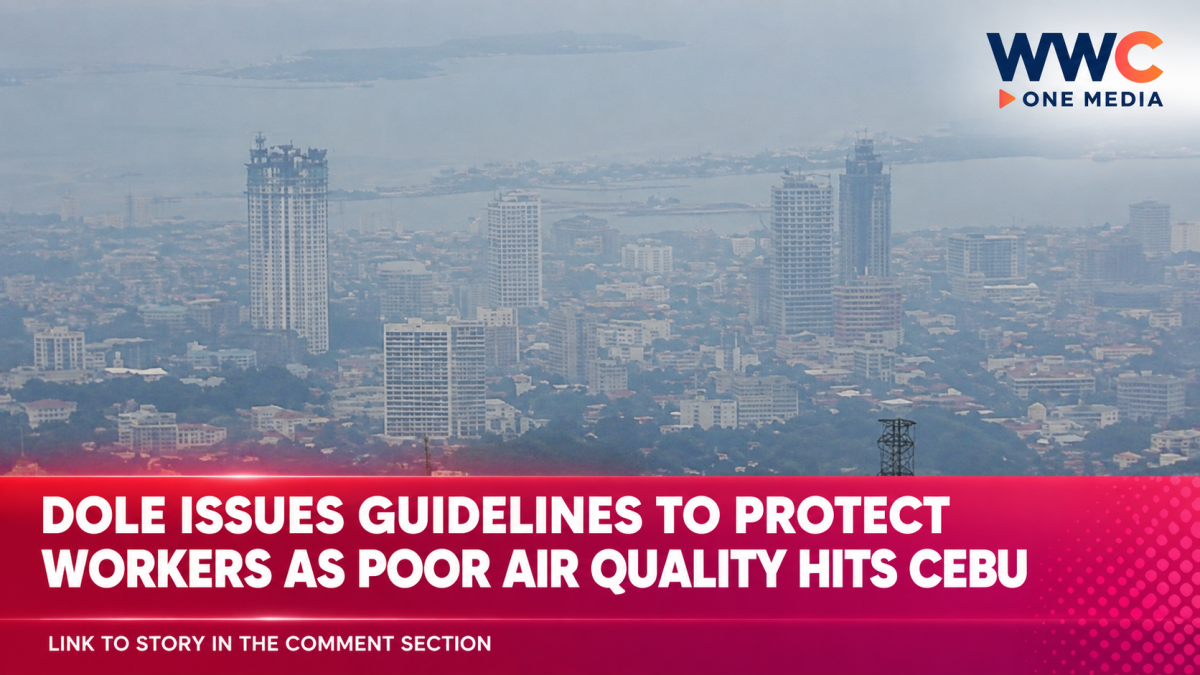
The Department of Labor and Employment has issued new guidelines to protect workers from health risks linked to poor air quality as haze continues to affect parts of Cebu and other areas of the country.
Labor Advisory No. 15, Series of 2026, signed by Labor Secretary Francis Tolentino on September 18 and released on September 22, directs employers to assess and manage workers’ exposure to polluted air.
Under the advisory, employers must implement Hazard Identification, Risk Assessment and Control procedures to determine how workers may be exposed to unhealthy air. These assessments should use the Air Quality Index Matrix and Action Points issued by the Department of Environment and Natural Resources and the Department of Health.
Employers are also required to regularly review and update their risk assessments whenever air quality, workplace conditions or workers’ exposure levels change.
When air quality reaches a very unhealthy level, employers are expected to monitor official air-quality advisories, provide appropriate protective equipment, improve indoor ventilation, and limit or suspend outdoor work when necessary.
Workers should also be informed about the health risks associated with exposure to polluted air.
For acutely unhealthy conditions, employers are advised to consider flexible work arrangements. If air quality reaches an emergency level, DOLE strongly recommends suspending non-essential work or adopting alternative work arrangements to protect employees.
The new guidelines come as parts of Cebu have experienced recurring haze episodes linked to smoke from forest fires in Indonesia. Earlier in September, monitoring stations in Cebu recorded air-quality readings in the very unhealthy range, with fine particulate matter carried across the region by prevailing winds.
More recently, air quality in Metro Cebu showed some improvement but remained at very unhealthy levels in some areas, prompting several local governments to suspend in-person classes because of the conditions.
DOLE said the measures are intended to ensure that employers take preventive action rather than wait until poor air quality becomes a serious threat to workers’ health and safety.