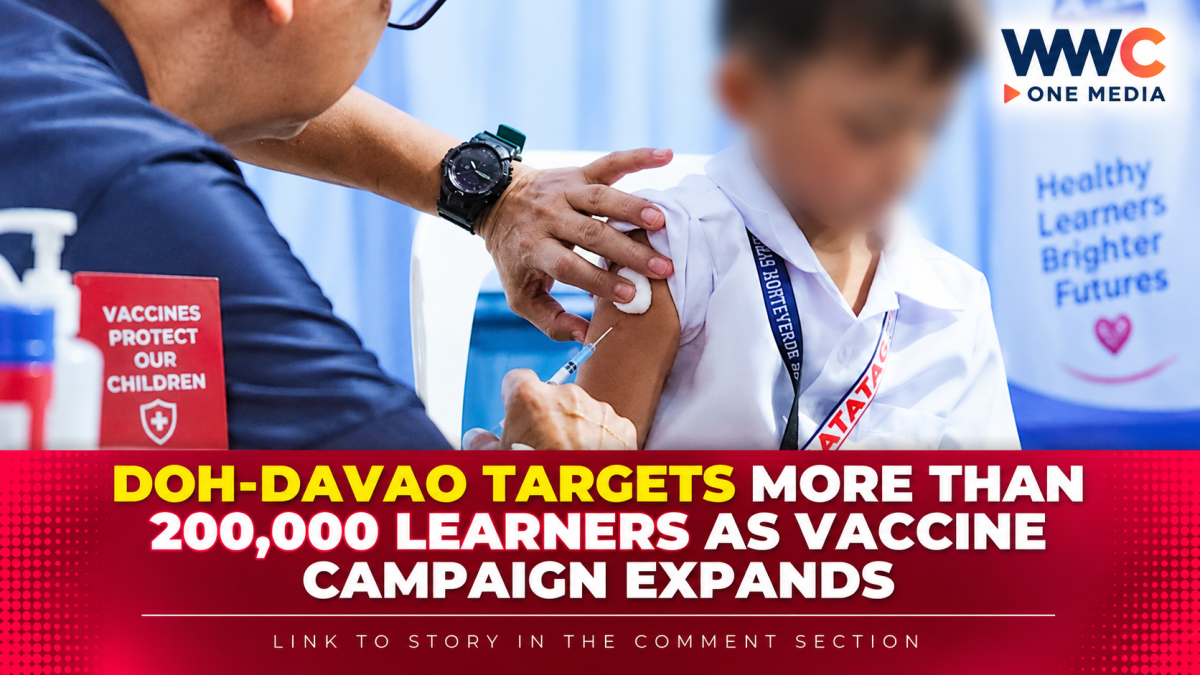
The Department of Health-Davao Center for Health Development (DOH-Davao) has resumed its school-based immunization program, targeting more than 200,000 learners across the Davao Region as health officials work to rebuild routine vaccination coverage disrupted during the Covid-19 pandemic.
The campaign is being implemented with local government units and the Department of Education in public schools throughout the region. It focuses on providing protection against vaccine-preventable diseases while giving parents and guardians additional information to address concerns and misconceptions surrounding childhood and adolescent vaccination.
Under the program, 105,707 Grade 1 learners and 105,001 Grade 7 learners are targeted to receive Measles-Rubella and Tetanus-Diphtheria vaccines and booster doses.
The campaign also includes 54,972 Grade 4 girls aged 9 to 14 who are eligible for the Human Papillomavirus vaccine, which helps protect against HPV-related cancers, including cervical cancer.
Health officials used a September 18 media engagement to address questions surrounding the vaccines, particularly HPV vaccination.
Dr. Allyne Aguelo, a pediatric infectious disease specialist representing the Philippine Pediatric Society, explained that HPV vaccination is given at an age when it can provide protection before potential exposure to the virus. She also clarified that the HPV vaccine is not a live vaccine.
Aguelo further cited evidence showing no increase in sexual activity among people who received the HPV vaccine, addressing a misconception that has contributed to vaccine hesitancy.
Common reactions to vaccination can include temporary pain or redness at the injection site and low-grade fever, according to the health discussion.
DOH-Davao Assistant Regional Director Dr. Annabelle Yumang emphasized the importance of accurate health information in encouraging parents to protect their children against preventable diseases.
The immunization campaign is also part of a broader push to improve women’s health in the region, with HPV vaccination complemented by efforts promoting cervical cancer screening and awareness.
Health and education authorities are preparing masterlists of eligible learners, securing signed consent from parents or guardians and conducting orientations before vaccination activities. Learners enrolled in private schools or home-school programs can also access vaccines through local health centers, according to the report.
The campaign follows a wider national and regional effort to address declining or incomplete immunization coverage. In nearby Soccsksargen, health officials have likewise urged communities to counter vaccination misinformation after the region reported low fully immunized-child coverage during the first half of 2026.
For DOH-Davao, the immediate goal is not only to reach more learners but also to rebuild confidence in routine immunization through accurate information and stronger coordination among health workers, schools, local governments and families.
As the school-based campaign moves forward, its reach will depend not only on the availability of vaccines but also on how many eligible learners receive parental consent and complete the recommended protection against vaccine-preventable diseases.