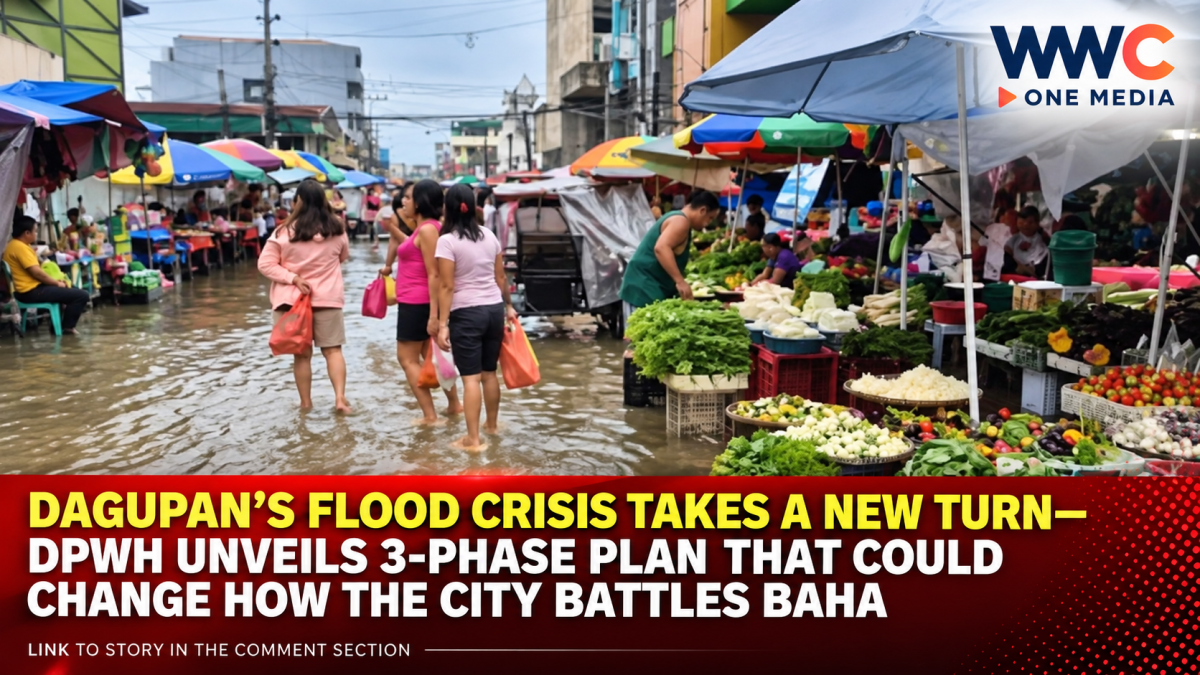
DAGUPAN CITY, Pangasinan — After recurring floods left communities across Dagupan struggling with prolonged inundation, the Department of Public Works and Highways (DPWH) has laid out a three-phase strategy combining immediate flood removal, medium-term water detention projects and a long-term plan aimed at controlling water flowing into the city.
Public Works Secretary Vince Dizon said the first priority is to improve the movement of floodwater through the Sinocalan River, particularly its upstream sections where floodwaters can remain for extended periods.
The DPWH plans to mobilize dredging equipment in the coming days, including equipment from the Pangasinan provincial government, according to Dizon.
Dredging, pumps and floodgate repairs
Dredging is only one part of the immediate response.
The DPWH also plans to deploy four mobile pumping units to help remove floodwater from affected barangays. Authorities will inspect existing gabions for possible repairs and work on floodgates in Barangays Bacayao Sur and Bacayao Norte.
The floodgates are expected to be repaired and reopened before eventually being turned over to the Dagupan City Engineering Office.
Officials are also looking into backflow from the Pantal River, particularly in the Careenan and Poblacion Oeste areas, as part of the effort to improve the movement of water through the city.
The plan moves beyond drainage
The medium-term strategy goes further than simply removing floodwater after heavy rains.
The DPWH is planning two water detention basins, including sites at the city plaza and Hinarangan Lake. The concept is patterned after the flood-management system at St. John the Evangelist Cathedral in Dagupan, whose grounds were cited as an example of how detention areas can temporarily hold excess water.
The agency also plans improvements to the drainage system along Burgos Street, with the projects targeted for implementation beginning in 2027.
The proposed detention approach is part of a broader shift toward temporarily storing excess water rather than relying solely on drainage channels to immediately carry floodwater away.
A 47-hectare project is being studied
The most ambitious proposal is outside Dagupan itself.
For the long term, the DPWH is studying the construction of a large artificial lake or detention basin covering roughly 47 hectares in Calasiao.
The concept includes a diversion channel that would redirect water from Calasiao toward the detention area before the water reaches Dagupan, with the system eventually directing water toward the Pantal River.
The project could take at least two and a half years to plan and complete, according to reports on Dizon’s presentation.
That proposal reflects the increasingly regional nature of the flooding problem.
Why Dagupan keeps struggling with floodwater
Local officials have said Dagupan functions partly as a catch basin, receiving water not only from rainfall within the city but also from upstream and neighboring areas.
Mayor Belen Fernandez has pointed to water coming from upland communities and nearby areas, while high river levels and high tide can slow the movement of water toward the sea. Local reports have also identified the Sinocalan River, Pantal River and water coming from areas around Calasiao as important factors in the city’s flooding situation.
The broader provincial picture is also significant.
The Pangasinan provincial government recently said enhanced southwest monsoon rains and successive weather disturbances affected at least 150 barangays in 12 municipalities and two cities, with about 1.167 million residents affected during the period covered by its assessment. Provincial officials have also cited the province’s low-lying plains, extensive upstream catchments, the Agno River Basin and intense rainfall as factors contributing to flood vulnerability.
Dredging is already being pursued across Pangasinan
The Dagupan plan comes as the Pangasinan provincial government separately pushes a broader river-dredging program.
Gov. Ramon Guico III has called for studies of major rivers and tributaries to determine water flow and develop a more coordinated river-restoration strategy. The province has begun dredging the Limahong Channel in Lingayen and has discussed possible dredging of the Sabangan River, a waterway connecting the Sinucalan-Marusay-Pantal river system toward Lingayen Gulf.
Provincial officials have also said dredging is being conducted in portions of the Sinucalan and Marusay river systems, while an interagency committee has been formed to oversee work on silted waterways.
Earlier DPWH projects remain part of the picture
The latest announcement follows months of attention on unfinished and existing flood-mitigation infrastructure in Dagupan.
In June, DPWH Secretary Dizon inspected an unfinished project in Barangay Mayombo after a resident’s social media post brought attention to the issue. The PIA reported that the project, funded under the 2024 General Appropriations Act, had a revised contract cost of about P24.05 million and covered 668 meters. Its purpose included reducing road inundation during high tide and heavy rainfall.
The same report said the project faced implementation difficulties because of the area’s dense commercial activity, limited traffic-diversion options and elevated water levels. Dizon directed attention toward completing unfinished projects while also emphasizing drainage cleaning and river dredging.
Dagupan’s flood battle is becoming a regional problem
The latest measures suggest that solving Dagupan’s flooding will require more than raising roads or expanding individual drainage lines.
The proposed approach combines river dredging, pumping, floodgate repairs, drainage upgrades, water detention basins and upstream diversion infrastructure.
The challenge is that water does not stop at city boundaries. Floodwater moving from upstream areas can converge in low-lying Dagupan, while high tides can make it harder for water to drain toward the Lingayen Gulf. Provincial officials have therefore advocated a more coordinated approach involving national agencies, local governments and multiple river systems.
For residents who have endured repeated flooding, the critical question now shifts from whether solutions have been identified to how quickly the proposed projects can move from plans and equipment deployment to completed infrastructure.