WASHINGTON — A Democratic congressman fighting one of the most closely watched House races of the 2026 midterms wants federal candidates banned from trading prediction-market contracts tied to their own elections after his Republican opponent admitted betting on her own campaign.
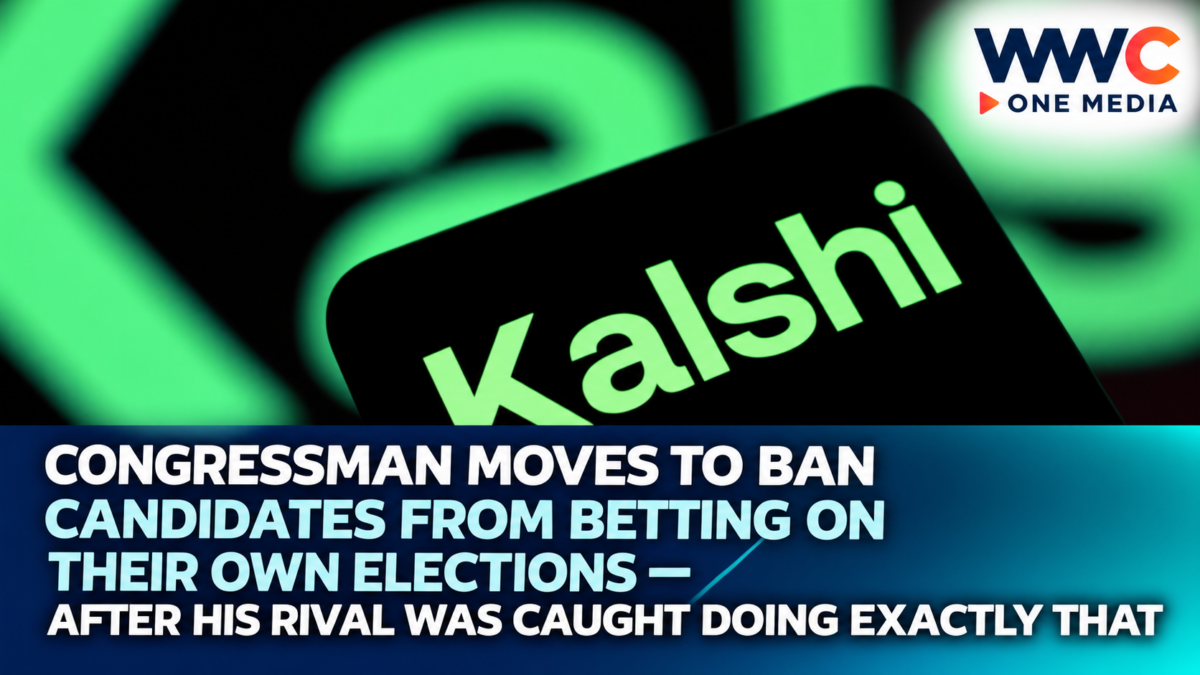
Rep. Don Davis of North Carolina introduced the No Betting on Your Own Race Act on October 5, seeking to make it illegal for candidates for federal office to buy, sell, hold or otherwise trade prediction-market contracts linked directly to the outcome of their own elections.
The proposal would impose a civil penalty of $10,000 per violation or three times the trader’s net financial gain, whichever is greater. It would also extend the prohibition beyond candidates themselves to their spouses, dependent children and authorized campaign committees.
Davis framed the issue in unusually simple terms:
professional athletes are generally prohibited from betting on games they can influence, he argues, so political candidates should not be allowed to financially speculate on contests in which they themselves determine part of the outcome.
But the proposal is not theoretical.
Davis’ Republican challenger Laurie Buckhout was suspended by prediction-market platform Kalshi after placing trades on the very congressional race she is trying to win.
Buckhout admitted: “I bet on myself”
Buckhout, a retired Army colonel challenging Davis in North Carolina’s 1st Congressional District, purchased less than $1,000 worth of contracts tied to her own candidacy, according to Kalshi’s disciplinary findings.
The platform imposed a $2,589.96 penalty and barred her from directly or indirectly accessing Kalshi for three years.
Buckhout did not deny the trades.
“I bet on myself. Literally,” she said after the disciplinary action became public, calling it a mistake and saying she cooperated after learning there was a problem.
That admission transformed what could have been an abstract ethics debate into an immediate campaign issue.
Davis is now trying to turn the controversy involving his own opponent into national legislation.
Kalshi already prohibits candidates from doing this
Prediction markets allow users to trade contracts whose value depends on whether a particular event happens.
A contract might ask:
Will Candidate A win?
Will a party control the House?
Will the Federal Reserve raise interest rates?
Will a particular geopolitical event occur?
If an outcome becomes more likely, the contract generally becomes more valuable.
That makes prediction markets look similar to gambling in some respects, but federally regulated platforms such as Kalshi operate as derivatives markets overseen by the Commodity Futures Trading Commission.
Kalshi already prohibits traders from participating in contracts when they can directly or indirectly influence the underlying event.
For a candidate, that creates an obvious problem:
the candidate is one of the people most capable of affecting whether the candidate wins.
Kalshi determined that Buckhout therefore qualified as someone with direct influence over the underlying event and was prohibited from trading the contract.
Davis wants a platform rule turned into federal law
That distinction is the heart of the new bill.
Right now, much of the restriction depends on individual platform rules and enforcement.
Davis wants Congress to establish a nationwide federal standard.
Under his proposal, candidates would not simply risk losing access to a trading platform.
They could face a statutory financial penalty for trading contracts tied to their own federal elections.
Davis said Congress needs a consistent rule so all federal candidates and campaigns understand that trading on their own elections is prohibited.
The proposal therefore goes beyond punishing one candidate.
It attempts to close what Davis sees as an ethics gap created by the explosive growth of prediction markets.
The Senate has already gone much further
Congress is not starting from zero.
On April 30, 2026, the Senate unanimously adopted a rule prohibiting senators, Senate officers and employees from participating in prediction markets altogether.
The resolution amended Senate ethics rules to prohibit members and staff from entering event contracts whose value depends on whether a specific event occurs.
It also formally encouraged the House, executive branch and judiciary to establish similar restrictions.
Sen. Bernie Moreno, the Republican sponsor, argued that senators should not be using public office to profit from speculative markets.
Democratic Sen. Alex Padilla successfully expanded the measure to cover Senate staff and officers as well.
Davis’ bill is narrower.
Rather than prohibiting every prediction-market trade by federal candidates, it specifically targets trades related to their own elections.
Why candidate trading creates an unusual insider-information problem
Candidates know things ordinary traders often do not.
They may know:
internal polling;
fundraising trends;
endorsement announcements;
campaign spending plans;
whether they are considering dropping out;
private health information;
internal scandals;
staff departures;
and confidential strategic decisions.
That creates a fundamental information imbalance.
A candidate may know, for example, that he or she is about to withdraw from an election before the public does.
A trader with that knowledge could potentially profit from a contract predicting the election outcome.
Even when no confidential information is involved, candidates still directly influence the event itself.
They choose whether to campaign.
They decide where to spend money.
They participate in debates.
And they can even decide whether to remain in the race.
That makes election contracts unusually sensitive to conflicts of interest.
George Santos showed how serious the problem can become
The broader prediction-market industry has already confronted an even more extreme example.
Kalshi permanently banned former Rep. George Santos after concluding that he improperly traded contracts tied to whether he would attend President Donald Trump’s State of the Union address.
Kalshi said Santos made misleading public statements, placed trades and later profited approximately $17,839.
The company imposed a penalty of more than $71,000 and banned him for life.
Santos also faced CFTC scrutiny.
The case became one of the clearest examples of how someone with direct control over an event could potentially profit from a prediction contract tied to that same event.
Kalshi has since disciplined several political candidates for trading on their own campaigns.
That makes Buckhout’s case part of a broader regulatory issue rather than an isolated political controversy.
Prediction markets have exploded since the 2024 election
The ethics fight comes as platforms such as Kalshi and Polymarket become much larger players in politics and finance.
Prediction markets attracted enormous attention during the 2024 presidential election because traders often moved faster than traditional polling averages.
Since then, activity has spread into:
congressional elections;
interest rates;
inflation;
sports;
wars;
corporate events;
and even highly specific political developments.
Kalshi and Polymarket together were recently processing monthly trading volumes exceeding $20 billion, according to Barron’s.
That growth has turned prediction markets from a niche internet experiment into a serious financial and political force.
It has also made enforcement more important.
Prediction-market prices are not polls
One source of confusion is the way prediction-market odds are discussed.
A contract trading around 60 cents may be interpreted as suggesting roughly a 60% market-implied probability.
But that does not mean 60% of voters support a candidate.
Prediction markets and polls measure different things.
Polls attempt to estimate voter preferences.
Prediction markets estimate what traders believe will ultimately happen.
Those traders can incorporate polling, fundraising, endorsements, news, turnout assumptions and private analysis into the price.
But markets can also be influenced by liquidity, large individual traders and speculation.
A Washington Post analysis earlier this year found prediction markets can contain useful electoral information, but they are not infallible—favorites can and do lose.
That distinction matters greatly in Davis’ race.
Davis’ congressional race is exactly the kind traders watch closely
North Carolina’s 1st District has become one of the most competitive House contests in the country.
Davis narrowly defeated Buckhout in their 2024 matchup, winning 49.5% to 47.8%, a margin of just over 6,000 votes.
Republicans then redrew the district.
Under the new boundaries, Donald Trump would have carried the district by roughly 12 percentage points in the 2024 presidential election, compared with only around three points under the previous map.
That dramatically improved Republican prospects.
Yet the race remains competitive.
Recent prediction-market pricing has continued to give Democrats a meaningful chance of holding the seat, illustrating how uncertain the contest remains.
That makes every piece of campaign information potentially valuable to traders.
And it makes the ethical concern about a candidate personally participating much more obvious.
The bill also creates a campaign weapon for Davis
There is another political reality that should not be ignored.
Davis is not a neutral regulator examining someone else’s race.
The politician introducing the bill is actively running against the candidate whose conduct helped inspire it.
That gives Democrats an obvious campaign message:
Buckhout violated prediction-market rules, while Davis is proposing legislation to prevent candidates from doing the same thing.
Republicans can counter that Davis is using a campaign mistake by his opponent to generate political attention weeks before Election Day.
Both things can be true.
The underlying ethical question exists independently of the campaign advantage Davis may gain from raising it.
Buckhout’s conduct should also be described precisely
It would be inaccurate to say Buckhout has been found guilty of a federal crime.
She has not.
The confirmed facts are narrower.
She traded less than $1,000 in contracts related to her own campaign.
Kalshi concluded the activity violated its rules.
She cooperated with the investigation.
The company imposed a $2,589.96 penalty and three-year suspension.
And she publicly acknowledged the mistake.
Davis has described the incident in much harsher terms politically.
But platform discipline should not automatically be equated with a criminal conviction.
That distinction is important in any accurate report.
The proposal would cover family members too
Davis’ legislation attempts to prevent candidates from simply routing trades through people close to them.
The proposed restriction would apply to:
the candidate;
the candidate’s spouse;
dependent children;
and authorized campaign committees.
It would cover buying, selling, holding or disposing of covered election contracts.
That family provision reflects a familiar problem in ethics regulation.
A rule banning only the officeholder can be easy to circumvent if a spouse or closely controlled entity is still permitted to make the transaction.
Congress has faced similar debates over stock-trading restrictions.
Congress is already struggling with a much broader trading debate
Just days before Davis introduced his prediction-market legislation, the Senate failed to advance a separate bill intended to restrict stock trading by lawmakers.
That proposal would have limited lawmakers, spouses and dependent children from purchasing individual public-company stocks, but it failed to reach the required 60 votes.
Democrats argued that it did not go far enough, while Republicans accused Democrats of blocking ethics reform.
That fight shows why Davis’ bill could face a difficult path.
There is broad public support for stricter financial ethics rules.
But Congress has repeatedly struggled to agree on exactly how far those restrictions should go.
And the House is barely in Washington before Election Day
Timing presents another major obstacle.
The No Betting on Your Own Race Act was introduced during a pro forma House session, and Congress is largely away campaigning ahead of the November 3 midterms.
That makes passage before this election extraordinarily unlikely.
The proposal is therefore more significant as a marker for future regulation than as something capable of immediately changing the 2026 campaign.
Any serious legislative push would probably come after the election.
That means this year’s candidates will continue operating primarily under existing platform rules and current federal law.
The deeper issue is whether political markets can police themselves
Prediction-market companies have a strong incentive to stop insider trading.
Their entire product depends on users trusting that prices are reasonably fair.
If traders believe politicians, government employees or other insiders can secretly profit from information ordinary participants do not have, confidence can quickly collapse.
Kalshi has tried to demonstrate aggressive enforcement.
It has suspended political candidates.
It permanently banned Santos.
And it maintains rules barring people with direct control over events from trading relevant contracts.
Supporters may argue that proves platform self-regulation works.
Davis’ response is effectively the opposite:
if the conduct is serious enough for the exchange to prohibit it, Congress should prohibit it too.
There is also a philosophical debate over whether insiders improve markets
Interestingly, not everyone believes candidate participation should automatically be banned.
In comments submitted to the CFTC earlier this year, one argument suggested allowing candidates to take limited positions on themselves could potentially improve prediction-market accuracy because candidates possess unique information about their own electoral prospects.
The theory is that prediction markets work by aggregating information—and candidates may possess some of the best information available.
But that argument creates an obvious ethical problem.
A market may become more accurate precisely because someone with privileged information is using it.
Financial markets generally treat material nonpublic information very differently.
That conflict—between market accuracy and market fairness—is at the center of the prediction-market debate.
Election betting has become too large for Washington to ignore
The political prediction-market boom is no longer just about people placing small wagers for entertainment.
Large traders can commit millions of dollars.
Prices are quoted on television.
Campaign reporters discuss them.
Investors use them.
Politicians share favorable odds.
And market movements can themselves become news stories.
That means prediction markets increasingly influence the political narrative they are supposedly only measuring.
When a candidate’s probability suddenly rises, donors and voters may interpret that as new information—even when the movement was caused by only a few large trades.
The larger these markets become, the more important transparency and conflict-of-interest rules become as well.
Davis is trying to create one simple line
The No Betting on Your Own Race Act does not attempt to solve every prediction-market controversy.
It would not ban Americans from trading election contracts.
It would not outlaw political prediction markets.
It would not resolve the continuing dispute over whether some event contracts are derivatives or gambling.
Instead, it proposes one narrow rule:
If you are the candidate, you cannot financially trade on whether you win.
That simplicity may ultimately become the bill’s strongest political argument.
But there is almost no chance it changes the 2026 election
The midterms are now less than a month away.
North Carolina’s 1st District remains competitive.
Prediction markets are already actively trading contracts tied to the result.
Buckhout has already served as the highest-profile example of the conduct Davis wants to outlaw.
But Congress is unlikely to act quickly enough for his bill to affect the current campaign.
So the legislation is really about what happens next.
As election markets get larger and more sophisticated, Congress will increasingly have to decide whether political candidates should be treated like ordinary traders—
or like athletes standing on the field of a game they are forbidden to bet on.
Davis has chosen the second answer.
And after his own opponent was fined and suspended for betting on her campaign, the question is no longer hypothetical:
Should candidates be allowed to make money betting on elections they themselves can influence?