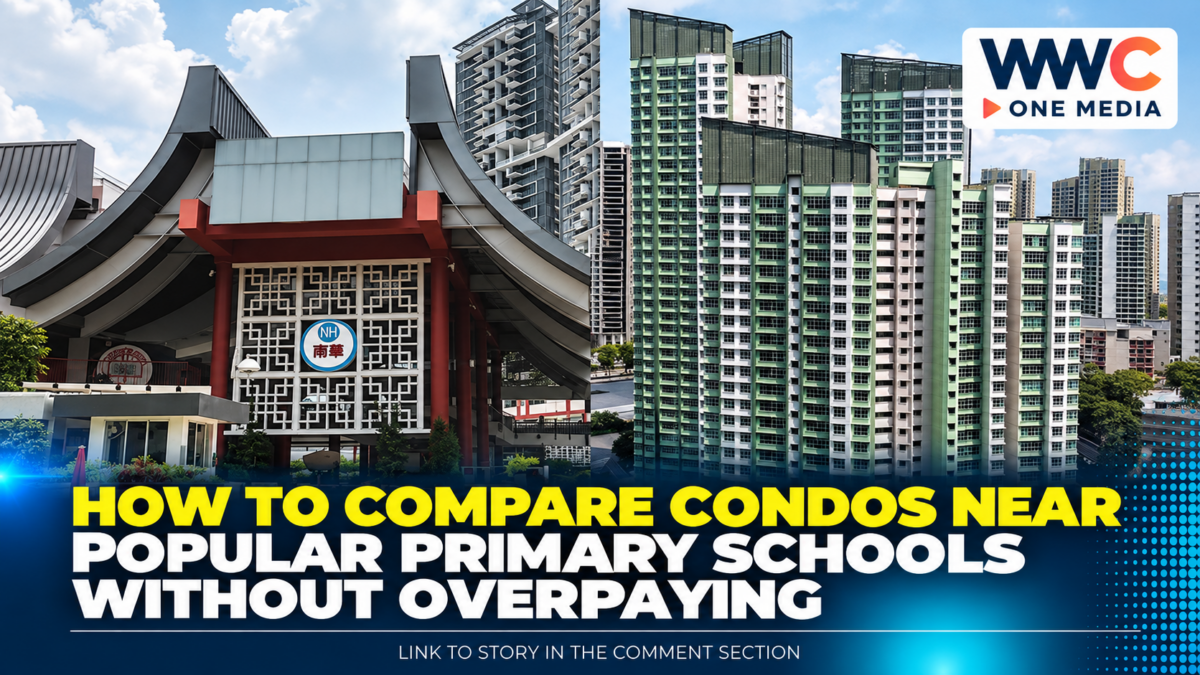
Buying a condominium within 1km of a popular primary school can be attractive to families in Singapore, particularly because the Home-School Distance category can provide priority during Primary 1 registration. But being inside the 1km boundary does not automatically mean a property is worth paying a premium for.
The Ministry of Education’s Primary 1 registration framework gives Singapore Citizen children living within 1km of a school priority over those living between 1km and 2km when places are oversubscribed, after other priority categories such as siblings are considered. This makes school proximity an important factor for some homebuyers.
However, buyers can run into problems when they treat every condominium within the 1km zone as equivalent. Differences in the exact location of individual blocks, unit sizes, layouts, development age and transaction activity can have a substantial effect on what a property is actually worth.
One of the first things buyers should check is the property’s postal code. Large developments can straddle the 1km boundary, meaning some blocks may qualify while others in the same condominium may not. For example, only some blocks at Jadescape fall within the Home-School Distance category for Ai Tong School. Buyers can verify the location using OneMap rather than relying solely on a property’s marketing material.
The next step is to compare similar properties on a like-for-like basis. A two-bedroom unit should not simply be compared with a three-bedroom unit because the latter has a higher absolute price. Families may have different requirements for space, bedrooms and layouts, while smaller units may appeal more to investors or buyers without children.
The age of the condominium also matters. An older development may offer considerably more floor space for the same price as a newer project nearby, but its lower price could reflect factors such as remaining lease, facilities, maintenance requirements or the condition of the property rather than its distance from the school.
Transaction volume is another factor that can easily be overlooked. If a condominium records only one or two sales in a year, the average selling price can be heavily influenced by the characteristics of those individual units. A single unusually large, renovated or high-floor apartment can make a development appear more expensive or cheaper than it normally is.
Buyers should therefore examine a larger set of transactions where possible instead of relying on one headline price or a small number of recent deals. Looking at comparable units within the same development and similar nearby projects can provide a clearer picture of whether a premium is actually being paid for school proximity.
Walking distance should also be considered separately from the formal 1km boundary. Two properties may both qualify for the same Home-School Distance category, yet one may provide a much more convenient walking route. Road crossings, sheltered walkways, traffic conditions and the actual route to the school can make a meaningful difference for families with young children.
The suitability of the condominium itself is equally important. A development may technically benefit from being within 1km of a popular school but have a unit mix dominated by small apartments that are less suitable for families. Conversely, a project with larger three-bedroom units may command stronger demand from households looking specifically for family-sized homes.
Lease tenure should also be part of the comparison. A freehold property and a 99-year leasehold condominium may have very different pricing even when they are located within the same school zone. Buyers therefore need to separate the value associated with tenure, development age and unit characteristics from the value associated with school proximity.
A broader comparison can reveal substantial differences between nearby developments. A recent analysis of 18 condominiums within 1km of Ai Tong School examined two- and three-bedroom resale units based on factors including price, size, layouts and investment returns.
This approach is particularly useful because school proximity is only one component of a property’s overall value. Buyers also need to consider whether the asking price is supported by comparable transactions, how frequently units change hands and whether the property meets their own long-term housing needs.
There is also evidence suggesting that the relationship between school proximity and property prices is more complicated than simply assuming that every home inside the 1km boundary commands a large premium. One analysis of resale transactions around popular schools found only a small difference in price per square foot between comparable homes just inside and just outside the 1km line, with the estimated effect not clearly distinguishable from zero.
This means buyers should be careful about paying a large premium solely because a property is marketed as being within 1km of a sought-after school. The priority-enrolment benefit may be valuable to a particular family, but the price of that benefit should still be assessed against the property’s size, condition, location, tenure and comparable sales.
For new-launch projects, additional caution may be necessary because the final qualification can depend on the exact block rather than simply the development’s overall address. Buyers should confirm the applicable distance rather than assuming that every unit in a large project receives the same treatment.
Ultimately, comparing condos near popular primary schools requires more than drawing a 1km circle around a school. Checking the exact postal code, comparing similar unit types, reviewing transaction volumes, assessing walking routes and accounting for development age and tenure can help buyers determine whether the price reflects genuine value or simply a school-location premium.