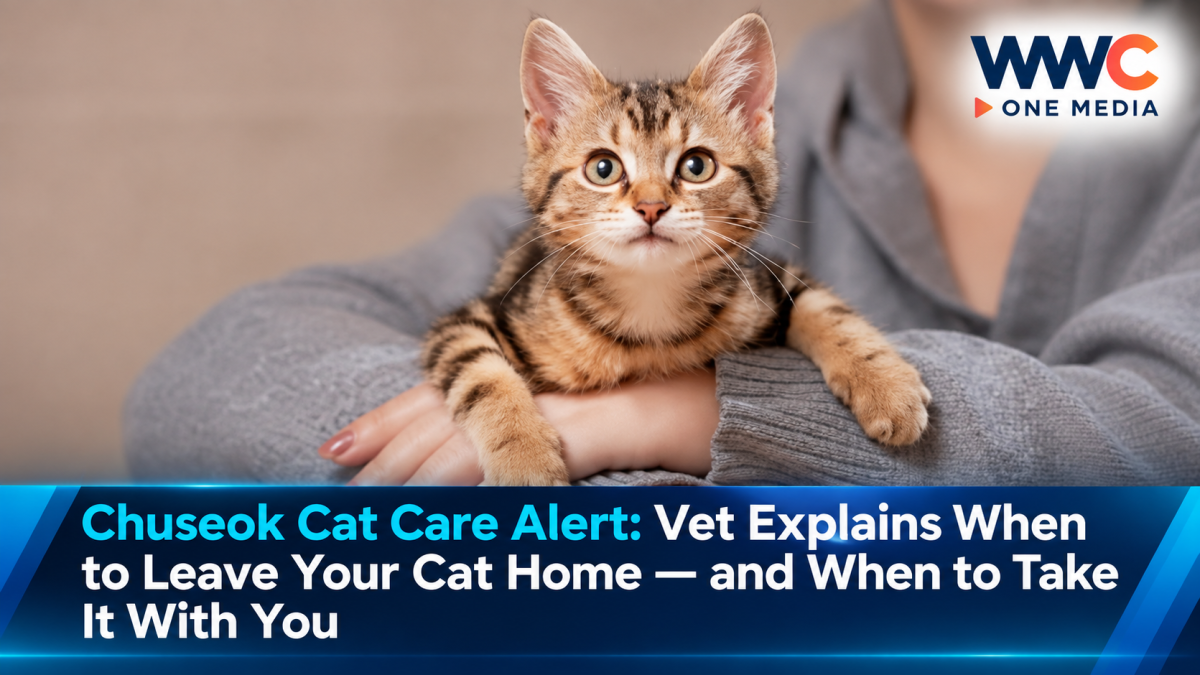
As South Korea prepares for the Chuseok holiday, cat owners face a familiar question: Should their pets stay at home or travel with the family?
Veterinary advice suggests there is no single answer for every cat. While cats generally feel safer in familiar surroundings, the length of time they will be left alone, their age, health and temperament should all be considered before owners make a holiday plan.
The issue is particularly important this year because the Chuseok break runs from Sept. 24 to Sept. 27, creating a concentrated period of family travel and visits across South Korea.
Cats Usually Prefer Their Familiar Environment
Unlike many dogs, cats can become stressed when suddenly moved to an unfamiliar environment.
Their home contains familiar smells, hiding places and routines, which can make staying at home less disruptive than traveling to another household.
However, that does not mean owners should simply leave a cat alone for the entire holiday.
The veterinarian interviewed by the Korea Times advised that even a healthy adult cat should not be left alone for more than about 24 hours. Younger kittens generally require an even shorter period without human care.
For a six-month-old kitten facing an absence of roughly 36 to 37 hours, the veterinarian recommended arranging someone to visit, considering travel with the owner if the kitten handles journeys well, or using a reputable boarding facility.
A Young Kitten Requires Extra Attention
Age can change the equation.
Young cats are naturally curious and energetic, which can increase the possibility of accidents when nobody is around.
For owners leaving a kitten at home, the recommendation is to arrange a pet sitter, home-care service or trusted person familiar with cats to check on the animal.
Boarding at a veterinary clinic or appropriate pet facility can also be considered when home visits or travel are not practical. Holiday boarding spaces can fill quickly, so advance planning is important.
Cat-Proof the Home Before Leaving
One of the biggest concerns is not simply whether a cat has enough food.
Owners should check the home for hazards before leaving, particularly if a kitten will be alone.
Veterinary guidance highlighted potentially dangerous items such as thread, string, hair ties, fishing line and plastic bags, as well as unsecured electrical cords. Windows and screens should also be checked, while balconies and laundry areas should be secured.
Food and water also require planning.
An automatic feeder can help dispense dry food, while multiple water bowls provide backup if one is accidentally knocked over. Wet food should not simply be left out for extended periods.
Litter boxes should be cleaned before departure. The guidance recommends one litter box per cat, plus one extra, to give cats sufficient access during the owner’s absence.
What If You Take Your Cat to the Family Home?
Traveling with a cat can work, but preparation is essential.
A secure carrier should be introduced before the journey so the cat becomes familiar with it. The veterinarian recommended a top-opening carrier and using positive associations, such as treats, to make the carrier feel safer.
Owners should also bring the cat’s normal food, bowls and familiar litter rather than suddenly changing its routine in an unfamiliar environment.
A portable litter box can be useful, particularly because some cats may resist using unfamiliar litter.
Once at the destination, the cat should ideally have a quiet room of its own containing its carrier, litter box, food, water and a place to hide. Giving the animal time to settle can reduce unnecessary stress.
The Journey Itself Can Be Stressful
Not every cat is suited to travel.
Some cats become anxious during transportation, while others are curious and adapt more easily. Owners should consider their individual pet’s behavior rather than assuming that all cats will respond the same way.
The veterinary guidance also emphasizes escape prevention during travel. Owners should avoid opening the carrier in uncontrolled public areas and keep identification information and a recent photograph available in case the animal becomes lost.
For cats that become anxious during travel, any medication should only be used under veterinary guidance, particularly after appropriate discussion with the animal’s veterinarian.
Older and Medically Vulnerable Cats Need More Planning
Certain cats should not simply be left alone during a holiday absence.
The veterinary advice specifically highlighted elderly cats, cats requiring daily medication and male cats with a history of urinary obstruction as animals that need additional consideration and monitoring.
Owners should also consider arranging more frequent checks if their pet has an existing health concern or a history of problems that could worsen without timely attention.
Holiday Visitors Can Stress Cats Too
Leaving home isn’t the only situation that can create problems.
A house full of relatives and unfamiliar visitors can also be stressful for a cat. A quiet, secure room can give the animal somewhere to retreat when the household becomes busy.
Family members should be told not to chase a hiding cat, force interaction, pick it up unnecessarily or feed it human food.
Extra attention should also be paid to the front door because increased traffic during the holiday can create opportunities for an animal to escape.
Korea’s Growing Pet-Friendly Holiday Culture
The question comes as pet ownership increasingly influences how South Koreans plan holidays.
Recent Korean reporting has highlighted the expansion of pet-friendly travel, with some families choosing destinations and accommodations specifically because they can bring their animals. A 2025 Korea Times report, citing government data, said 28.6% of Korean households had pets, illustrating the growing role of companion animals in household life.
This year’s Chuseok travel patterns also show strong interest in shorter domestic trips and nearby destinations, according to Trip.com data reported by Korea JoongAng Daily.
For cat owners, however, the holiday decision ultimately comes down to the individual animal.
The key question isn’t simply “home or travel?” — it’s whether the cat can remain safe, comfortable and properly monitored throughout the owner’s absence.
With Chuseok travel beginning, making that decision before leaving could prevent an otherwise festive family holiday from becoming an emergency.
WWC ONE MEDIA G,A