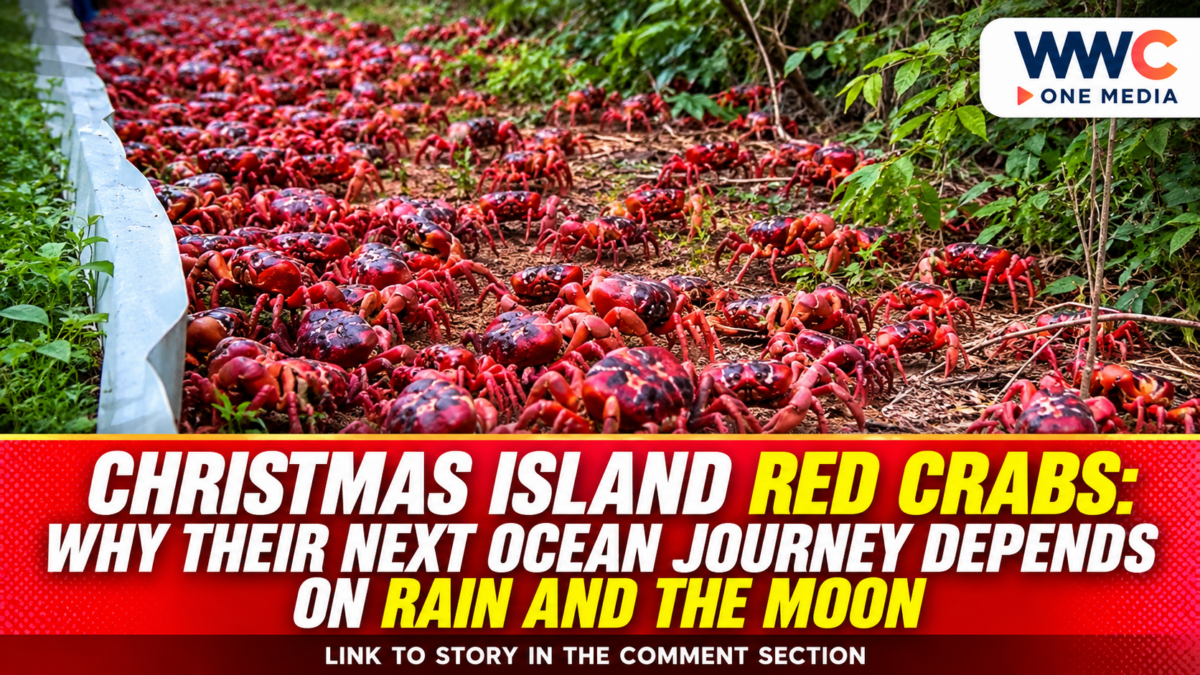
Christmas Island’s famous red crabs are entering another seasonal breeding period, with a possible spawning window listed for Dec. 5–6, 2026. The Christmas Island red crabs do not follow a fixed calendar alone: their journey from rainforest to coast depends on the first substantial wet-season rain, lunar timing and the tides. Christmas Island+1
The date is a forecast, not confirmation that mass spawning will happen on those exact days. The island’s tourism authority says migration usually begins around four to five weeks before a predicted spawning date, provided suitable rain arrives. As of Nov. 19, no current Parks Australia field announcement confirming the full 2026 migration was located. Christmas Island
The annual movement is more than a wildlife spectacle. The crabs help maintain the island’s rainforest, while their breeding cycle also feeds marine life offshore. Their journey brings a practical challenge: roads, vehicles and invasive species can threaten animals moving between the forest and the sea.
The next red crab migration window depends on the weather
Christmas Island’s published 2026 schedule lists possible spawning dates of Nov. 4–6, Dec. 5–6 and Jan. 2–3, 2027. The November dates have passed, leaving the December and January windows as the next dates on the published forecast. Christmas Island
The timetable also warns that spawning may occur a day either side of the listed dates. The migration itself is triggered by suitable rainfall, which can arrive at different times from one wet season to another.
This explains why a predicted date should not be treated as a guaranteed wildlife event. If rain arrives early, crabs may move more slowly towards the coast. If it comes close to the preferred spawning period, the journey can become faster. If conditions arrive too late, some crabs may remain in their burrows and take part in a later cycle. Christmas Island
The moon also plays a role. The crabs release their eggs before dawn around a receding high tide during the last quarter of the lunar cycle. Rainfall starts the movement, while lunar and tidal conditions help determine when the eggs enter the ocean. Christmas Island
Why millions of crabs leave the rainforest
Christmas Island is home to more than 100 million red crabs, with most living in its moist rainforest. They are also found on coastal terraces and in other habitats across the island. Christmas Island
The crabs spend much of the year in burrows or rock crevices, where they can conserve moisture. When the breeding season approaches, males lead the movement towards lower coastal terraces. Females follow, and mating takes place in or near burrows dug by the males. Christmas Island
After mating, males begin returning inland. Females remain in moist burrows while their eggs develop, then move towards the shoreline to release them into the sea. A female can carry up to 100,000 eggs, according to the island’s migration guide. Christmas Island
The eggs hatch after entering seawater. The larvae spend more than four weeks developing in the ocean before the survivors return towards shore as tiny crabs. The young animals then begin their own journey inland, eventually settling in forest habitat. Christmas Island
The cycle connects the island’s land and marine environments. It also provides food for marine animals: fish, manta rays and whale sharks consume crab larvae in the surrounding waters. Most larvae do not survive to become young crabs, making successful returns an important part of maintaining the population. Christmas Island
The crabs are important to rainforest health
The red crab’s ecological role does not begin and end with breeding. Its regular feeding helps shape the forest floor.
The crabs consume fallen leaves, fruit, flowers and seedlings. They also turn over soil and contribute nutrients through their droppings, helping maintain the structure and condition of the rainforest. Christmas Island+1
Australia’s government describes the annual mass movement as a significant natural feature of Christmas Island. The island’s biodiversity includes a range of land crabs and seabirds, while its central plateau supports dense rainforest. infrastructure.gov.au
This makes the red crab population important beyond its visibility during migration season. Changes affecting the crabs can also affect the wider ecosystem in which they live.
WWC has previously examined how conservation programmes use technology to monitor and protect wildlife in its report on environmental groups using artificial intelligence for conservation. The Christmas Island example highlights another side of conservation: protecting a species during a predictable but weather-dependent mass movement.
Road crossings and invasive ants remain conservation challenges
A migration involving millions of animals inevitably intersects with human infrastructure. Roads can become dangerous crossing points, particularly when large numbers of crabs move between forest areas and the coast.
Parks Australia has described measures that include temporary roadside barriers, traffic diversions, road closures and purpose-built crossings. Underpasses and overpasses help guide crabs away from vehicles, while the island’s crab bridges allow them to cross certain roads above traffic. Parks Australia+1
Invasive yellow crazy ants are another concern. Parks Australia says the ants attack red crabs and can kill them, disrupting the island’s ecological processes.
A September 2024 Parks Australia update described the use of an uncrewed helicopter to target yellow crazy ant supercolonies. The operation covered 76 hectares of dense rainforest, following an earlier 2023 operation that targeted more than 56 hectares. Parks Australia
The agency also reported that red crab numbers had increased from 50 million to more than 100 million over five years by January 2024, attributing the improvement in part to conservation work against the invasive ants. That figure is an agency-reported population estimate, not a new count conducted for the 2026 season. Parks Australia
The wider conservation challenge has parallels elsewhere in the region. WWC has reported on a community-based Indonesian wildlife project that rewards residents for documenting animals, as well as new funding approaches for African wildlife protection. The methods differ, but each illustrates how conservation depends on sustained management, local participation and resources.
What happens next
The next possible spawning period on the published Christmas Island calendar is Dec. 5–6, followed by Jan. 2–3, 2027. Both remain weather-dependent forecasts rather than confirmed events. Christmas Island
Visitors planning to see the migration should monitor local notices and follow instructions from national park staff. The island’s tourism information identifies Drumsite, Flying Fish Cove, Ethel Beach and Greta Beach as places where migration and spawning may be observed. It also warns that road sections can close at short notice to protect the crabs. Christmas Island
For conservation teams, the priority is to keep migration routes passable while reducing vehicle deaths and limiting the effects of invasive species. The spectacle may attract visitors, but its lasting importance lies in the role these animals play in the island’s natural systems.
The next few weeks will show whether rainfall and lunar conditions align with the forecast. Until an official field update confirms the movement, the December dates should be treated as a possible window—not a promise.
Frequently asked questions
When do Christmas Island’s red crabs migrate?
The migration generally begins with the first substantial wet-season rain, usually around October or November, although it can start later. The exact timing depends on rainfall, the moon and tides. Christmas Island
When is the next possible red crab spawning date in 2026?
The island’s published calendar lists Dec. 5–6, 2026, as the next possible spawning window after the Nov. 4–6 dates. The schedule allows for a possible shift of a day either side. Christmas Island
How many red crabs live on Christmas Island?
The island’s tourism information says the population exceeds 100 million. Parks Australia reported in January 2024 that the estimated population had increased from 50 million to more than 100 million over five years. Christmas Island+1
Why do red crabs migrate to the sea?
They migrate to mate and reproduce. Females eventually release their eggs into the ocean, where the larvae develop before surviving young crabs return to shore and move inland. Christmas Island
How are the crabs protected during migration?
Measures include road closures, traffic diversions, temporary barriers, underpasses and overpasses. Parks Australia and the local community also work to control invasive yellow crazy ants.