
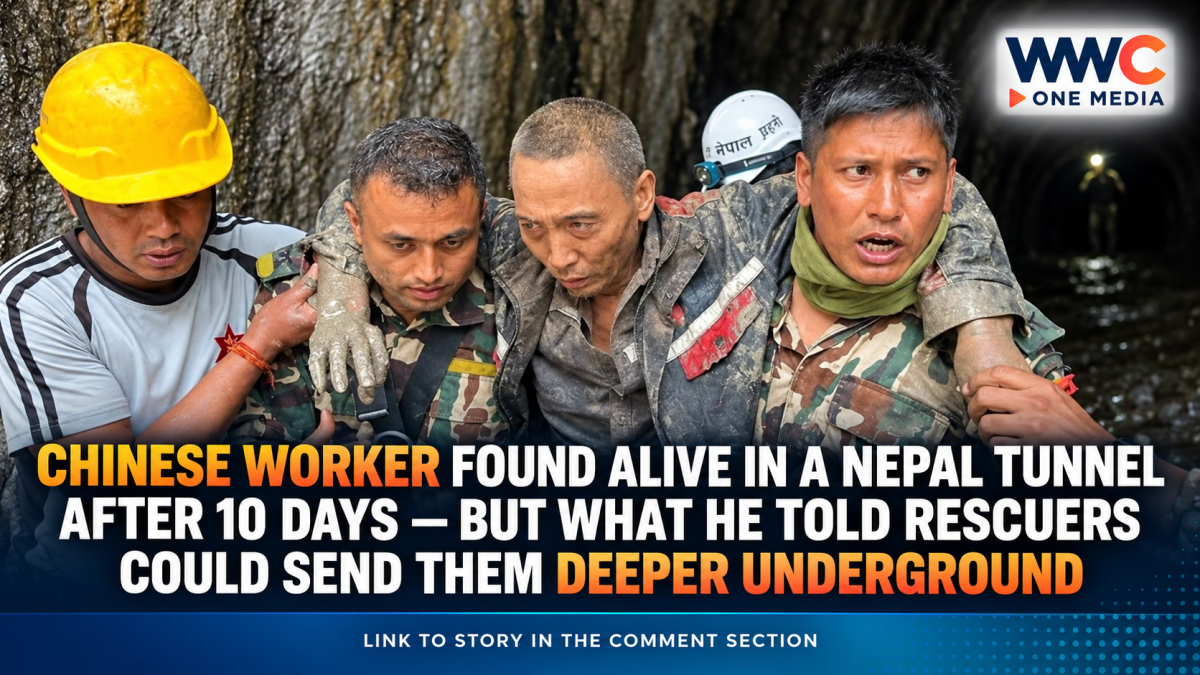
Chinese Worker Found Alive in Nepal Tunnel 10 Days After Catastrophic Flood — But Hundreds May Still Be Trapped Underground
Chinese national Lu Haitao was pulled alive Saturday from inside a 225-meter tunnel at the Upper Trishuli-1 Hydropower Project in Rasuwa district, according to Nepal’s military and government authorities. The Japan Times, carrying the breaking report, described him as the third worker rescued alive from hydropower tunnels since the Aug. 26 catastrophe.
Reuters reported that Lu emerged with no visible major injuries and stable vital signs, although he showed signs of mild hypothermia. Nepal Army footage showed an exhausted and disoriented Lu receiving medical attention aboard a helicopter before being flown to an army hospital.
That alone would make the rescue extraordinary.
But what rescuers discovered — and what Lu reportedly told them afterward — could make it even more consequential.
He saw the rescuers’ lights before they could hear him
Associated Press, citing Chinese state broadcaster CCTV, reported that Lu had repeatedly shouted when he saw rescue lights inside the tunnel, only for teams to pass without hearing him.
When rescuers finally reached him, Lu said he could hardly believe the light in front of him was real. He was later reported in stable condition.
His survival is all the more remarkable because authorities believe enormous numbers of workers were caught inside or around Nepal’s damaged hydropower infrastructure when the Aug. 26 flood struck.
AP reports that roughly 900 workers remain missing across 12 hydropower projects, with around 500 believed to be inside tunnels. Teams from Nepal and several foreign countries are now concentrating heavily on those underground sites.
Reuters similarly said authorities believe about 900 people may have been trapped in tunnels connected with hydropower projects along the Trishuli river system.
Lu therefore represents much more than one successful rescue.
He is evidence that people can survive underground far longer than rescue teams originally dared to assume.
Two Nepali workers had survived nine days in another tunnel
The breakthrough did not come out of nowhere.
Just one day earlier, rescuers pulled Sanjay Sah and Kabir Maharjan alive from a tunnel at the Upper Trishuli 3A Hydropower Station after they had spent nine days trapped underground.
Sah, a mechanical foreman, told rescuers that he had remained behind in a control room to help other workers escape when news of the disaster reached the plant. He later said he had been in contact with several other people deeper inside the tunnel, raising hopes that additional survivors could still be found.
The two men were taken to an army hospital in Kathmandu. Reuters reported their vital signs were stable, although Maharjan was unable to move his arms and legs at the time of the initial hospital assessment.
Then, less than 24 hours later, came Lu.
South Korean specialists helped bring him out
The rescue also had an international dimension.
Nepal’s army said Lu was reached by a joint team involving Nepali military personnel and South Korean disaster experts. AP, Korea Times and Yonhap all confirmed South Korean participation in the operation.
For South Korea, the location carries particular significance.
Yonhap reported that nine South Koreans — six employees of Doosan Enerbility and three from Korea South-East Power — disappeared while working at the same Upper Trishuli-1 hydropower construction site.
That makes Lu’s survival especially important for the families of the missing Korean workers.
Yonhap reported that rescuers found the Chinese worker in the same project area where the nine Koreans had been employed, prompting renewed attention to continuing searches there.
South Korean Foreign Minister Cho Hyun also arrived in Nepal on Sept. 5 for talks on search operations and longer-term reconstruction assistance, while planning to meet families of the missing Koreans and members of Seoul’s disaster relief team.
Then Lu gave rescuers another reason to keep searching
According to subsequent Yonhap reporting, Lu told South Korea’s Korea Disaster Relief Team that another person had been near him inside the tunnel, although he could not confirm whether that individual was still alive.
The team said additional searches would continue.
That statement is likely to intensify efforts in a disaster zone where every surviving witness can potentially help rescuers narrow down where others were positioned before tunnels filled with water, mud and debris.
It also changes the psychology of the operation.
After 10 days, every hour normally pushes a rescue mission closer toward recovery rather than survival.
Lu’s appearance has complicated that assumption.
A second survivor emerged from the mud the same day
The tunnel was not the only place rescuers found life Saturday.
Nepal’s army also rescued Chandika Kumari Shrestha from her flood-damaged home in Betrawati, Nuwakot district.
Reuters images showed her coated in mud inside a confined, flooded structure while rescuers provided water and worked to free her. She was later evacuated for treatment.
AP reported that rescuers found the woman buried inside the damaged house before pulling her out wrapped in a blanket and airlifting her toward Kathmandu.
Al Jazeera identified her as 64 years old and reported that the two rescues — Lu from the tunnel and Shrestha from her home — renewed hope across devastated communities.
The scale of the disaster remains staggering
The rescues came against one of Nepal’s worst natural disasters in years.
Nepal’s Ministry of Foreign Affairs said in its official Sept. 5 situation update that 1,344 bodies had been recovered, around 5,000 people remained missing, including approximately 600 foreign nationals from 35 countries, and 13,098 people had been rescued since the disaster began.
Reuters separately reported 4,887 people still missing in Nepal as of its latest disaster-authority tally, including 583 foreign nationals. The small differences among published totals reflect rapidly changing casualty and missing-person lists as people are located and bodies identified.
On the Chinese side of the border, Tibet authorities had reported 31 deaths and 531 missing, according to Reuters, including hundreds of foreign nationals.
Nepal’s government has also begun DNA identification efforts for victims whose remains cannot be identified visually, asking close relatives of missing people to provide biological samples.
What actually caused the disaster?
The flooding struck on Aug. 26 after a massive collapse involving glacier ice and rock in the high Himalayas sent water, mud and debris racing through river valleys along the Nepal-China border.
Reuters has described the disaster as resulting from a glacier collapse on the upper reaches of the river, while AP says the floods were likely caused by such a collapse and notes that scientists are still examining the precise chain of events.
That distinction matters.
Scientists told AP it is too early to attribute this individual disaster directly to climate change. But researchers say warming across the Hindu Kush Himalaya is increasing the likelihood of cascading hazards involving melting ice, rockfalls, landslides, temporary river blockages and sudden floods.
The region contains the greatest concentration of ice outside the polar regions, and rivers originating there ultimately support nearly two billion people.
Nepal’s hydropower boom is now part of the disaster story
The flood has also exposed a vulnerability in Nepal’s growing reliance on hydropower.
Tunnels that were designed to channel huge volumes of water through mountain infrastructure became some of the most difficult rescue environments imaginable once mud, rock, water and debris cut off access.
Reuters reported that engineers around the world have even been helping rescue teams through a specialized WhatsApp group, using tunnel plans and technical expertise to identify locations where trapped workers might have found survivable pockets.
The disaster wiped out roughly 10% of Nepal’s power-generation capacity, according to Reuters reporting on the rescue operation.
Earlier estimates from Nepal’s disaster authority put damage to property, housing and infrastructure at at least 387.5 billion Nepalese rupees, about $2.56 billion, with around 20,000 homes expected to require rebuilding.
From a farmer in Henan to a tunnel in Nepal
Lu’s personal story adds another dimension to the rescue.
His sister told Chinese media, as reported by AP, that the 49-year-old came from Henan province, had previously worked as a farmer and carpenter and traveled to Nepal in February for work.
He has a wife and son. His family had spent days waiting for news after communication disappeared following the flood.
His sister said she finally knew he had survived when she saw his photograph in news coverage.
For thousands of other families, that moment has not yet arrived.
Walls in Nuwakot have been covered with photographs of missing workers, according to Reuters. Relatives continue to wait near rescue bases, hoping that the next person carried from a tunnel will be someone they recognize.
And that is why the rescue of one exhausted man from 225 meters underground has changed the mood of an operation confronting overwhelming loss.
Ten days after the flood, Lu Haitao was still alive.
Two Nepali workers had survived nine days underground before him.
A woman survived for 10 days amid the wreckage of her home.
Hundreds of hydropower workers remain missing.
The arithmetic is still devastating — but rescuers now have evidence that time alone does not mean every tunnel has gone silent.
WWC ONE MEDIA M.J.E



Leave a Reply