
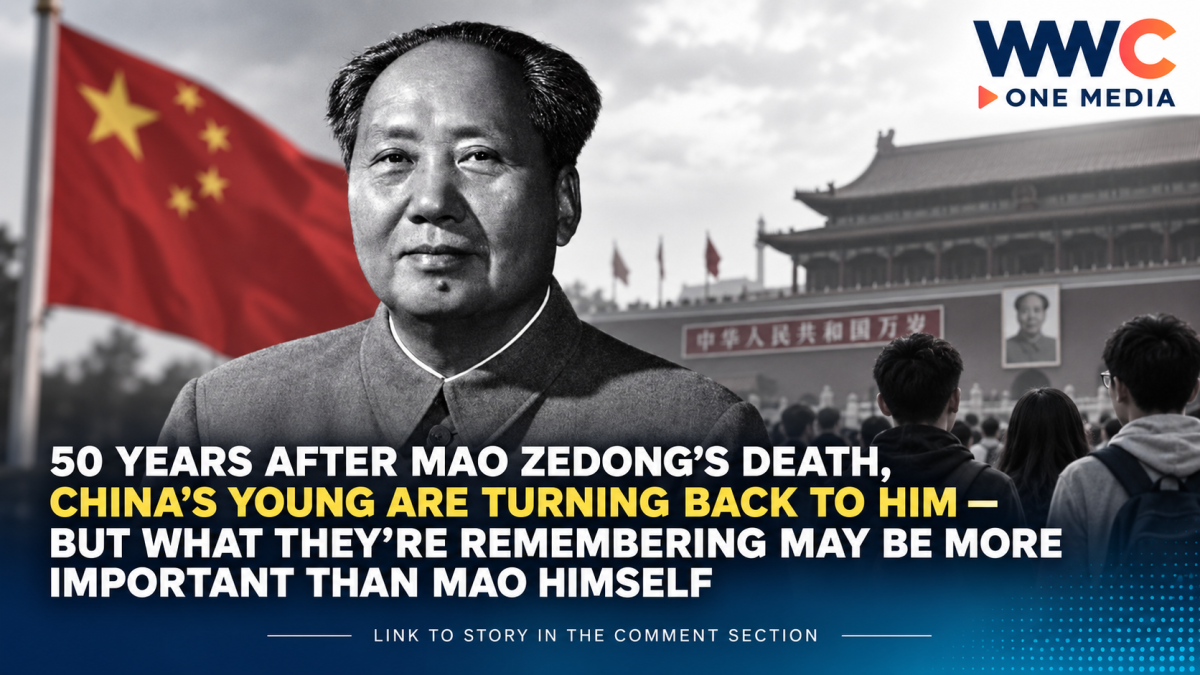
NANJIE, China — Half a century after Mao Zedong’s death, China has transformed almost beyond recognition. Skyscrapers have replaced communes, private enterprise drives much of the economy, and Chinese companies compete at the frontiers of electric vehicles, artificial intelligence and advanced manufacturing.
Yet Mao is far from disappearing.
As China approaches the 50th anniversary of Mao’s death on September 9, 2026, the revolutionary leader’s image is again resonating with some young Chinese — including people born decades after the upheavals, political campaigns and economic disasters that defined parts of his rule.
The revival is not necessarily a demand to restore Maoist China. Instead, it appears increasingly tied to dissatisfaction with the pressures of modern life: difficult employment prospects, long working hours, expensive housing, fierce competition and perceptions of widening social inequality.
Mao Never Really Left China
In Nanjie, a village in central Henan province frequently described as one of China’s last remaining Maoist communities, Mao’s presence is impossible to miss.
A towering statue of the former Communist Party chairman dominates the village’s “East is Red” Square. Socialist slogans and Mao portraits decorate buildings, while cooperative ownership remains a central feature of the local economy.
Unlike most of China, which embraced market-oriented reforms following Mao’s death, Nanjie continues to operate around collective principles. Local enterprises help finance benefits including housing for residents.
For some younger residents, Mao represents something increasingly difficult to find in modern Chinese society: a belief in collective purpose.
AFP interviewed 22-year-old university student Xie Kaiyue, who said she continued to revere Mao despite being born decades after his death. Her comments reflected a romantic idea of an earlier society that was supposedly less materialistic and more united by common goals.
That sentiment is appearing elsewhere.
In Shijiazhuang, young students interviewed near another enormous Mao statue described him as a historic figure who founded “New China.” Meanwhile, Maoist memorabilia — portraits, quotations, badges, ceramics and copies of the famous “Little Red Book” — remains commercially popular in several places associated with revolutionary history.
Why Mao Appeals to Some of China’s Gen Z
The timing of the renewed fascination matters.
China’s economy today bears little resemblance to Mao’s centrally planned system, but younger Chinese are entering adulthood during a considerably more difficult economic environment than the rapid-growth decades experienced by their parents.
China’s unemployment rate for urban workers aged 16 to 24, excluding students, climbed to 17.9% in July 2026, according to official data reported by Reuters. That was the highest level in 11 months and a sharp rise from 14.9% in June.
China’s broader economy has also slowed. Second-quarter GDP growth eased to 4.3% year on year, its weakest pace in more than three years, even as manufacturing indicators showed some improvement in August. Weak domestic demand and continuing pressure in the property sector remain major concerns.
Against that backdrop, Mao’s rhetoric about workers, equality and resistance to privilege can acquire new meaning for people who never experienced Maoism themselves.
This trend is not entirely new. Reporting as far back as 2021 documented Mao gaining a following among younger Chinese frustrated by demanding work schedules and declining expectations of upward mobility.
But the 2026 anniversary has sharpened the debate.
A series of videos discussing the 2017 Chinese film Youth went viral on Bilibili, a platform especially popular among younger users. According to AFP, the videos portrayed the Cultural Revolution through a dramatically more sympathetic lens and blamed capitalist elites for destroying Mao’s project.
They accumulated more than 35 million views in less than a week before being removed.
That episode exposes the contradiction at the center of today’s Mao revival: younger Chinese can be intensely familiar with Mao’s symbolism while having much less exposure to open public discussion of the darkest episodes of his rule.
The History Behind the Nostalgia Is Far More Complicated
Mao led the Communist victory over the Nationalists and proclaimed the People’s Republic of China in 1949, permanently reshaping the country and the geopolitical balance of Asia.
His supporters credit his leadership with reunifying much of China after decades of war and instability, expanding basic education and health systems, accelerating industrialization and establishing the political foundations of the modern Chinese state.
But Mao’s record also includes catastrophic political and economic campaigns.
The Great Leap Forward, launched in the late 1950s, contributed to a famine in which millions died. Estimates of the death toll differ substantially; AFP notes that Chinese authorities have cited around 15 million deaths while historians have produced estimates reaching roughly 20 million to more than 40 million.
Then came the Cultural Revolution, launched by Mao in 1966.
Schools closed. Intellectuals, officials and alleged political enemies were publicly denounced and persecuted. Red Guard factions battled opponents while China’s educational, cultural and political institutions suffered enormous disruption.
Even China’s Communist Party eventually issued a devastating assessment.
Its landmark 1981 historical resolution declared the Cultural Revolution responsible for “the most severe setback and the heaviest losses” experienced by the party, state and people since the People’s Republic was founded, and said Mao bore chief responsibility for its fundamental errors.
Four decades later, the party’s 2021 historical resolution under Xi Jinping maintained that judgment, describing the Cultural Revolution as 10 years of turmoil that produced some of the most serious losses and setbacks in the history of the People’s Republic.
So Beijing’s official position remains carefully balanced: Mao is celebrated as the revolutionary founder of modern China, while some of his later policies are officially acknowledged as grave mistakes.
Mao’s Image Survives — While Debate About His Era Remains Restricted
That balance is visible throughout modern China.
Mao’s portrait still dominates the entrance to Beijing’s Tiananmen Square. His face appears on Chinese banknotes. His embalmed body remains inside the Chairman Mao Memorial Hall.
At the same time, detailed public discussion of the Great Leap Forward and Cultural Revolution remains politically sensitive.
AFP reported that material about the Cultural Revolution had even been physically removed from signage at one museum it visited. Scholars quoted in the report said public interpretations of Mao-era history are expected to remain inside the Communist Party’s established historical framework.
President Xi Jinping has repeatedly warned against what the party calls “historical nihilism” — interpretations of Communist Party history viewed as undermining its official narrative and political legitimacy.
That creates an unusual environment: Mao is omnipresent as a national symbol, but unrestricted examination of everything that happened under Mao remains difficult.
And that can make nostalgia easier.
Remembering an Ideal — or Forgetting the Cost?
Kerry Brown, director of the Lau China Institute at King’s College London and an author on China, told AFP that some people now imagine the Cultural Revolution as a period driven by idealism rather than relentless competition for money.
His assessment of that romanticized interpretation was unequivocal: it bears little resemblance to the historical reality.
Yet another scholar, Mobo Gao of the University of Adelaide, points to why Mao’s appeal cannot simply be dismissed as ignorance.
For many Chinese, Mao remains inseparable from the creation of the People’s Republic itself. Whatever his later failures, he was the leader under whom the Communist Party defeated its rivals and established the state that eventually became today’s global power.
That is what makes Mao’s legacy so politically powerful 50 years later.
He simultaneously represents revolution and repression, national independence and political upheaval, egalitarianism and economic catastrophe.
For older Chinese, those contradictions can be personal memories.
For a growing number of younger Chinese, however, Mao belongs to history — which means his image can be reinterpreted to answer the problems of the present.
And as economic anxiety increases, the most revealing question may no longer be why China still remembers Mao.
It may be which version of Mao the next generation chooses to remember.
WWC ONE MEDIA M.J.E




Leave a Reply