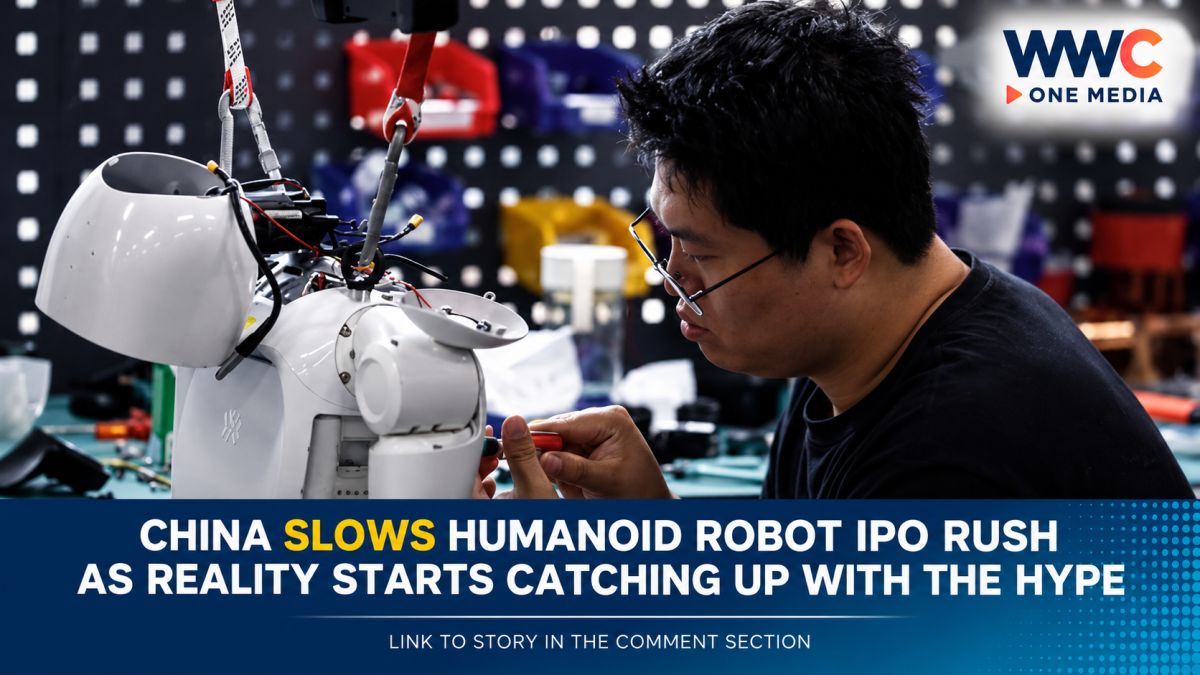
China is putting the brakes on a rush of humanoid robotics companies seeking stock-market listings, as regulators scrutinise soaring valuations and question whether some of the industry’s revenue reflects genuine commercial demand.
The move follows a surge of investor enthusiasm around humanoid robots, which Beijing has identified as a strategic technology sector. But the recent market performance of major robotics companies has raised questions about whether excitement over the technology has moved faster than actual sales and deployment.
The most closely watched example is Unitree Robotics. Its shares surged more than fivefold when the company made its Shanghai debut in August, before falling sharply. By Sept. 21, the stock had dropped about 55% from its peak, highlighting the volatility surrounding one of China’s hottest technology themes.
Chinese regulators have reportedly used informal “window guidance” to raise the bar for humanoid-robot companies seeking IPO approval. One source said listings in the sector had effectively been frozen for now, while another described the situation as a sector-specific slowdown rather than a formal ban.
The China Securities Regulatory Commission had not publicly announced a blanket prohibition on humanoid-robot IPOs.
At least half a dozen Chinese humanoid robotics companies are preparing to go public, including Deep Robotics, X Square Robot and AGIBOT. The regulatory scrutiny could force companies seeking listings to demonstrate stronger recurring revenue, sustainable business models and clearer evidence of commercial demand.
One major concern is the quality of revenue being reported by some robotics companies. According to people familiar with the sector, local-government-backed robot data-collection centres and joint ventures have generated significant business for some firms, with local governments sometimes providing most of the initial investment.
Such projects can help generate orders and support company valuations, but regulators are questioning whether they represent sustainable demand from independent customers rather than business heavily supported by government funding.
An investor source cited in the reporting estimated that valuations at some companies could fall by 60% to 70% if revenue associated with data-collection centres were excluded. That estimate is an industry assessment, not an official regulatory valuation.
The scrutiny comes as China’s humanoid-robot industry tries to turn impressive demonstrations into practical commercial applications. Robots capable of walking, running, dancing and performing complex movements have attracted enormous public attention, but actual sales remain relatively small compared with the expectations surrounding the sector.
Around 7,000 humanoid robots were sold globally in 2025, according to figures compiled by the International Federation of Robotics, with most sales going to research and industrial or professional applications.
China’s regulatory caution therefore does not necessarily signal a retreat from humanoid robotics. Instead, investors and industry executives say the focus is shifting toward deployment numbers, real orders, useful applications and whether companies can generate sustainable revenue.
That shift could mark a new phase for China’s robotics industry. The technology remains a major national priority, but companies may now face a tougher question before reaching the stock market: can the robots move from spectacular demonstrations to businesses that customers are actually willing to pay for?