
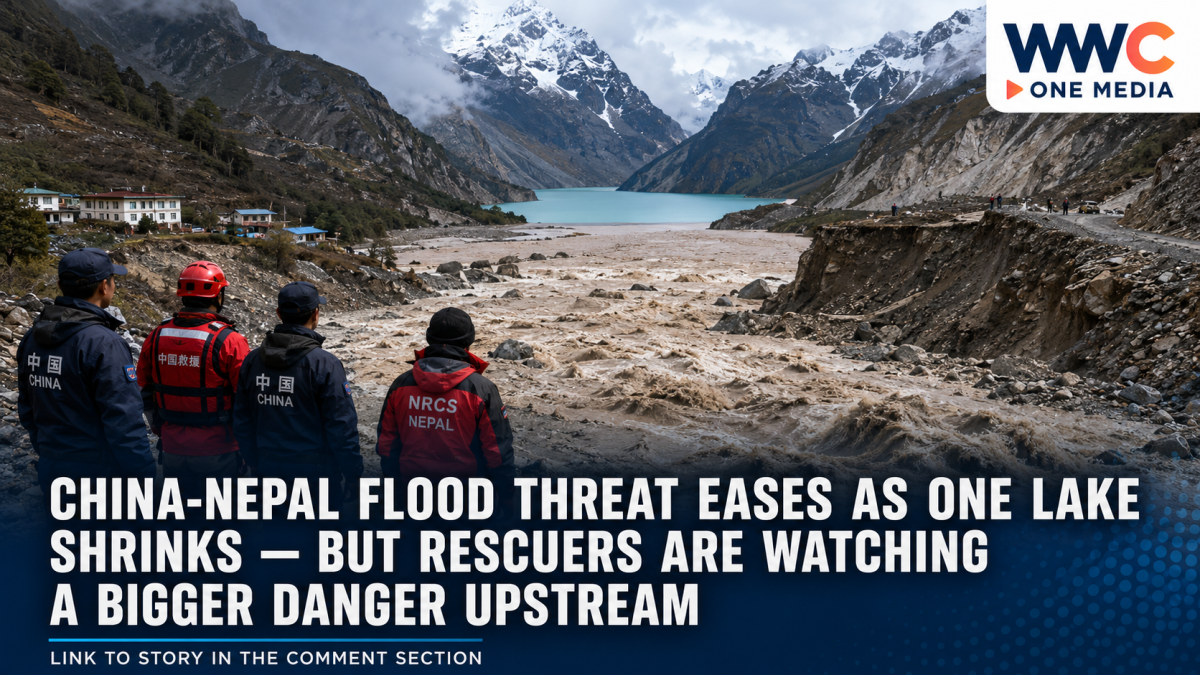
BEIJING/KATHMANDU — A feared second disaster along the China-Nepal border appears less imminent after satellite images showed a newly formed mountain lake gradually shrinking — but officials are warning that the Himalayan emergency is far from over.
Chinese authorities said Saturday that the surface area of a debris-dammed lake near the disaster zone had fallen to about 99,000 square metres, roughly 21,000 square metres smaller than it appeared in satellite images taken Thursday. The reduction suggests water has been slowly escaping rather than building relentlessly behind the natural barrier.
That is encouraging news for rescue crews and communities downstream. But it is not an all-clear.
Authorities have identified another, larger body of water near the base of the glacier collapse. A Chinese geological disaster expert estimated its surface area at more than 120,000 square metres, while its depth — and therefore the amount of water it may contain — remained unknown. Nepalese disaster officials have warned that flood danger will persist until both bodies of water have safely drained.
That unresolved threat is hanging over one of the deadliest Himalayan disasters in recent memory.
One lake is shrinking. The disaster around it is still growing.
The catastrophe began on August 26, when a massive collapse involving glacial ice, rock and debris unleashed a high-speed torrent into the mountain river system near the Nepal-Tibet frontier.
The resulting surge tore through valleys, settlements and critical infrastructure, including the strategically important Gyirong border crossing, which connects China’s Tibet region with Nepal. Buildings, bridges, roads and power facilities were swept away or buried under enormous quantities of mud, rock and debris.
The event was so violent that early reports initially raised questions about whether an earthquake had triggered the disaster. Scientists have instead focused on the collapse of rock and glacial ice high in the mountains as the source of the destructive chain reaction. Researchers are still investigating exactly what destabilised the slope, and it would be premature to attribute the individual event solely to climate change.
What followed was a classic cascading mountain disaster: the initial collapse sent ice, rock, sediment and water downstream, while huge quantities of displaced debris blocked waterways and created new temporary lakes.
Those lakes then became hazards of their own.
Overflow already forced rescuers to retreat
The danger became clear Friday when one of the newly formed lakes began overflowing.
Its reservoir had earlier grown beyond 2.5 million cubic metres, according to Chinese engineering assessments. Fears that the natural debris barrier could fail forced Chinese rescue personnel and vehicles to withdraw temporarily to safer ground, while Nepal also paused rescue work in threatened areas.
Operations resumed after authorities determined that the immediate risk had become manageable.
By Saturday, satellite observations provided the first significant indication that the lake was losing water rather than continuing to expand. Chinese engineers have deployed reconnaissance drones, portable satellite equipment and surveillance cameras to keep watching the unstable terrain.
But even a shrinking lake does not eliminate the possibility of another dangerous surge.
Associated Press reported that the lake lies about 10 kilometres from Gyirong Port and roughly 1,000 metres higher in elevation, demonstrating why even a partial failure could pose serious risks downstream. Experts also warned that continued glacial melt, loose debris and unstable slopes could create new blockages or water accumulations.
Nearly 3,000 people still missing
Meanwhile, the human toll continues to rise.
According to Reuters’ latest figures on Saturday, at least 626 people had been confirmed dead in Nepal and seven in China’s Tibet region, while nearly 3,000 remained missing — about 2,426 in Nepal and at least 558 in Tibet’s Gyirong County. At least 540 of those missing were foreigners, many of them pilgrims travelling toward the sacred Mount Kailash region.
CNA likewise reported Saturday that the overall number of missing had climbed to nearly 3,000 as emergency teams struggled through mud and destroyed transport routes to reach isolated areas. Because the situation is changing rapidly, casualty numbers from different news organisations may vary depending on when official figures were collected.
On the Chinese side, authorities said nearly 500 villagers and construction workers had been evacuated along with all 555 tourists known to have been in the immediate disaster area.
Poor weather remains another major obstacle. Heavy rain and fog forced Nepal to temporarily suspend some search-and-rescue operations Saturday, while destroyed bridges, roads and communications have made reaching remote communities extraordinarily difficult.
Nepal now faces a multibillion-dollar recovery
The disaster is rapidly becoming an economic crisis as well.
Nepal’s Finance Minister Swarnim Wagle told Reuters that preliminary estimates suggest rebuilding could cost between US$4 billion and US$5 billion, an amount approaching one-tenth of the country’s economy.
Floodwaters damaged towns, transportation links and major hydropower facilities that account for more than 12 per cent of Nepal’s electricity-generating capacity, potentially adding power and economic pressures long after the emergency phase ends.
Nepal has also requested specialised international assistance — particularly expertise for rescuing people trapped in tunnels, reopening transport and communications, identifying bodies, DNA testing and managing remains — rather than simply asking foreign countries to take over its general rescue operations.
India has already delivered about 60 tonnes of relief supplies and offered technical teams, medical assistance and prefabricated bridges.
The United Nations has also mobilised humanitarian agencies and emergency funding. UN officials said food, shelter, healthcare, clean water and sanitation needs are increasing as damaged roads continue to complicate aid deliveries.
Why the shrinking lake does not mean the danger is over
The latest satellite images therefore offer something badly needed in the disaster zone: a sign that one immediate threat may be receding.
But the Himalayan landscape left behind by the glacier collapse remains unstable.
One lake is draining. Another larger body of water is still being assessed. Rivers are carrying enormous amounts of sediment and debris. Roads and bridges have disappeared. Rain continues to fall. And rescue workers are entering terrain where new landslides, avalanches and sudden floods remain possible.
Scientists at the International Centre for Integrated Mountain Development have stressed that understanding the full sequence and causes of the August 26 disaster will take time. The episode also reinforces a broader challenge facing the Hindu Kush Himalaya: hazards in high mountain areas can rapidly cross national borders and turn an isolated collapse into a regional emergency.
For Nepal and China, then, Saturday’s shrinking lake is genuinely good news.
But with another lake still looming above the disaster zone and thousands of people still missing, the most dangerous assumption would be that the crisis has already passed.




Leave a Reply