
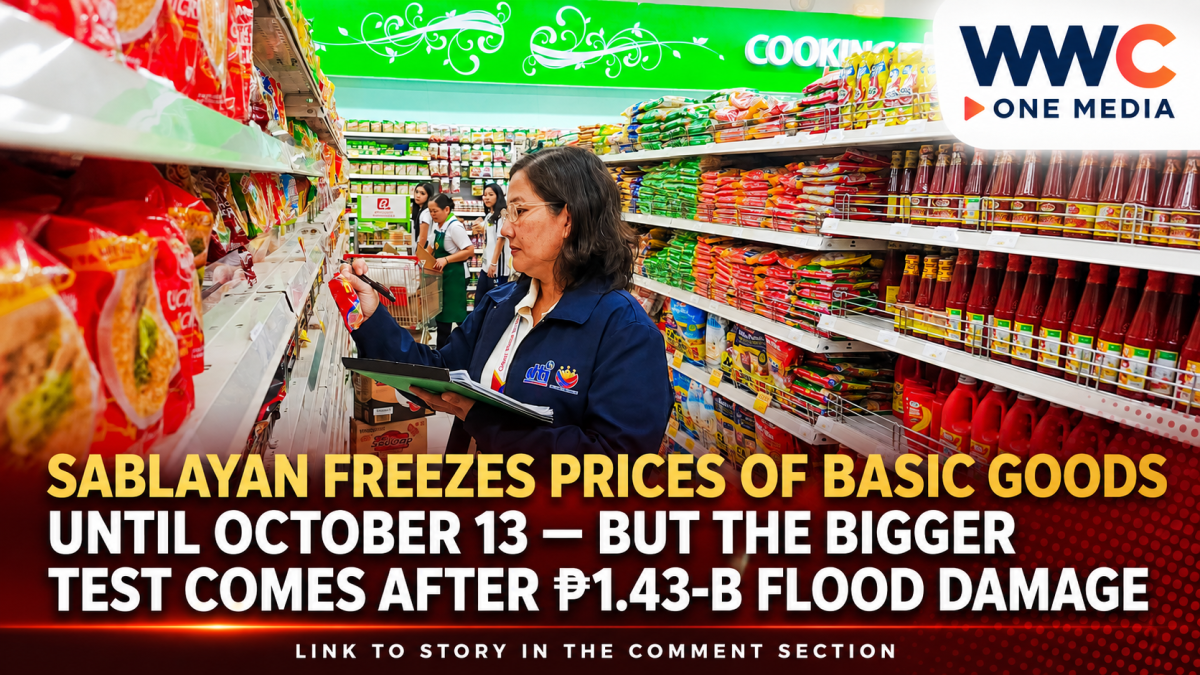
SABLAYAN, Occidental Mindoro — Families struggling to recover from weeks of destructive rains and flooding are getting at least one layer of protection at the checkout counter: prices of key basic necessities in Sablayan have been frozen for 60 days as the municipality deals with massive storm damage estimated at more than ₱1.4 billion.
The Department of Trade and Industry said the automatic price freeze took effect on August 14, 2026, following Sablayan’s declaration of a state of calamity after Tropical Cyclones Luis and Maymay and the enhanced southwest monsoon battered the municipality.
Unless lifted earlier by the President, the price control will remain in force until October 13, 2026, according to DTI Occidental Mindoro and Sangguniang Bayan Resolution No. 2026-GGM457.
For residents whose homes, farms, livelihoods and local infrastructure have already been hit by flooding, the measure is designed to prevent another crisis: sudden increases in the prices of necessities when demand is high and supplies may be under pressure.
What prices are frozen?
The freeze covers basic necessities under DTI jurisdiction, including canned fish and other covered marine products, processed milk such as evaporated, condensed and powdered milk, coffee, laundry or detergent soap, candles, bread including pandesal and loaf bread, iodized salt, locally manufactured instant noodles and bottled water.
Under the Price Act, the applicable prices are generally the prevailing prices before the state of calamity took effect. That means the measure is not necessarily a government-mandated discount or sale. Instead, retailers are prohibited from increasing covered prices beyond the legally applicable frozen levels during the control period.
DTI MIMAROPA said monitoring of both prices and supplies will be intensified to make sure retailers comply and essential goods remain available.
Sablayan is not alone. The Inquirer reported that nearby Paluan is also subject to an automatic price freeze after it separately declared a state of calamity due to the continuing effects of the southwest monsoon.
The price freeze comes after enormous damage
The consumer protection order becomes more significant when viewed against the scale of destruction in Sablayan.
According to the municipality’s final damage assessment reported by the Philippine Daily Inquirer, successive weather disturbances caused approximately ₱1.433 billion in losses.
About ₱1.38 billion of that amount involved infrastructure, including flood-control structures, roads, bridges and seawalls. Agricultural losses were estimated at another ₱53.33 million, affecting roughly 1,586 hectares planted with rice, corn and high-value crops.
All 22 barangays in Sablayan were affected.
A separate PIA report, citing the Sablayan Municipal Disaster Risk Reduction and Management Office, said approximately 67,200 residents — about 66 percent of the municipality’s population — were affected by the weather disturbances that struck between August 5 and August 20.
The affected population included farmers, fisherfolk, vendors, laborers and internally displaced residents — precisely the groups most vulnerable to sharp increases in food and household expenses after a disaster.
Flood-control damage adds another problem
The disaster has also raised questions about damaged flood-control infrastructure.
The Inquirer reported that Sablayan officials sought help from the Department of Public Works and Highways to repair and strengthen damaged riverbank protection and flood-control facilities following the storms.
Flood-control structures in Barangays Tagumpay, Claudio Salgado and Victoria alone accounted for more than ₱1.17 billion in reported damage.
GMA News separately reported that communities and rice fields in Barangay Tagumpay were flooded after a flood-control structure collapsed amid continuous heavy rains, adding another layer to concerns over the municipality’s ability to withstand future extreme weather.
The wider province has also been repeatedly battered by the habagat. ABS-CBN reported continuing widespread flooding across Occidental Mindoro, while provincial authorities were preparing for further monsoon rains even as communities were still recovering.
What happens if businesses break the price freeze?
Republic Act No. 7581, or the Price Act, as amended by Republic Act No. 10623, provides for automatic price controls on basic necessities in areas placed under a state of calamity. The controls generally remain effective for the duration of the condition that triggered them, but not longer than 60 days, unless lifted earlier.
A retailer found violating a price ceiling may face one to 10 years’ imprisonment, a fine ranging from ₱5,000 to ₱1 million, or both, depending on the court’s decision.
Separate and heavier penalties may apply to illegal price manipulation such as hoarding, profiteering or participation in cartels.
Consumers who encounter suspected overpricing may contact the DTI through its 1-DTI (1-384) customer hotline. DTI has also urged consumers in calamity-affected areas to report suspected violations as monitoring teams inspect retailers and check supplies.
More than a price issue
For Sablayan, however, keeping grocery prices stable may be only one part of a much larger recovery.
The storms have damaged infrastructure, agricultural land, homes and livelihoods at the same time that thousands of households are trying to rebuild. With roads, flood-control systems and farms sustaining extensive losses, keeping essential goods affordable — and ensuring those goods actually reach stores — could become just as important as enforcing the prices printed on shelves.
And with the southwest monsoon continuing to threaten parts of Occidental Mindoro, the real test may not simply be whether businesses follow the price freeze until October 13.
It may be whether Sablayan’s supply lines, farms and damaged infrastructure can recover fast enough to keep necessities available once that protection eventually disappears.




Leave a Reply