
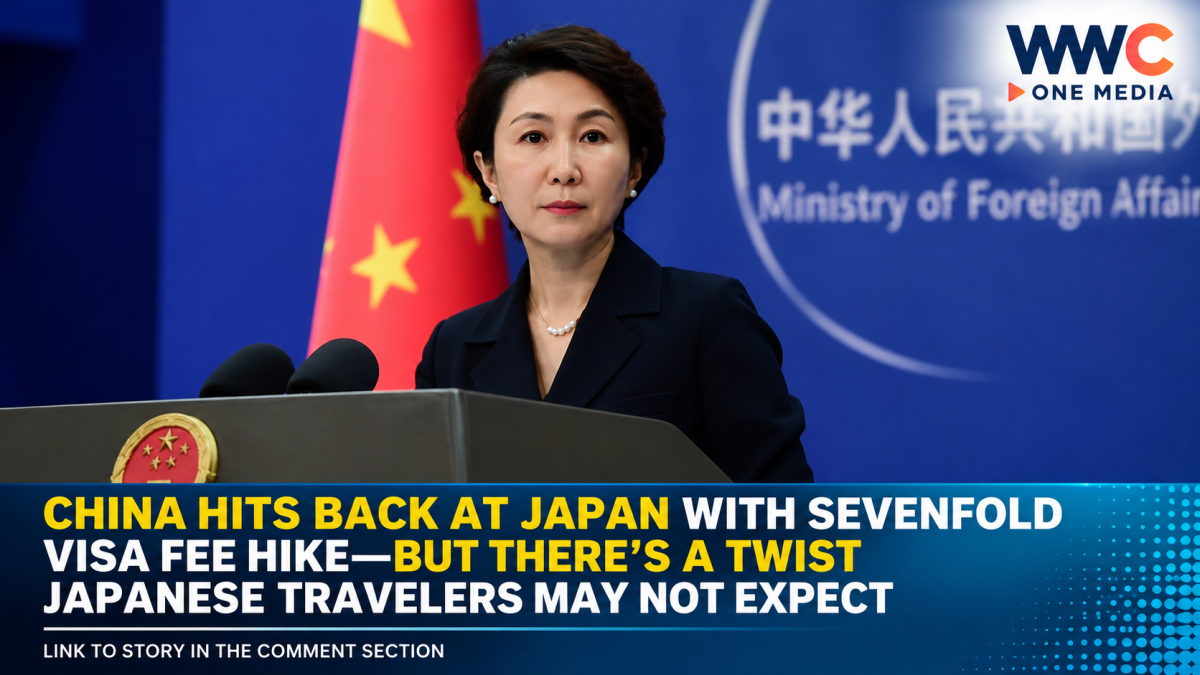
BEIJING/TOKYO — China is sharply increasing visa fees for Japanese nationals, with some charges set to jump about sevenfold beginning September 14, in what Beijing says is a reciprocal response to Japan’s own major increase in visa fees earlier this year.
The Chinese Embassy in Tokyo announced that the new fees will apply to applications submitted from Monday, September 14, adding another layer of friction to an already complicated relationship between the two Asian economic powers.
Chinese Foreign Ministry spokesperson Mao Ning said Friday that the adjustment was made according to the principle of reciprocity, linking Beijing’s decision directly to Japan’s July increase in visa charges.
How much will China’s visa fees increase?
Under the new schedule, a single-entry Chinese visa for Japanese nationals will rise from ¥2,250 to ¥16,750.
A double-entry visa will increase from ¥3,750 to ¥25,100. Other multiple-entry categories will also become substantially more expensive, with the one-year multiple-entry fee rising to ¥50,250, according to reports citing the new fee schedule.
Applicants also face a separate service charge from the Chinese visa application center.
The Chinese Visa Application Service Center in Tokyo has separately published an official notice confirming that the revised charges will take effect for Japanese applicants on September 14, 2026, citing reciprocity as the basis for the change.
Why is China doing this?
The timing is significant.
Japan raised its visa fees for foreign nationals on July 1, marking the first major revision to the country’s visa charges since 1978. The standard single-entry fee increased from ¥3,000 to ¥15,000, while multiple-entry visas rose from ¥6,000 to ¥30,000.
Japanese officials said the increase reflected inflation, exchange-rate changes and the need to bring visa charges closer to those imposed by other developed countries.
But the policy has drawn particular attention because Chinese travelers are among the major groups directly affected. Chinese nationals generally need visas for short-term travel to Japan, unlike travelers from many other major tourism markets that benefit from visa exemptions.
Beijing’s response therefore creates a clear tit-for-tat dynamic: Tokyo raised visa costs, and Beijing is now raising its own charges for Japanese applicants.
But Japanese tourists can still enter China visa-free
There is an important catch.
The new Chinese visa fees will not immediately affect most Japanese tourists making short visits to China, because Beijing restored a short-term visa-waiver policy for Japanese citizens in November 2024.
Under the current arrangement, eligible Japanese visitors can enter China without a visa for stays of up to 30 days for purposes including tourism.
That means the immediate impact of the fee increase will fall primarily on Japanese nationals who still need visas—for example, travelers whose purpose or length of stay falls outside the visa-free arrangement.
The exemption is currently scheduled to run through December 31, 2026, meaning the longer-term significance of the new fees could become much greater if the visa waiver is not extended.
China-Japan tourism is already under pressure
The visa dispute comes as travel between the two countries is already being affected by deteriorating relations.
Mainland Chinese arrivals to Japan fell 56.1% year-on-year in July, according to Japan National Tourism Organization figures reported by The Japan Times. It was the eighth consecutive month of decline in Chinese arrivals.
The broader number of foreign visitors to Japan, however, remained strong. Japan recorded about 3.44 million foreign arrivals in July, a record for the month, even as Chinese arrivals plunged.
This divergence underscores how heavily the China-Japan relationship can influence particular segments of Japan’s tourism industry.
A new pressure point in an already difficult relationship
The latest visa decision comes amid broader disagreements between Beijing and Tokyo involving trade, security and regional politics.
At the same time, both governments have incentives to keep economic and people-to-people ties from deteriorating too far.
Japan remains one of China’s major economic partners, while Chinese tourists have historically been an important source of visitors for Japan.
The latest visa-fee exchange therefore risks becoming more than a simple administrative adjustment. It adds another economic and diplomatic pressure point at a time when both governments are already managing increasingly sensitive bilateral relations.
For travelers, the immediate message is relatively straightforward: Japanese tourists eligible for China’s current 30-day visa waiver can still travel without paying the new visa fee.
But for those who require a Chinese visa, the price of entry is about to become dramatically higher.
And if the current visa-free arrangement expires at the end of the year without an extension, the sevenfold fee increase could suddenly become a much bigger issue for Japanese travelers—and another sign of how costly the China-Japan relationship is becoming.




Leave a Reply