
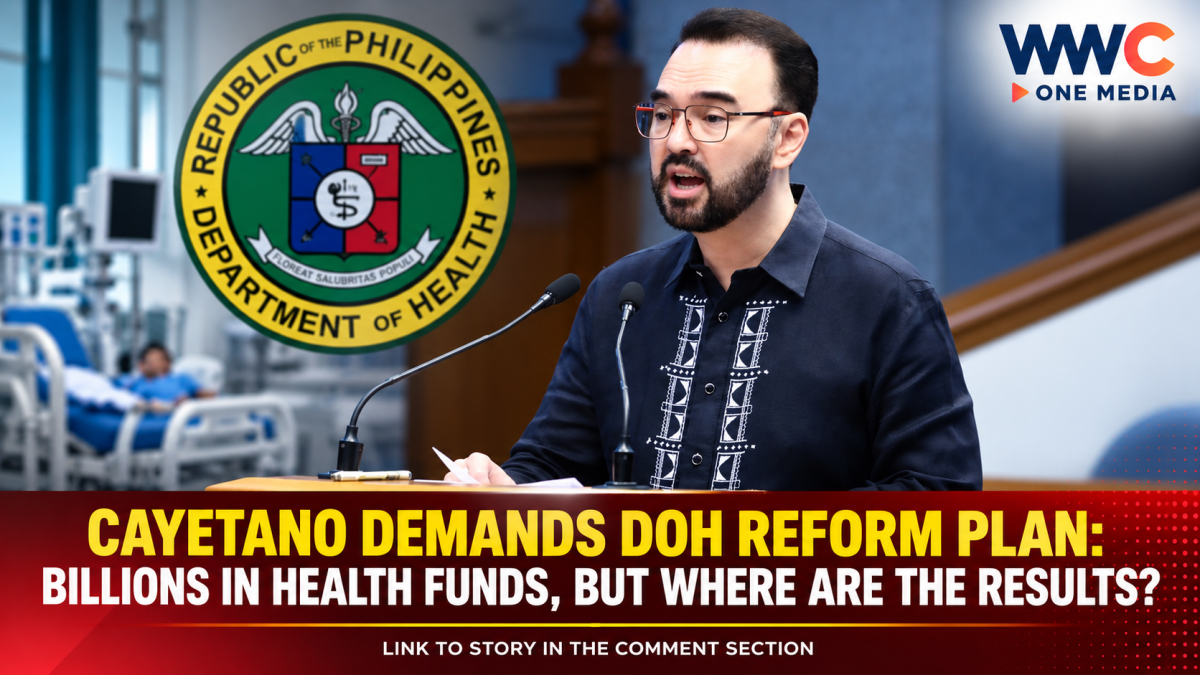
MANILA, Philippines — Senate Minority Leader Alan Peter Cayetano is pressing the Department of Health (DOH) to present a clear reform agenda, specific targets and measurable results as lawmakers scrutinize the government’s proposed 2027 health budget.
Cayetano submitted questions to Senate Finance Committee Chairman JV Ejercito on September 4, asking the DOH under Health Secretary Dr. Edwin Mercado to explain how public health spending will translate into better and more accessible healthcare for Filipinos.
The questions came as the Senate began deliberating the DOH’s proposed 2027 budget, putting the agency’s priorities, spending plans and performance under closer congressional scrutiny.
“The national health budget is more than an accounting of appropriations.”
For Cayetano, the issue is not simply how much money the government will allocate to healthcare, but whether those funds will produce tangible improvements in people’s lives.
He wants the DOH to identify the reforms it intends to pursue, the outcomes it expects to achieve and the mechanisms that will hold the agency accountable for delivering them.
Stunting becomes a major test
One of Cayetano’s strongest concerns is the country’s continuing problem with child stunting.
He asked the DOH to explain why stunting prevalence has increased despite commitments made during previous budget deliberations and what the agency intends to do differently under the Philippine Plan of Action for Nutrition 2023–2028.
The senator is also seeking specific targets and measurable outcomes for government anti-stunting programs rather than broad commitments.
The concern is significant because stunting is associated with long-term consequences for physical and cognitive development, making early intervention particularly important.
Cayetano filed Senate Bill No. 416, the proposed Anti-Stunting Action Plan Council Act of 2025, which seeks to establish a high-level body to coordinate a nationwide, whole-of-government approach to preventing and reducing child stunting. The proposal emphasizes data-driven monitoring, targeted interventions and accountability.
The measure remains part of a broader legislative push to make anti-stunting programs more coordinated and targeted, with similar proposals also filed in the House.
Vaccine delays also back in the spotlight
Cayetano is also demanding a complete inventory and status report covering the procurement and delivery of vaccines from 2022 to the present.
The request follows his previous concerns about delayed vaccine deliveries, which he said need to be examined to determine whether government funds are being converted into timely health services.
The senator wants lawmakers to have enough information to determine whether procurement and delivery systems are working as intended before approving future allocations.
Primary healthcare gaps under scrutiny
Another major issue is access to primary healthcare, particularly in geographically isolated and disadvantaged areas.
Cayetano asked the DOH to submit a timetable for addressing gaps in facilities and services in underserved communities.
He also requested a report on the distribution and utilization of health infrastructure funds from 2022 to 2026, including allocations under the Health Facilities Enhancement Program (HFEP).
That issue has become especially important in the 2027 budget debate.
During House deliberations, Mercado said the DOH’s proposed HFEP allocation had been reduced substantially from the agency’s original request. Inquirer.net reported that the department initially proposed P29 billion for HFEP, but the National Expenditure Program provided about P14 billion.
Health budget faces competing demands
The DOH’s 2027 spending plan is already under pressure from competing healthcare needs.
GMA News reported that the department presented a proposed P358.8-billion 2027 budget, about 21 percent below its P448-billion appropriated budget for 2026. The agency said it also needs additional funding for PhilHealth, HFEP and hospital operations.
The House of Representatives separately reported that the National Expenditure Program included a combined P353.8-billion allocation for the DOH, with the proposed spending structured around five priorities: healthy schools, workplaces and communities; functional primary care; quality and efficient hospitals; digital transformation; and stronger institutions and the health workforce.
The differences in figures reflect different stages and components of the budget process, underscoring why congressional scrutiny of the agency’s numbers and priorities matters.
PhilHealth and hospitals need more funds
Mercado has identified PhilHealth, HFEP and DOH hospital operations among the areas where additional funding is being sought.
According to GMA News, the DOH requested additional funding of roughly P170 billion for PhilHealth, P15 billion for HFEP and P12 billion for hospital operations.
PhilHealth funding has likewise become a major point of discussion. The House reported that PhilHealth President and CEO Beverly Ho sought restoration of at least P170 billion from the insurer’s original proposal to help cover contributions for indirect contributors, including indigent Filipinos, senior citizens and persons with disabilities.
For Cayetano, however, additional funding must be matched by clear evidence that the money will produce better outcomes.
DOH also promises more health workers
The department is simultaneously planning to expand its healthcare workforce.
GMA News reported that DOH intends to deploy 24,381 health professionals nationwide in 2027, including doctors, nurses, radiologic technologists and medical technologists, as part of efforts to address manpower shortages, particularly in underserved areas.
The workforce plan gives added context to Cayetano’s call for a broader reform agenda: infrastructure, staffing, medicines, vaccines and primary care all need to work together if increased spending is to result in better health outcomes.
Digital medical assistance expands
The DOH is also pursuing digital reforms.
The Philippine News Agency reported that the department is expanding its electronic Medical Assistance to Indigent and Financially Incapacitated Patients system to local government hospitals after more than 32,000 patients were processed in about a month following its initial rollout in DOH hospitals.
The program is intended to reduce processing delays and make financial assistance more accessible to patients who need help paying for hospitalization and treatment.
For 2027, the DOH proposed P24.2 billion for the medical assistance program, according to PNA.
The bigger question: What will Filipinos actually get?
Cayetano’s questions point to a broader issue confronting the government as it prepares the 2027 national budget: Can increased or protected healthcare spending be directly connected to measurable improvements in public health?
The country already has a legal framework requiring evidence-informed health planning and monitoring.
The Universal Health Care Act calls for an integrated approach to healthcare, equitable access, evidence-informed policy and monitoring of health outcomes. It also requires the DOH to strengthen health systems research and publish health-related data to support policy and planning.
The DOH’s own National Objectives for Health 2023–2028 likewise identifies primary healthcare, community health, health workers, stronger institutions and quality services as key areas for improving the country’s health system.
That makes Cayetano’s demand for measurable outcomes particularly consequential.
The upcoming budget debate is therefore not only about how much the government will spend on healthcare. It is increasingly about whether agencies can demonstrate what Filipinos should expect in return — fewer delays, better access, stronger primary care, improved nutrition outcomes, adequate health workers and more efficient hospitals.
Cayetano said his questions are intended to strengthen the Senate’s budget review and help produce a 2027 health budget that is adequately funded, evidence-based and responsive to actual healthcare needs.
The next critical step is whether the DOH can provide concrete answers — and measurable targets — that lawmakers can use to judge whether the billions requested are delivering the results Filipinos need.
WWC ONE MEDIA J.M.S
Leave a Reply