
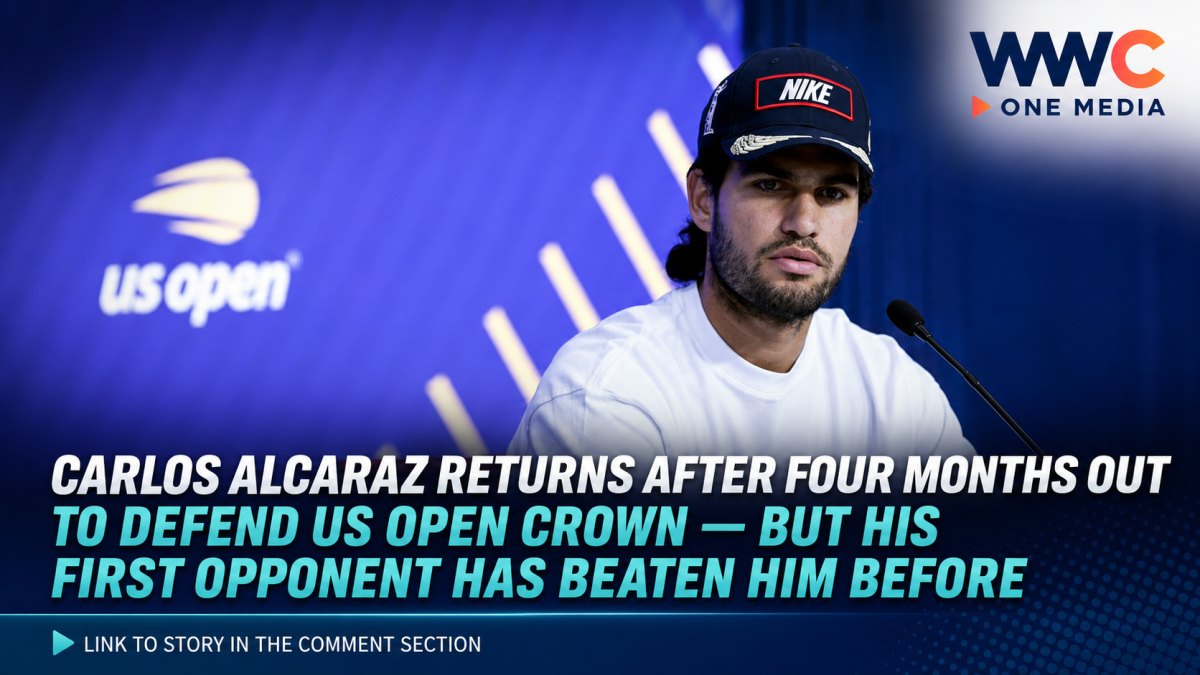
NEW YORK — Carlos Alcaraz is about to discover whether four months away from singles tennis has weakened his grip on the US Open — or simply given one of the sport’s most explosive champions time to reload.
The 23-year-old Spaniard returns to singles competition at Flushing Meadows on Monday, August 31, after a right wrist injury kept him out of action since April, forcing him to miss the French Open, Wimbledon and much of the North American hard-court season.
Yet despite the unusually long interruption, several of Alcaraz’s fellow professionals believe the defending champion remains one of the most dangerous players in the draw.
And history gives them plenty of reasons.
Alcaraz already owns seven Grand Slam singles titles, completed the career Grand Slam by winning the Australian Open earlier this year and has produced a remarkable 24–3 record at the US Open, where he captured championships in 2022 and 2025.
Now he is chasing an eighth major championship and a third US Open crown.
But this comeback is unlike almost anything Alcaraz has attempted before.
Four Months Without a Singles Match
Alcaraz’s last singles appearance came in Barcelona in April. After beating Otto Virtanen, the Spaniard withdrew because of the wrist problem and began a recovery process that eventually stretched across the heart of the tennis calendar.
He had initially hoped to return during the North American hard-court swing and was expected to compete in Cincinnati, where he was the defending champion. Instead, Alcaraz withdrew and gave himself additional time to recover.
That decision meant he arrived in New York without the normal sequence of tour-level singles matches players typically use to prepare for a Grand Slam.
Alcaraz said before the tournament that the decision to return was not automatic. He and his team subjected the wrist to long, intense practice sessions before deciding he was ready to compete.
His first competitive action came not in singles but in the revamped US Open mixed doubles competition, where he partnered returning American legend Serena Williams.
The celebrity pairing reached the quarter-finals before losing to Belinda Bencic and Flavio Cobolli, giving Alcaraz at least some exposure to match conditions and the Arthur Ashe Stadium atmosphere before his singles campaign.
Jessica Pegula: Alcaraz Can Find His Form Quickly
American star Jessica Pegula acknowledged that returning directly at a Grand Slam after such a lengthy absence is difficult, but she believes Alcaraz is uniquely equipped to handle it.
Pegula described him as a “special player” and argued that the best-of-five-set format in the men’s tournament may actually give him additional time to rediscover his rhythm during matches.
Her most important point was simple: if Alcaraz survives the opening rounds, his level could rise rapidly.
That view was echoed by American Tommy Paul, who noted that the precise effect of a long layoff depends heavily on the injury involved. Because Alcaraz’s problem affected his wrist rather than his legs, his movement may remain sharp even if his timing initially requires adjustment.
Taylor Fritz reached a similar conclusion. The American ninth seed said that once a player moves through the opening rounds, competitive rhythm and confidence can return surprisingly quickly.
That could make the first week particularly important for the defending champion.
Alcaraz’s First Test Is More Dangerous Than It Looks
Alcaraz begins against Russia’s Roman Safiullin, currently ranked No. 98 in the world.
On paper, the difference between the two players is enormous.
Alcaraz is a seven-time major champion. Safiullin has never reached that level of sustained success.
But there is one statistic that makes the opener considerably more interesting:
Their head-to-head record is tied 1–1.
Safiullin defeated Alcaraz on a hard court at the 2023 Paris Masters before the Spaniard later gained revenge on clay at the Paris Olympics.
For a healthy Alcaraz playing regularly, that history might be little more than trivia.
For a player contesting his first singles match since April, it becomes far more relevant.
Safiullin knows he can beat him.
And Alcaraz must establish almost immediately whether months of rehabilitation have affected one of the biggest weapons in his game: the ability to accelerate through the ball with his forehand and change direction at extraordinary speed.
The US Open Draw Has Suddenly Opened Up
Alcaraz’s return carries even greater significance because his biggest rival will not be standing across the net in New York.
World No. 1 Jannik Sinner withdrew from the US Open with a right knee injury after also missing Montreal and Cincinnati.
The Italian had produced a dominant 44–3 season before the injury and had won Wimbledon earlier this summer. His absence removes the player who lost to Alcaraz in last year’s US Open final and has shared much of the sport’s recent Grand Slam dominance with the Spaniard.
Alcaraz and Sinner have won 10 of the last 11 Grand Slam tournaments, with Alexander Zverev’s 2026 French Open victory the lone interruption.
Sinner’s withdrawal has elevated Zverev to the No. 1 seed in New York, while Alcaraz is seeded second despite currently sitting No. 3 in the ATP rankings.
Novak Djokovic, meanwhile, remains a major threat as he continues his pursuit of a record 25th Grand Slam singles championship.
American contenders including Ben Shelton, Taylor Fritz and Frances Tiafoe will also see opportunity in a tournament missing the world No. 1 and featuring a defending champion whose match fitness has yet to be tested.
Alcaraz Is Still the Player Nobody Wants to Face
There is an obvious contradiction surrounding Carlos Alcaraz at this US Open.
Nobody really knows what four months without singles competition will look like once a five-set match begins.
His timing could be rusty.
His wrist could be tested under pressure in ways practice cannot reproduce.
His body must suddenly adjust from rehabilitation and training to potentially playing seven demanding matches across two weeks.
But the other side of the equation is why his rivals remain reluctant to discount him.
Alcaraz has already won the US Open twice. He became the youngest man to complete the career Grand Slam when he won the Australian Open earlier this year. And despite being only 23, he has accumulated the type of major-tournament experience normally associated with players far deeper into their careers.
He also knows exactly how quickly a US Open campaign can gather momentum.
That may be why Pegula, Paul and Fritz all arrived at essentially the same conclusion: the dangerous moment for the rest of the field could come if Alcaraz survives his first few matches.
Because once Carlos Alcaraz starts feeling comfortable on Arthur Ashe Stadium again, four months of uncertainty could disappear very quickly.
And then the question may no longer be whether the defending champion can rediscover his game.
It may be whether anyone in New York can stop him.




Leave a Reply