
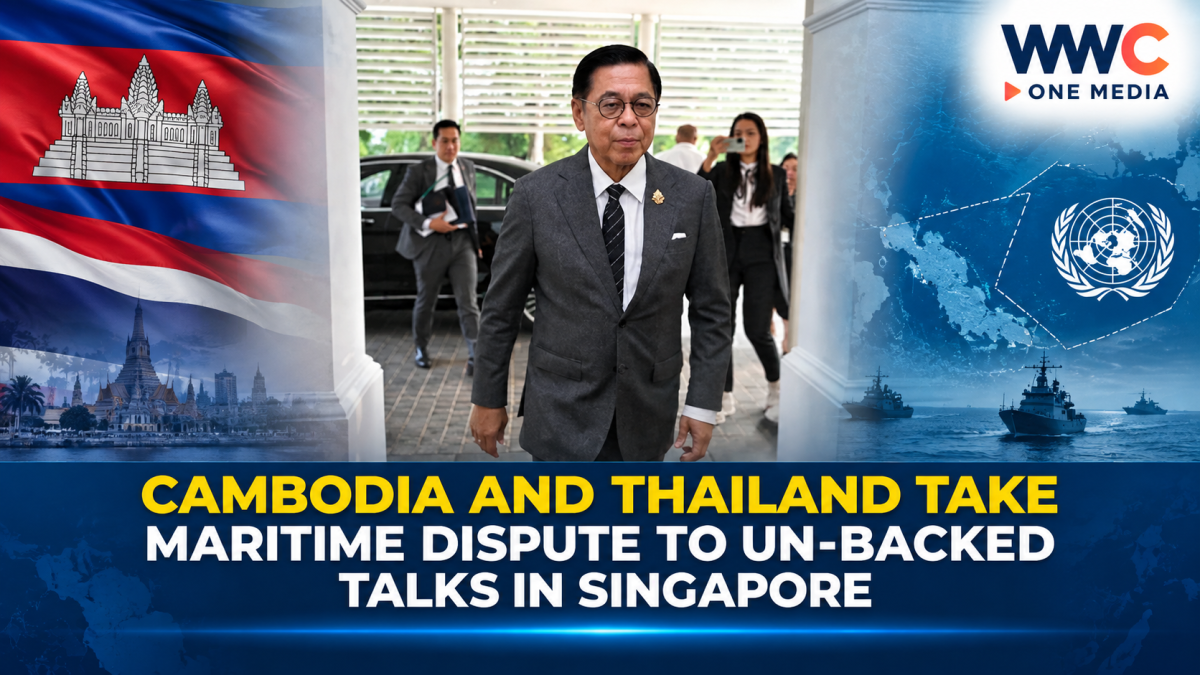
Cambodia and Thailand have begun a UN-backed conciliation process in Singapore to resolve a long-running dispute over their overlapping maritime claims in the Gulf of Thailand.
The first meeting of the compulsory conciliation process opened on Sept 15, bringing the two countries before an international panel as they seek a peaceful solution to a dispute involving a resource-rich stretch of sea.
The talks are being conducted under the United Nations Convention on the Law of the Sea, or UNCLOS, with a five-member commission assisting the negotiations.
Disputed Waters Cover Thousands of Square Kilometres
At the centre of the dispute is an area of roughly 27,000 square kilometres in the Gulf of Thailand.
The waters are believed to contain significant offshore oil and natural gas resources, making the unresolved maritime boundary issue economically important to both countries.
Cambodia and Thailand had previously sought to address the issue through a 2001 memorandum of understanding that provided a framework for negotiations and potential joint development of offshore resources.
However, progress under the agreement stalled for years.
Thailand terminated the 2001 agreement in May, prompting Cambodia to pursue the UNCLOS conciliation mechanism.
Cambodia Offers Two Possible Paths
Cambodian Foreign Minister Prak Sokhonn said Phnom Penh wants to reach a treaty with Thailand that would establish a single maritime boundary between the two countries.
As an alternative, Cambodia has indicated that it would consider an agreement allowing both countries to jointly develop and share resources in the disputed area.
The proposals reflect Cambodia’s attempt to keep negotiations focused on either a definitive maritime boundary or a practical arrangement for exploiting resources while the territorial disagreement remains unresolved.
Thailand Wants a Fresh Start
Thailand has argued that the previous bilateral framework failed to produce meaningful progress.
Thai Foreign Minister Sihasak Phuangketkeow said Bangkok now wants a fresh approach to negotiations after years of stalled discussions.
Thailand has also accused Cambodia of presenting itself as the victim in the broader dispute, underscoring how politically sensitive the maritime issue remains.
The two sides have nevertheless agreed to participate in the UN-backed process, giving them a new diplomatic channel at a time when relations remain fragile.
Maritime Dispute Follows Border Conflict
The maritime disagreement comes after relations between Cambodia and Thailand deteriorated sharply following deadly fighting along their land border in 2025.
The clashes caused deaths and mass displacement before a ceasefire was reached.
Although the border conflict and the maritime dispute are separate issues, the deterioration in bilateral relations has made negotiations over the Gulf of Thailand considerably more sensitive.
The maritime talks therefore carry significance beyond offshore resources, as any progress could help prevent another source of tension from worsening relations between the neighbouring countries.
Singapore Hosts a Delicate Negotiation
Singapore is hosting the conciliation meetings at the Permanent Court of Arbitration, providing a neutral setting for the two sides to present their positions.
The process is not the same as a court ruling that would automatically impose a settlement. Instead, the UNCLOS conciliation mechanism is intended to help the countries negotiate a mutually acceptable solution.
The current meetings are scheduled to continue through Wednesday.
Both governments have stressed the importance of resolving the dispute peacefully and through international legal mechanisms, even though major differences remain over how the maritime boundary should be settled.
Stakes Extend Beyond Oil and Gas
A settlement could eventually unlock offshore energy development in an area believed to hold valuable hydrocarbon resources.
For Cambodia, an agreement could provide greater clarity over its maritime boundaries and access to potential energy resources.
For Thailand, resolving the dispute could remove a longstanding obstacle to offshore development while reducing another source of tension with a close neighbour.
But the negotiations will likely be difficult.
The two countries must reconcile competing claims, domestic political pressures and the legacy of their recent border confrontation.
For now, the decision to bring the maritime dispute into a UN-backed conciliation process gives Cambodia and Thailand a new opportunity to negotiate rather than allowing another unresolved territorial issue to deepen their already strained relationship.



Leave a Reply