
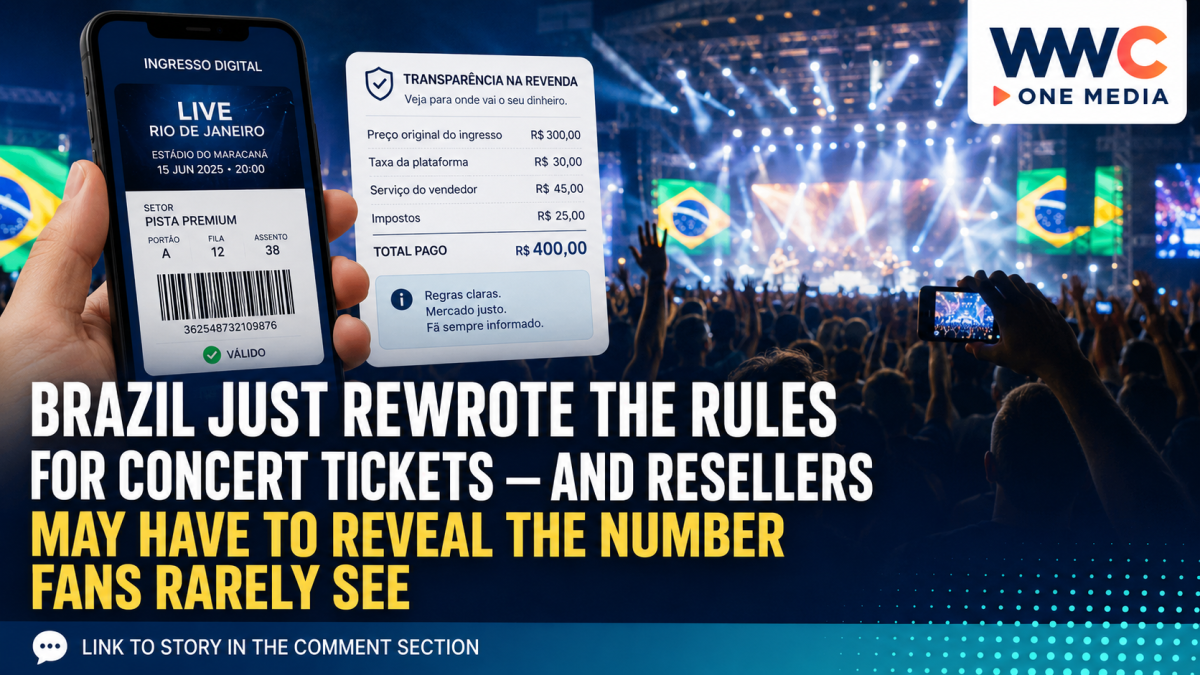
Brazil is taking aim at one of the biggest frustrations facing concertgoers worldwide: tickets that disappear in seconds, unexplained fees that appear at checkout and seats that quickly reappear on resale sites at sharply higher prices.
President Luiz Inácio Lula da Silva signed new regulations on August 31 governing the sale and resale of tickets for cultural and entertainment events, introducing tougher transparency requirements for ticketing companies and new measures designed to stop automated systems from buying tickets in bulk.
The changes go substantially further than simply banning ticket-buying bots.
Brazilian platforms will have to reveal prices and additional fees more clearly, provide consumers with more information while they wait in virtual queues, make ticket transfers available without an extra charge and disclose crucial information when tickets are offered for resale.
And in a separate decree signed at the same ceremony, Brazil is making another major change for large events: access to drinking water.
Bots and mass ticket buying are in the government’s crosshairs
At the center of the ticketing overhaul is what Brazilian authorities call “cambismo digital” — digital scalping in which tickets are acquired in large quantities, sometimes with automated software, and later resold.
Under the new rules, companies responsible for primary ticket sales must implement measures intended to prevent mass, abusive or speculative purchases, including purchases made through bots, software and scripts.
Reuters reported that the government did not specify a single numerical limit defining an abusive bulk purchase. Instead, ticket platforms will be responsible for putting systems in place to prevent automated or speculative buying.
The decree also calls for systems designed to prevent duplicated and counterfeit tickets while allowing consumers to verify ticket authenticity and trace transfers.
That could make the regulation particularly significant for blockbuster tours where demand can overwhelm ticketing systems within minutes.
The problem is hardly unique to Brazil. Ticketing companies around the world have faced mounting scrutiny over bots, scalping, high fees and resale practices. The disastrous 2022 US presale for Taylor Swift’s Eras Tour, for example, was overwhelmed by extraordinary demand that Ticketmaster said included fans, bots and scalpers, ultimately triggering political and consumer scrutiny in the United States.
Ticket buyers must see the real price earlier
Brazil’s new rules also attack another frequent consumer complaint: discovering the true cost of a ticket only after moving through several stages of checkout.
Ticket sellers and platforms will have to clearly display the total ticket price and break down additional charges throughout the purchase process.
Automatic addition of extra services or charges without the buyer’s prior knowledge and consent will be prohibited. Charges that are duplicated or that do not correspond to an identifiable service can also be treated as abusive.
For fans, that means the advertised price is supposed to become a much more reliable indication of what they will actually be asked to pay.
Even the dreaded virtual queue is changing
For major concerts, simply reaching the ticket page can be half the battle.
Brazil’s decree addresses that experience directly.
When platforms use virtual queues, consumers are expected to receive information including their position in line, an estimate of how many people are ahead of them and an approximate waiting time before reaching the purchase stage.
Once a customer reaches the payment stage, the selected ticket must also be reserved for a sufficient period to complete the transaction without its price changing during that window, according to UOL’s detailed account of the regulation.
Large-demand events may still use virtual queues, preregistration and limits on the number of tickets purchased by each consumer.
Resellers will have to reveal what the ticket originally cost
The secondary ticket market is getting its own transparency requirements.
When a ticket is listed on a resale platform, buyers must be told the ticket’s original price, the total resale price, how much has been added to the original amount and whether the seller is an individual or a business.
That last requirement could be one of the most consequential changes for consumers because it makes the resale markup visible before a purchase is completed.
Platforms will also be expected to identify patterns associated with habitual, professional or organized resale and remove listings connected to activities prohibited by the regulation. Detailed transaction records must be retained for at least two years so operations can be audited, according to UOL.
The rules arrive as Brazil’s National Consumer Secretariat, or Senacon, has already increased scrutiny of the secondary ticket market.
In July, Senacon opened an administrative proceeding against Viagogo and ordered the company to make it clearer to consumers that it operates as a resale platform rather than an official primary ticket seller. In August, authorities also opened proceedings involving FunBuyNet and Buyticket while examining issues including seller identification, ticket authenticity, fraud prevention and price transparency.
Fans will also gain stronger transfer and refund protections
Official platforms must allow ticket holders to transfer ownership of a ticket without being charged a transfer fee.
For online purchases, consumers must also have an accessible channel for exercising applicable cancellation or withdrawal rights under Brazil’s Consumer Protection Code.
If an event is cancelled, postponed or significantly changed, consumers are to be offered options that can include attending the rescheduled event, receiving credit or obtaining a full refund.
The decree additionally strengthens Brazil’s meia-entrada, or half-price ticket system.
Practices that artificially reduce the availability of half-price tickets, create excessive registration or technological barriers or impose charges that undermine access to the discount can be considered abusive. Promotional tickets also cannot simply be counted toward the legally required half-price allocation.
A second decree makes free water mandatory at large events
The ticket crackdown was only half of the government’s announcement.
Lula also signed a decree requiring events with more than 1,000 attendees to provide free access to drinking water. The measure applies to events held indoors and outdoors, including festivals, concerts, conferences, congresses and fairs.
Attendees will also be allowed to enter covered events carrying water, while organizers must provide free drinking-water distribution points.
The issue carries particular significance in Brazil following the death of 23-year-old Ana Clara Benevides during Taylor Swift’s November 2023 Eras Tour stop in Rio de Janeiro.
Police later said Benevides died from heat exhaustion. The concert took place during extreme heat, and attendees reported that they had not been allowed to bring water bottles into the venue.
Brazilian authorities responded at the time with emergency consumer-protection measures requiring event producers to allow personal water and provide free hydration points. The newly signed decree now embeds broader water-access requirements for qualifying events.
Sporting events are not included
One important limitation deserves attention.
The new ticket-sale rules apply to in-person and online sales for cultural and entertainment events, but sporting events are excluded because Brazil already has separate legislation governing them, according to Brazilian coverage of the decree.
Violations of the new requirements can expose businesses to sanctions available under Brazil’s Consumer Protection Code as well as other applicable penalties.
Brazilian reports say the new rules are scheduled to take effect 30 days after their official publication.
The bigger question: can the rules beat the scalpers?
On paper, Brazil’s new system attacks several of the pressure points that have made buying tickets for superstar concerts so frustrating: invisible fees, opaque queues, automated bulk buying, questionable resale listings and difficulty determining whether a ticket is genuine.
But the real test will arrive when the next enormous tour goes on sale.
Bots and professional resellers evolve quickly, while enforcement will depend on how aggressively ticketing companies detect automated purchases, how closely regulators audit platforms and whether penalties are strong enough to make violations expensive.
Brazil has now put ticket sellers and resellers on notice.
The next sold-out stadium show may reveal whether the new rules actually put fans ahead of the machines.



Leave a Reply