
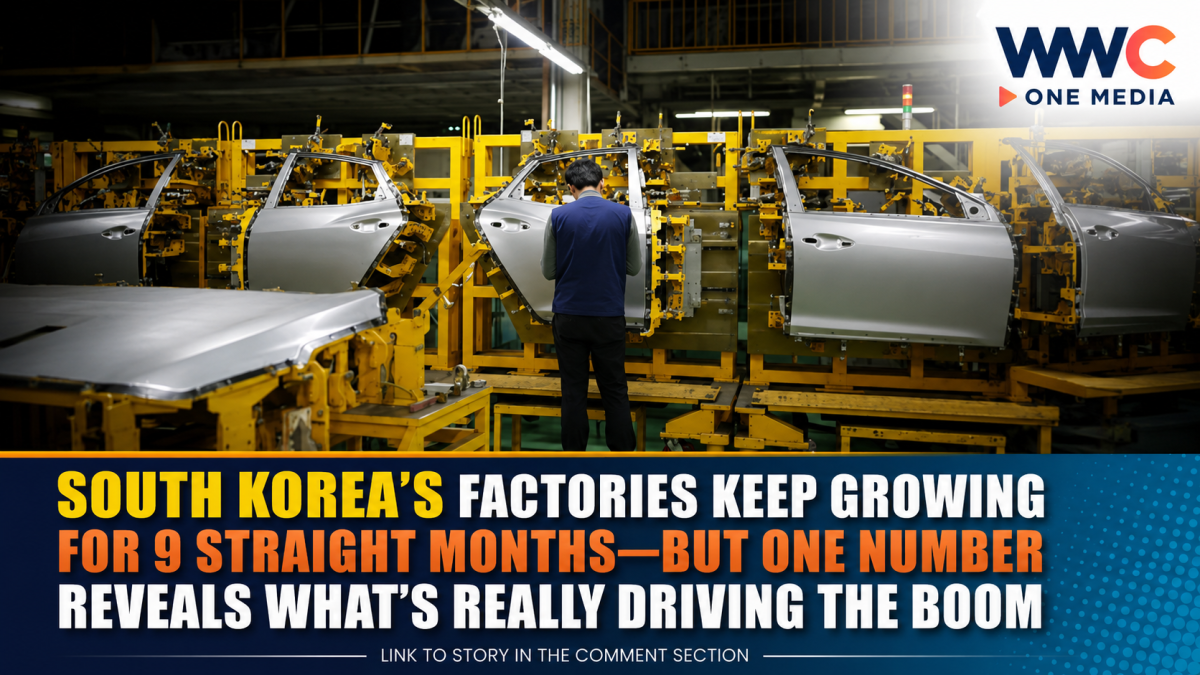
SEOUL — South Korea’s manufacturing sector continued its expansion in August, extending its growth streak to nine consecutive months as strong export demand helped keep the country’s factories moving despite a modest slowdown in overall new orders.
The seasonally adjusted S&P Global Purchasing Managers’ Index (PMI) fell to 52.3 in August from 53.1 in July, but remained comfortably above the 50-point threshold that separates expansion from contraction. The latest reading means South Korean factory activity has remained in growth territory for nine straight months.
The more important signal came from overseas demand.
South Korean manufacturers continued to report healthy new orders, with the new-orders index standing at 53.5 in August, down from 54.8 in July. However, export demand strengthened substantially, with the survey recording its strongest increase since November 2020.
S&P Global economist David Owen said the surge in export demand suggests South Korean manufacturers are continuing to benefit from the ongoing AI and semiconductor investment cycle.
AI and chips remain the key engines
The latest PMI figures reinforce a trend that has become increasingly important to South Korea’s economic outlook: the country’s manufacturing strength is being heavily supported by technology exports.
South Korea is a major global producer of memory semiconductors, and demand linked to artificial intelligence infrastructure has provided a powerful boost to chip sales.
That momentum was also visible in the country’s trade figures.
South Korea’s August exports jumped 68.7% from a year earlier to $98.26 billion, according to government data reported by Reuters. That marked the 15th consecutive month of export growth and significantly exceeded economists’ median forecast of 62.6%.
Imports increased 22.5%, leaving the country with a preliminary trade surplus of $34.75 billion for the month. On a working-day-adjusted basis, average daily exports rose 72.5% year on year.
The figures show just how powerful the semiconductor-led export cycle has become for Asia’s fourth-largest economy.
But the recovery is not evenly spread
Despite the encouraging manufacturing and trade figures, South Korea’s broader economy is showing a more complicated picture.
Government data released at the end of August showed that overall industrial output was flat in July from the previous month. Mining and manufacturing production edged up 0.2%, helped by a sharp 20.7% increase in electronic-component production.
At the same time, retail sales weakened, highlighting the difference between South Korea’s booming external sector and parts of its domestic economy.
Business confidence, however, has been improving. The Bank of Korea’s composite business sentiment index rose to 99.6 in August, its highest level since September 2022. Manufacturing sentiment climbed to 103.8, remaining above the 100-point mark for a fourth consecutive month.
That suggests companies are becoming more confident about the near-term outlook, even as uncertainty surrounding global trade, costs and domestic demand remains.
Why the latest PMI matters
The PMI is closely watched because it provides an early snapshot of manufacturing conditions before official industrial-production figures are released.
A reading above 50 indicates that manufacturing activity is expanding compared with the previous month, while a reading below 50 indicates contraction.
South Korea’s 52.3 reading therefore signals continued growth—but at a slower pace than July. The stronger export component is particularly significant because South Korea’s economy is deeply integrated into global technology and manufacturing supply chains.
The latest figures also come after a stronger-than-expected second quarter, when semiconductor exports helped offset weakness in construction investment.
The bigger story: Can the chip boom last?
For now, the numbers point to a manufacturing sector that remains resilient.
The combination of rising semiconductor demand, AI-related investment and exceptionally strong exports is giving South Korea an important economic cushion at a time when other major Asian manufacturing economies are facing uneven demand.
But the key question is no longer simply whether South Korea’s factories are growing.
It is how long the AI and semiconductor boom can continue to compensate for weaker areas of the domestic economy and global trade risks.
For the moment, the answer is encouraging: South Korea’s factories have now stayed in expansion territory for nine consecutive months, while exports are growing at an extraordinary pace.
And with AI infrastructure investment continuing to fuel demand for advanced chips, the next few months could determine whether this manufacturing upswing becomes a broader economic recovery—or remains a powerful boom concentrated in a handful of export-driven industries.


Leave a Reply