
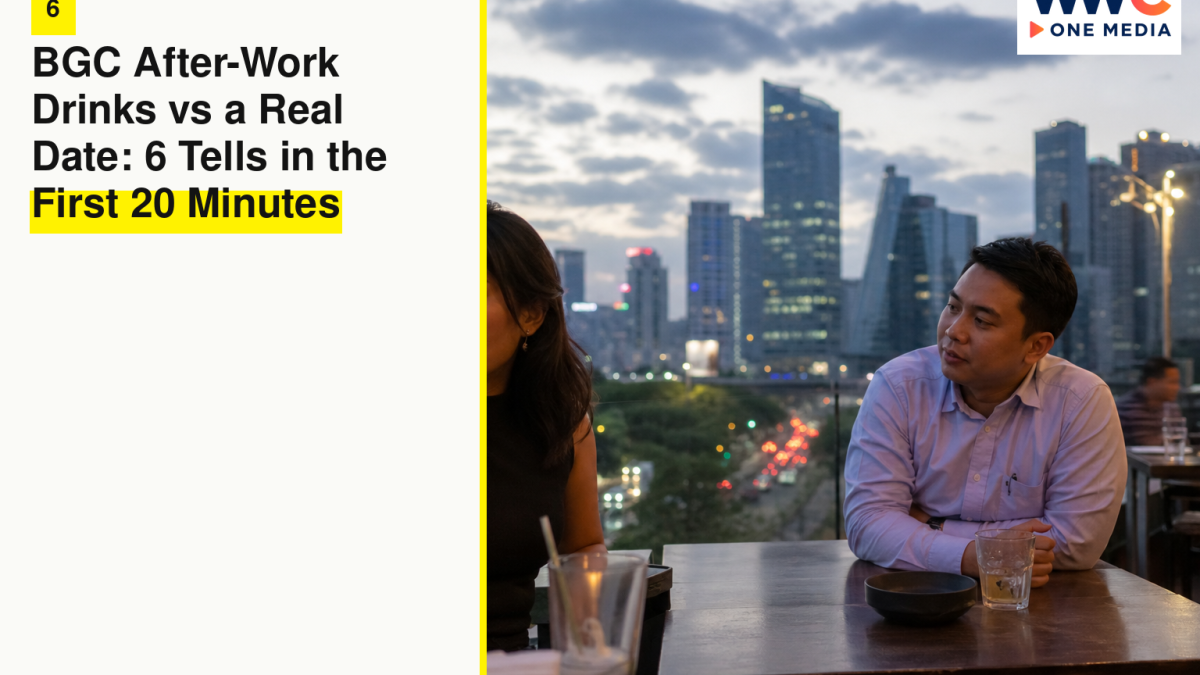
TAGUIG, Philippines — BGC after-work drinks vs a real date is a twenty-minute exam with better lighting. High Street still in office shoes. Uptown a little louder. A table that already existed before you arrived because colleagues were “just finishing.” The check. The last trip of a BGC Bus you both pretend is later than it is. Couples and almost-couples lose the plot here because the Fort looks like a date district after 6 p.m. It is also a spillover of open offices. The first twenty minutes tell you which one you walked into.
This is not a bar ranking. The bars will keep opening along 26th, along 5th, in the malls, in the places with a view of other glass. The newsdesk version is behavioral. Six tells. If you needed a speech about chemistry, you could have had it in a Salcedo lunch. You came after work. Watch the work.
Last trip is already a clock. Treat it as one.
1. Who is already at the table, and whether BGC after-work drinks swallowed the date
The first tell in the first 20 minutes is the census. You walk into High Street or a Uptown spot and the person is not a person. They are a cluster. A lead who is still talking about a deck. A teammate who “might go in a bit.” A college friend who works in the next tower and always appears when there is a pitcher. If you were told “drinks,” this might be honest. If you were told “I want to see you,” this is the date getting eaten in public.
A real date can start near colleagues and still become a date. The tell is whether anyone tries. Introductions with names, a shift to a two-top, a sentence that says we are peeling off at 6:40. If at minute twelve you are still the quiet extra in a work story, you are not on a date. You are on a bench in their office, only with a cocktail menu.
BGC after-work drinks have a current: people drift from One Bonifacio, from a tower on 32nd, from a gym that was a performance of leaving the desk. The current is not rude. Using the current to avoid being alone with you is rude. Watch whether they sit at the end of the table toward you or keep a colleague as a human shield. Shields look like “we’re a fun team.” They feel like you should have stayed in Guadalupe.
What not to do: laugh along for forty minutes hoping the cluster will evaporate from politeness. Clusters do not evaporate. They order another round. You can be polite and still say, at minute fifteen, “I’m going to grab a two-top or I’m going to catch a bus.” That is a tell you give them, which is allowed.
Script: “Good to meet you. We’re going to steal a table — work can keep the pitcher.” Then stand. If they cannot stand, you have the result without a fight. The first 20 minutes are for results, not for speeches about respect.
If they warned you — “my team is wrapping, give me twenty, then it’s us” — believe the warning once. Time it. Twenty is twenty. BGC after-work drinks vs a real date is often just whether twenty stays twenty.
2. The phone, the Slack glow, and whether you are the third meeting
The second tell is the device. In BGC the phone is a colleague. It lights up with a thread that never ended because hybrid work means someone in another time zone still thinks 7 p.m. is a standup. A real date puts the phone face down or in a bag for the first 20 minutes except a parent or a driver. After-work drinks keep the phone as a participant. You can see the difference in the wrists.
Watch what they do when a ping arrives. Do they say “I need two minutes,” mute, return. Or do they narrate the ping into the date so you are now in the meeting. Narration is a tell: they want credit for being busy more than they want a table with you. Busy is real in this district. Credit is a personality.
AirPods still in when you arrive is not a cute transition. It is a person who has not left the office. Ask them to take them out. If that feels like nagging in minute three, you are already doing unpaid management. A real date can start messy — a blazer, a laptop bag, a sweat from the walk between Uptown and High Street. Messy is human. Split attention as a default is a category.
What not to do: compete with the phone by going on your own phone. Then you are two meetings that happen to share fries. If you need to check a last trip, check it, say it, put it away. Last trip is logistics. A For You page is not.
Script: “I’m glad we did this. Can we do twenty minutes with phones in the bag so I know if this is a date or a lobby.” If they flinch at the word date, that is also a tell. BGC after-work drinks hide in the word “chill.” Chill is a temperature. It is not a relationship status.
If their job is actually on call — a hospital, a production, a trading floor that still pings — they should have said so when they invited you. On call is a fact. Surprise on call is a dodge.
3. How they introduce you — colleague, friend, or a person they meant to meet
The third tell in the first 20 minutes is the introduction, if there is a cluster, and the greeting, if there is not. Names matter. “This is my friend” is a category. “This is [name], we were grabbing dinner” is a category. No introduction while a table looks at you is a category. BGC after-work drinks vs a real date often announces itself in that sentence.
If you are a secret from a team that they drink with four nights a week, the Fort is a bad secret-keeping district. These towers leak. The person who will not name you to a teammate at Uptown will not name you in a month when it counts. There are reasons to be careful — a reporting line, a messy split, a workplace policy. Reasons can be said in one line. Silence plus a pitcher is not a policy.
Watch their body in the greeting. A hug that is a hug. A cheek that is a performance for the table. A wave from a stool as if you were the Grab. A real date stands up. After-work drinks nod and keep the anecdote going. You can survive a nod if the peel-off happens by minute ten. You should not survive a nod that lasts the hour.
What not to do: over-introduce yourself as a joke. “I’m the date they forgot they booked.” Jokes like that hand the table a script. Be brief. Be a name. Then see if they match you.
Script if they freeze: “Hi, I’m [name]. Good to meet you. We’ll catch you — we’re going to eat.” You are allowed to narrate the date into existence. If they contradict you — “oh we’re not staying, this is just the team” — believe the contradiction.
Colleagues still at the table will test you with a work in-joke. You do not need to win it. You need to see whether your person pulls the joke back or feeds you to it. Feeding you to it is a tell that this hour is for them, not for a two-person room.
4. The order, the table shape, and whether this looks like BGC after-work drinks on purpose
The fourth tell is material. Two menus. A table for two. Food that is food, not only alcohol. A reservation or a plan that is not “we’ll see what’s open on High Street.” After-work drinks default to a standing cluster, a pitcher, a kitchen that is an afterthought, a noise level that makes a first conversation into a throat exercise. A real date can still be a bar. It needs a corner, a face, a way to hear “how was your week” without three other weeks piled on top.
If they bring you to the same stool they use for every Thursday with the team, you are being slotted into a habit. Habits are not insults. Unnamed habits are. “This is my regular, is that okay, we can move if you want quiet” is a date. “You’ll love this place” while a colleague is already waving is a merge.
Watch the order. Do they ask what you want. Do they order for the table as if you were a plus-one to a department card. Do they assume you drink. Do they assume you do not eat because it is “just drinks.” People skip dinner in BGC and then get mean at 9 p.m. A real date protects blood sugar. After-work drinks protect the round.
Uptown versus High Street versus a quieter strip toward the track is not a moral map. It is volume and crowd type. Pick for the conversation you claimed you wanted. If you claimed nothing, you will get the default, and the default in this district after 6 is work spilling into glass.
What not to do: perform being low-maintenance by saying “anything” and then being angry at a pitcher. Say “I want food and a two-top.” That sentence sorts BGC after-work drinks vs a real date faster than a quiz.
Script to a host: “I can do one drink with your team. Then I want a table that is us, or I will head out before the last trip.” Put the last trip in the sentence so the clock is shared. Shared clocks are intimate. Hidden clocks are how people get stranded at Market! Market! with a surge.
5. The check in the first 20 minutes — yes, it already speaks
The fifth tell is money, earlier than people think. You may not have the bill yet at minute twenty, but you have the posture. Who asked the waiter to open a tab. Whose card is already with the bar because this is their after-work house. Who says “department is covering” and who says nothing while a round lands. BGC after-work drinks vs a real date shows up in whether you are on a personal tab or a cloud of other people’s beers.
A real date names the plan. Split. My treat. Your turn because last time in Poblacion. Company card for their team, personal for ours. Any of those is adult. A fog is not. Fog is how you find out at minute fifty that you are paying for a lead’s third gin because you were too polite to ask at minute ten.
If a colleague says “just put it on one” and looks at your person, watch your person. Do they protect a boundary — “team tab here, we’re separate” — or do they smile you into a subsidy. Subsidy is not a love language. It is how after-work culture eats dating culture.
You do not need a formula from a magazine. You need a sentence before the second round. If they flinch at the sentence, they wanted a plus-one, not a date.
What not to do: perform a card war in front of a team to prove this is a date. Proof can be quiet. Peel off. Pay your two drinks. Leave. The show is for people who think High Street is a theater.
Script: “I’ll get mine and yours if this is us. If this is the team, I shouldn’t be on that tab.” Then stop talking. The next two minutes are the tell.
If they invited you as a date and let the team tab swallow you, you can still salvage a walk toward the parkway, a cheaper food, a conversation without a pitcher. Salvage has a deadline. The last trip is a deadline. Pride is not.
6. Last trip, last ride, and the exit that proves the first 20 minutes were a date
The sixth tell is the end, which in BGC starts early. Last trip on a BGC Bus. A P2P. A Grab surge that turns a “quick drink” into a decision. A parking slot in a basement that costs more if you linger. After-work drinks assume someone will stay until the cluster dies. A real date assumes someone has a morning, a parent in Cavite, a roommate in Makati, a dog in a condo on 8th.
In the first 20 minutes, a date-minded person will mention the exit. “I can stay until 8.” “I have to walk to the bus by 9.” “If this is good we can move to food.” After-work drinks mention none of it because the cluster will decide. If you do not hear an exit, offer yours. See if they match, negotiate, or ignore. Ignore is a tell. You will be the person looking at a dead bus map while they order nachos for a table that is not yours.
Watch whether they walk you toward a ride or tilt back to the team. Walking you out is a small, old move and it still works on 26th Street with traffic cones and a marshal. Tilting back while saying “text me you got home” is a phrase that wants credit without minutes. Minutes are the currency.
If the first 20 minutes were good and the cluster is still there, the date is the peel-off. If they cannot peel off, believe them. BGC after-work drinks vs a real date is not a puzzle. It is a series of small movements toward a two-person room. No movement is an answer.
What not to do: stay until 11 to “win.” You cannot win a table that was never a date. You can lose a last trip and a morning. Go.
Script at minute eighteen: “I like this. I don’t like the crowd for a first real talk. Walk me to a quieter food, or let’s call it and do a proper dinner on Thursday.” Proper dinner is a test of whether Thursday exists. If Thursday never exists and only Thursday-after-work-with-the-team exists, you have the category.
Ubers and Grabs from Uptown at peak are a fight. Agree who waits with whom. Do not put a woman or anyone who asked for a wait in a dark curb “because the pin is faster.” Pins are not safer than a well-lit front of a mall. After-work culture forgets this because the team is loud and the street feels like a campus. It is a city.
High Street, Uptown, and the map that is not interchangeable
High Street is a walk, a retail outdoor, a place where after-work and dates share the same bricks. Uptown is more vertical, more mall, more “we’re already here.” The Fort Strip and the older bar rows have their own habits. None of these is morally better. They produce different first 20 minutes. A walk from a tower to High Street can be the start of a date if the person uses the walk to leave work in their mouth. A jump straight into a dark table with a team playlist will not.
If they work in a tower beside the venue, you are on their campus. Campus dates need extra peel-off energy. Suggest a place that is a ten-minute walk if you want a real date. See if they will leave the radius. Radius loyalty is a tell. Some people cannot be a partner within sight of a boss. That might be wise. It might be a refusal to be seen with you. Ask which.
Market! Market! as a fallback food is honest. A fancy room as a cover for not talking is not. You are not owed a tasting menu. You are owed a face.
Colleagues still at the table will try to migrate with you if the peel-off is weak. “We’ll come.” Then you are on a group date you did not consent to. Consent to a group is a different night. Say no to the migration once. If your person does not back the no, you are not the date. You are the extra stop.
Scripts for the first 20 minutes, including the walk-away
At the door: “Hey. Good to see you. Is this us or is this the team.”
At a cluster: names, one minute, then “we’re going to grab a table.”
At the phone: “Can that wait twenty.”
At the order: “I need food, not only a round.”
At the tab: “Separate from the team, please.”
At minute twenty: “This is a date for me. If it’s drinks with a guest, I’m going to catch the bus.”
Walk-away: pay yours, thank them, do not slam a glass. BGC is small. You will see the team at a lunch. Dignity travels.
If they follow, you have a date after all. If they do not, you had after-work drinks. Both are information. Only one deserves a Thursday.
What not to do when BGC after-work drinks pretend to be a real date
Do not get drunker than the table to belong.
Do not badmouth their lead to impress them. The lead is still at the other end of the pitcher.
Do not kiss as a claim in front of colleagues unless that conversation already happened in private. Claims at Uptown become Slack.
Do not interrogate the ex who used to work on the 28th floor. The Fort is full of ghosts. Tonight is census, phone, intro, table, check, exit.
Do not miss the last trip to prove you are fun. Fun is a Tuesday that was planned.
Do not invite yourself to the next round “because I’m already here” if the tells were cold. Already here is how people leak an hour into a night.
Do not grade them in a group chat from the bathroom. Grade them on the walk to the bus, privately, to yourself, then decide Thursday.
If you are the one who invited a person into your team’s Thursday, this list is yours. Peel off. Introduce. Put a cap on the tab. Walk them out. Do not make a guest do the adult work of turning your campus into a date. If you cannot leave the team, do not use the word date. Use drinks. Let them choose drinks.
The second date test that the first 20 minutes already predicted
If Thursday happens, in a place that is not beside their tower, without a pitcher of colleagues, you can believe the peel-off. If the only offers are “same time after stand-up,” you are a satellite of BGC after-work drinks. Satellites do not become partners by accumulating Thursdays on 26th Street. They become lore. Lore is a kind of lonely.
A real date in this city can still be cheap: a walk that actually talks, food that is food, a clock that is named. The Fort can host that. It hosts it less often than it hosts a cluster. Go in with a twenty-minute timer in your head. The timer is not unromantic. The timer is how you do not give a whole last trip to a maybe.
Bottom line
BGC after-work drinks vs a real date shows in the first 20 minutes: who is already at the table, whether the phone is a colleague, how they introduce you, whether the table is a two-top with food, how the check is framed, and whether an exit exists before the last trip. High Street and Uptown will keep looking like a date district. Colleagues will keep finishing a pitcher. Believe the census, not the lighting. Peel off or go. Thursday will tell you if any of it was a date.




Leave a Reply