
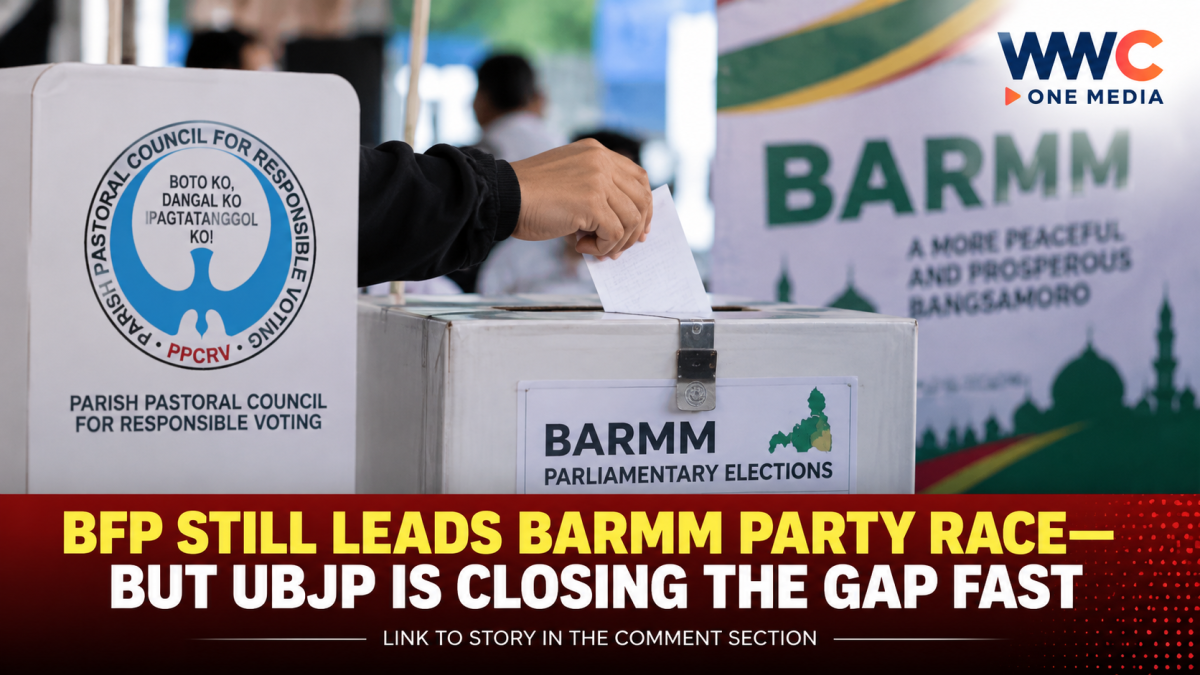
The Bangsamoro Federalist Party (BFP) continues to hold the lead over the United Bangsamoro Justice Party (UBJP) in the unofficial parallel count for the first-ever parliamentary elections in the Bangsamoro Autonomous Region in Muslim Mindanao (BARMM)—but the race remains too close to call based on unofficial figures.
The latest count monitored by the Parish Pastoral Council for Responsible Voting (PPCRV) showed BFP ahead of UBJP, with the BARMM Grand Coalition (BGC) maintaining third place.
An earlier PPCRV tally had BFP with 456,658 votes, followed by UBJP with 405,250 and BGC with 278,043. As counting progressed, BFP and UBJP both crossed the half-million mark, underscoring how dominant the two parties have been in the regional party vote.
By the latest reported partial tally early Tuesday, BFP had reached 646,743 votes, or 34.9%, while UBJP had 600,550 votes, or 32.4%. BGC was third with 383,321 votes, or 20.7%. The count was based on 5,064 of 5,212 expected election returns, or 97.16%, according to the reported PPCRV figures.
The crucial number: 40 party seats
The party contest is particularly important because 40 of the 80 seats in the Bangsamoro Parliament are allocated to regional parliamentary political parties.
The remaining seats consist of 32 district representatives and eight sectoral representatives. Voters therefore did not simply choose individual candidates; they also selected a regional parliamentary party whose nominees can occupy seats based on the party’s share of the vote.
The Commission on Elections’ certified list included 13 regional parliamentary political parties, including BFP, UBJP and BGC.
That makes the BFP-UBJP contest much more consequential than a conventional candidate race: the final party vote could determine the balance of power inside the region’s first elected Parliament.
Why BFP and UBJP matter
The contest also reflects the political realignment that has emerged from the Bangsamoro peace process.
The UBJP is associated with the Moro Islamic Liberation Front (MILF), while the BFP has also drawn support from former MILF members and supporters. The parties are now competing within the electoral system created by the peace agreement and the Bangsamoro Organic Law.
The stakes are enormous.
BARMM was created following the 2014 peace agreement between the Philippine government and the MILF, with the Bangsamoro Organic Law later establishing the autonomous region’s current political framework. The September 14 election marks the transition from the appointed Bangsamoro Transition Authority to an elected regional government.
Historic election, historic test
The first parliamentary election drew about 2.4 million registered voters and was conducted across the autonomous region on September 14.
More than 5,000 voting precincts opened for the historic exercise, with voters choosing a regional parliamentary party, a district representative and six sectoral representatives.
The election also attracted international attention. 108 observers from 16 international organizations and delegations were expected to monitor the polls, according to the Office of the Presidential Adviser on Peace, Reconciliation and Unity.
The PPCRV also established command centers and mobilized thousands of volunteers to conduct its unofficial parallel count and monitor election-related developments.
The bigger question now
While BFP’s lead is significant, the unofficial count is not yet the final result.
The official winners will ultimately be determined through the Comelec canvassing process. The PPCRV figures are intended as an independent parallel check and should not be treated as a proclamation of winners.
And with BFP and UBJP separated by only a few percentage points in the latest reported count, the remaining official canvass could determine how the 40 regional party seats are distributed.
For BARMM, this is more than a race for the top spot. It is the opening battle for control of the region’s first elected Parliament—and potentially the political direction of the Bangsamoro government for years to come.
Why this election matters
The historic vote is the culmination of a peace process designed to give the Bangsamoro greater political autonomy after decades of armed conflict.
The new Parliament will be responsible for legislation and regional governance, while its members will choose the Chief Minister from among themselves.
BARMM has also recorded economic progress, with its economy growing 5.0% in 2025, according to regional and national economic data cited by Reuters. Yet poverty, development gaps, security concerns and political competition remain major challenges for the new elected government.
For now, BFP has the advantage. UBJP is within striking distance. And the final official tally will determine whether the early leader can turn its vote advantage into parliamentary power.


Leave a Reply