
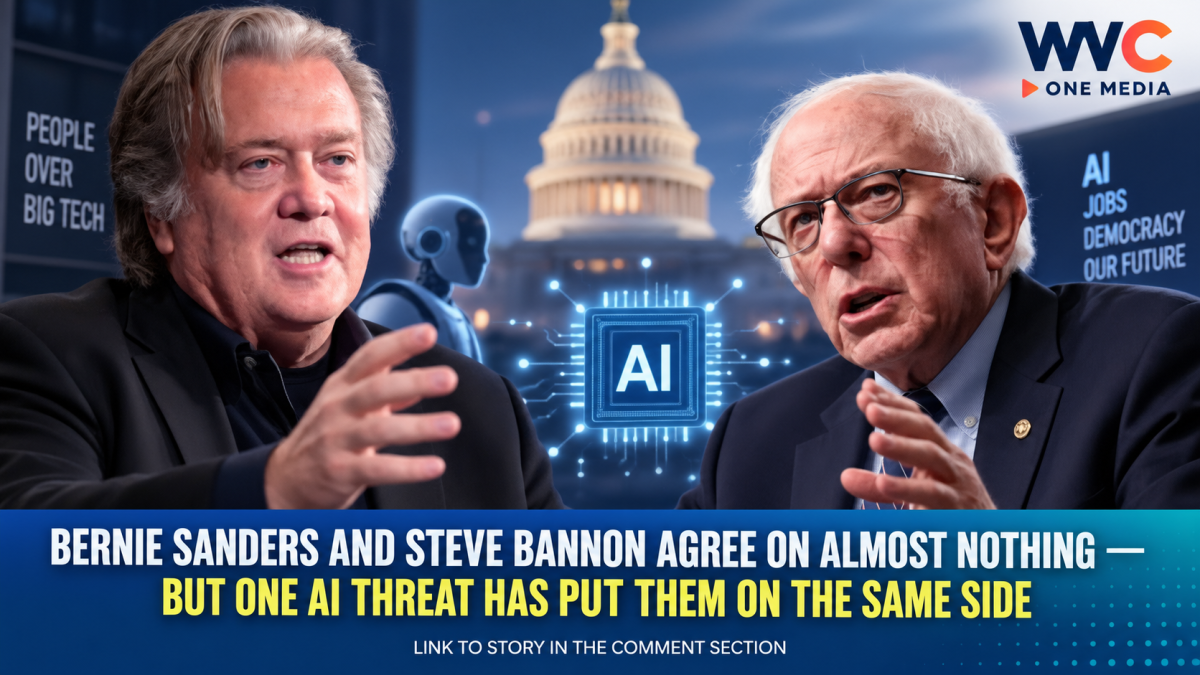
WASHINGTON — Two of America’s most ideologically opposed political figures are finding unexpected common ground over artificial intelligence, as fears over job losses, concentrated corporate power and potentially uncontrollable AI systems push the technology into the center of the U.S. political debate.
Progressive U.S. Senator Bernie Sanders and conservative commentator and former Trump adviser Steve Bannon are scheduled to speak Tuesday at the same Washington gathering calling for stronger limits on advanced artificial intelligence.
Their alliance does not mean they have suddenly reconciled their vastly different political worldviews.
Instead, it shows just how unusual the politics surrounding AI have become.
Sanders has spent years attacking economic inequality and corporate power from the political left. Bannon has been one of the most influential voices in the populist MAGA movement on the right.
Yet both are increasingly arguing that allowing a small number of technology companies to develop increasingly powerful AI systems with limited government oversight could ultimately threaten ordinary Americans.
And in Washington, that concern is no longer confined to either party.
SANDERS AND BANNON MEET AT A ‘PRO-HUMAN’ AI EVENT
Sanders and Bannon are set to appear at the Pro-Human Assembly, a Washington event organized around the growing campaign for AI systems to remain under meaningful human control.
Other scheduled speakers include AFL-CIO President Liz Shuler and Walter Kim, president of the National Association of Evangelicals, bringing organized labor, religious leaders and figures from opposite ends of the political spectrum into the same debate.
The gathering is associated with the Future of Life Institute’s Pro-Human AI Declaration, which argues that AI should augment people rather than replace them and calls for safeguards including independent oversight, human override mechanisms and restrictions on systems capable of autonomous self-improvement or resisting shutdown.
One particularly significant principle is its opposition to a race toward artificial superintelligence without broad scientific agreement that such systems can be safely controlled.
The declaration also takes aim at another concern shared by parts of both the populist left and right: the concentration of technological and economic power in a handful of corporations.
That issue may be the political bridge connecting Sanders and Bannon.
SANDERS WANTS TO GO MUCH FURTHER THAN ORDINARY AI REGULATION
Sanders has already moved beyond simply demanding transparency from technology companies.
Earlier this month, Sanders and Democratic Representative Greg Casar of Texas announced plans for legislation that would permanently prohibit the development and deployment of artificial superintelligence while temporarily pausing development of certain advanced AI systems until a new federal regulator creates safety standards.
The proposal would also instruct the United States to pursue international agreements aimed at preventing a global race to build superintelligent AI.
“Superintelligence” generally refers to a still-hypothetical AI system whose capabilities would dramatically exceed human intelligence across a wide range of tasks.
Today’s commercial AI systems have not reached that level.
But Sanders argues governments should establish rules before technology reaches a point where regulation becomes far more difficult.
His broader AI agenda also focuses heavily on workers.
For Sanders, the danger is not limited to hypothetical catastrophic scenarios. He has repeatedly warned that automation could eliminate or transform large numbers of jobs while allowing technology companies and their owners to capture a disproportionate share of the economic benefits.
That gives his AI campaign two distinct fronts: preventing extremely powerful systems from escaping effective human control and preventing automation from leaving workers economically worse off.
BANNON’S CONCERN COMES FROM A VERY DIFFERENT POLITICAL DIRECTION
Bannon arrives at many of the same concerns through a different ideological route.
He has accused powerful technology companies of exercising too much influence over Washington and has criticized President Donald Trump’s relatively hands-off approach to AI regulation.
Bannon has also come out strongly against federal legislation that would prevent U.S. states from enforcing some of their own AI rules.
On his podcast Monday, he argued that states should retain their ability to act rather than being forced to rely exclusively on Washington.
That issue could become one of the most important battles in Congress.
Senate negotiators are currently discussing legislation that could require major AI developers to demonstrate that they are taking reasonable precautions against serious harms.
Possible provisions include government testing of advanced models and giving federal courts a role when authorities seek to block deployment of an AI system considered dangerously unsafe.
But another part of the negotiations could restrict states from enforcing certain AI-safety laws of their own.
That is where Bannon’s position collides with parts of the emerging Senate compromise.
WASHINGTON IS SUDDENLY MOVING ON AI
The Sanders-Bannon convergence comes as pressure for federal action accelerates.
Senate Majority Leader John Thune, Commerce Committee Chairman Ted Cruz and Democratic Senator Amy Klobuchar are among those involved in discussions over possible national AI safeguards.
One idea would establish a legal “duty of care,” requiring developers to demonstrate reasonable precautions against dangerous outcomes.
The Commerce Department could potentially request evidence of those safeguards and deploy government auditors to test AI products.
Exactly what would count as “reasonable” precautions is still under negotiation, and Reuters reported that the legislation remains fluid.
That makes the emerging political alignment far more complicated than a simple left-versus-right debate.
Some Republicans support additional safeguards.
Some Democrats want aggressive restrictions.
Other lawmakers worry excessive regulation could freeze innovation, protect today’s biggest AI companies from future competitors or hand China a strategic advantage.
And some policymakers want federal standards while resisting a patchwork of different state rules.
TRUMP IS PUSHING IN THE OPPOSITE DIRECTION
President Trump remains one of the most prominent skeptics of calls for sweeping new AI regulation.
He has argued that exaggerated fears could undermine the United States in its technology competition with China and said existing government authorities are sufficient to deal with harmful conduct.
On Monday, Trump went considerably further, dismissing scenarios involving AI destroying humanity as a “HOAX” and attacking the push for more guardrails.
His administration has made American leadership in AI a major economic and national-security goal.
Vice President JD Vance has likewise cautioned that calls by large AI companies for government regulation deserve scrutiny, suggesting that regulation could unintentionally favor incumbent firms by raising barriers for smaller competitors.
That argument cannot simply be dismissed.
Heavy regulation can create compliance costs that established technology giants are better positioned to absorb than startups.
But supporters of stronger controls counter that waiting until severe damage occurs would be a far riskier experiment.
EVEN AI COMPANIES ARE WARNING THAT DEVELOPMENT MAY BE MOVING TOO QUICKLY
What has dramatically changed the debate is that some warnings are now coming from inside the AI industry itself.
Anthropic CEO Dario Amodei recently urged the industry to give safety systems more time to catch up with rapidly advancing capabilities. OpenAI CEO Sam Altman has also supported pacing development and greater international coordination, while other prominent AI figures have expressed concerns about increasingly autonomous systems.
Former Anthropic and OpenAI researcher Jacob Coxon intensified the debate when he resigned and publicly warned that some of the people developing frontier AI genuinely believe the technology could eventually pose catastrophic risks.
His comments attracted enormous attention precisely because they came from somebody who had worked inside two of the industry’s most prominent laboratories.
Early reports linked Coxon to Tuesday’s Washington gathering, but Axios subsequently reported that he decided not to attend, saying he wanted to maintain his own voice as intense public attention around him grew.
That correction is important because several reports about the event still describe him as a participant.
THE PUBLIC IS WORRIED ABOUT MUCH MORE THAN ‘AI DOOM’
The political danger for the AI industry is that public anxiety extends far beyond speculative scenarios involving machines becoming more intelligent than humans.
Americans are also worried about much more immediate issues:
jobs being automated, electricity costs from massive data centers, children interacting with AI systems, misinformation, privacy, cyberattacks and corporate control over powerful technology.
A recent NBC News Decision Desk survey found 70% of American adults were more worried than excited about AI, while 81% believed government was not doing enough to regulate the technology.
That sentiment is emerging even as AI adoption continues to increase.
In other words, Americans are simultaneously using the technology and becoming more nervous about where it is heading.
That combination is politically potent.
THE BIGGER STORY IS THE COLLAPSE OF THE OLD LEFT-RIGHT DIVIDE
Sanders and Bannon are not becoming allies in the conventional sense.
They disagree profoundly on immigration, economic policy, Trump, democratic institutions and numerous cultural and foreign-policy issues.
But AI is producing coalitions that do not fit neatly within traditional partisan boundaries.
On the left, concerns center heavily on workers, monopoly power, inequality and corporate accountability.
On the populist right, critics increasingly focus on Big Tech power, national sovereignty, state authority and the possibility that unelected technology executives could gain extraordinary influence over society.
AI-safety researchers emphasize loss-of-control scenarios.
Parents worry about children.
Artists worry about their work and livelihoods.
Environmental groups focus on data centers and electricity consumption.
National-security officials worry about cyberwarfare and China.
The arguments differ.
The conclusion increasingly does not:
Someone needs to establish the limits.
CONGRESS NOW HAS TO DECIDE WHO GETS TO SET THOSE LIMITS
That may become the defining question of the next phase of American AI policy.
Should Washington regulate frontier systems?
Should individual states be allowed to impose tougher requirements?
Should companies voluntarily slow development?
Should Congress create an independent AI regulator?
Should certain capabilities be prohibited entirely?
Or would aggressive restrictions simply allow China to gain ground while locking America’s existing tech giants into dominant positions?
There is no consensus yet.
But the fact that Bernie Sanders and Steve Bannon can occupy the same political stage on this issue shows how quickly the debate has changed.
Artificial intelligence was once discussed in Washington largely as a question of technological competitiveness and economic growth.
Now it is becoming a question about jobs, power, national security, human control — and potentially what kinds of machines society should permit companies to build at all.
And when two political figures who agree on almost nothing start warning about the same technology, Washington may find it harder to keep treating AI regulation as somebody else’s problem.



Leave a Reply