
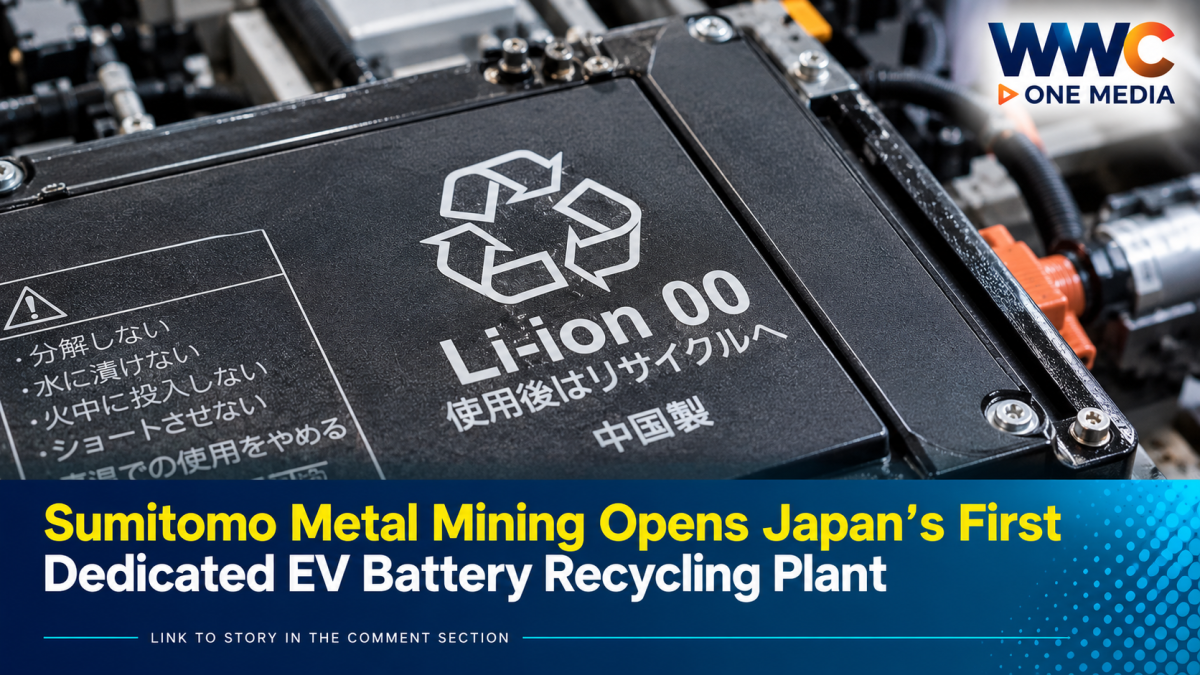
TOKYO — Japan is taking another major step toward building a domestic battery-recycling industry after Sumitomo Metal Mining Co. opened what it describes as Japan’s first dedicated recycling facility for electric-vehicle batteries.
The new plant is designed to recover valuable materials from used lithium-ion batteries, including lithium and other critical metals, creating a potential domestic source of resources for Japan’s rapidly developing electric-vehicle supply chain.
The move comes as Japan seeks to reduce its dependence on overseas supplies of battery materials and build a more circular system in which materials from old batteries can eventually return to the battery-production chain.
Japan turns used EV batteries into a resource
EV batteries contain valuable materials that can be recovered instead of being discarded at the end of their useful life.
For Japan, recycling has an added strategic importance because the country relies heavily on imports for many of the raw materials needed to manufacture advanced batteries.
Sumitomo Metal Mining’s new facility therefore represents more than an environmental initiative. It is part of a broader effort to strengthen Japan’s critical-mineral security and battery supply chain.
The company has been developing battery-recycling technology for years. In 2021, Sumitomo Metal Mining announced technology capable of recovering nickel and cobalt from rechargeable batteries.
Why lithium and other battery metals matter
Lithium-ion batteries depend on a range of materials whose supply chains are increasingly viewed as strategically important.
Recovering those materials from used batteries can potentially reduce the need for newly mined resources while creating another source of raw materials for battery manufacturers.
Sumitomo Metal Mining already operates across several stages of the battery-material supply chain, including nickel and cathode-material production. Its recycling strategy therefore fits into an existing business centered on supplying materials used in rechargeable batteries.
The company has also been expanding its nickel-based cathode-material production capacity as demand for batteries continues to evolve.
A bigger push for battery recycling in Japan
Sumitomo Metal Mining’s move comes as Japan’s battery industry increasingly looks toward closed-loop recycling.
Other Japanese companies are also developing technologies designed to recover materials from used batteries. A consortium led by KDDI announced in August 2026 that prototype batteries made with materials recovered from used lithium-ion batteries achieved performance equivalent to prototypes using virgin materials.
That development points toward a potentially important future model: recover battery materials, refine them, and then use them to manufacture new batteries.
Such a system could reduce waste while making battery-material supply chains more resilient.
The global EV industry is racing toward a circular supply chain
Battery recycling is becoming increasingly important worldwide as the number of electric vehicles grows.
Automakers and battery companies are investing in recycling because today’s EV batteries contain materials that could become valuable secondary resources as more vehicles reach the end of their service lives.
Japan is competing in that emerging industry alongside companies in Europe, the United States, South Korea and China.
For Japanese manufacturers, developing domestic recycling capacity could also help reduce exposure to disruptions in international mining and refining markets.
From mining to recycling
The development represents an interesting evolution for Sumitomo Metal Mining.
The company has traditionally been associated with mining and refining metals such as nickel and copper. Its growing involvement in battery recycling adds another dimension: recovering strategically important materials from products already in circulation.
That could eventually allow Japan to treat retired batteries as a form of “urban mine,” extracting useful resources from existing products rather than relying exclusively on newly mined ore.
Japan has already experimented with battery-to-battery recycling for years. In 2010, Toyota, Toyota Chemical Engineering, Sumitomo Metal Mining and Primearth EV Energy launched a recycling system that recovered nickel from used nickel-metal-hydride hybrid-vehicle batteries for use in new batteries.
The latest facility brings that concept into the rapidly expanding EV-battery era.
Why the plant could matter beyond Japan
The significance of Sumitomo Metal Mining’s facility extends beyond recycling itself.
If Japan can efficiently recover battery materials domestically, recycling could become an important component of the country’s strategy to secure critical minerals while supporting its automotive and battery industries.
It could also reduce the environmental pressure associated with extracting new resources and help create a more circular EV economy.
The challenge will be scaling the technology economically as the number of end-of-life EV batteries increases.
For now, Sumitomo Metal Mining’s new facility marks a significant milestone in Japan’s attempt to build that future.
The question is no longer whether EV batteries can be recycled—it is whether Japan can turn those discarded batteries into a major domestic source of the materials needed for its next generation of electric vehicles.



Leave a Reply