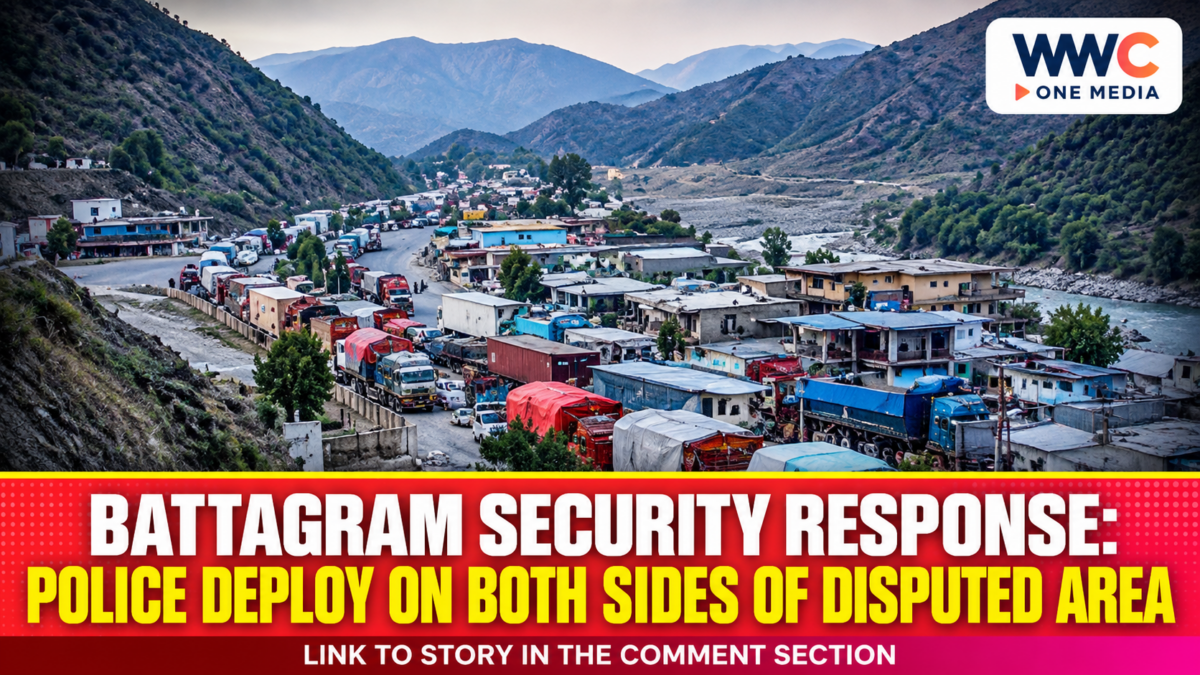
District administration and police officials in Battagram, Pakistan, reviewed security measures on November 21 after a deadly incident in the Allai area, agreeing to coordinate deployments and further operations around the disputed locality. A government news-agency dispatch reported that officials considered the situation under control while security personnel continued monitoring the area. UrduPoint
The response places the immediate focus on preventing another confrontation and restoring stability in a location affected by a longstanding dispute. But the public record available for this report does not include the original police incident report, a copy of the FIRs or a complete account of the events that led to the loss of life.
That distinction matters. The authorities’ response can be reported from the official dispatch, while casualty details and claims about how the confrontation began require separate confirmation.
Battagram security response centres on coordinated deployment
The meeting took place at the District Police Officer’s Office in Battagram on November 21. It brought together officials from the district administration and police departments responsible for Battagram and neighbouring Kolai-Palas Kohistan.
The participants named in the dispatch were Deputy Commissioner Gohar Ali Khan, Battagram District Police Officer Qamar Hayat Khan, Kolai-Palas Kohistan DPO Jameel-ur-Rehman Khan and SSP Investigation Battagram Khabeer Muhammad. UrduPoint
The meeting reviewed the law-and-order situation following what the dispatch called the Bhalija Mali incident in Allai. Officials agreed on coordinated measures intended to reduce tensions and support a lasting return to peace.
The dispatch also said a substantial police force had been deployed on both sides of the disputed area. Search operations and other security measures were underway, while relevant departments were monitoring developments through coordinated efforts.
This is significant because the reported response involves authorities from more than one district. When a disputed area lies near administrative boundaries, coordination can matter for patrol coverage, information-sharing and decisions about which local authority handles a particular development.
The dispatch does not provide the number of officers deployed, the precise locations of their posts or the duration of the operation. Those details should not be assumed.
Officials say the situation was under control
The meeting was informed that the overall situation was under control, with security measures continuing and departments monitoring the area.
That assessment describes the position communicated to officials during the meeting. It should not be read as proof that the underlying dispute has been resolved or that the risk of further tension has disappeared.
The participants expressed grief over the loss of human lives and identified the protection of residents, an end to hostilities and the restoration of lasting peace as priorities. They also reiterated that the rule of law would be enforced and that individuals would not be permitted to take the law into their own hands. UrduPoint
The distinction between stabilising an area and resolving a dispute is important. A police deployment can help prevent immediate violence, but a lasting settlement may require a separate process involving the parties, local administration and any relevant legal authorities.
WWC has previously examined Pakistan’s security operations and the limits of what official announcements establish. That report concerns different operations, but it illustrates why official security assessments should be attributed precisely and not treated as independent proof of every circumstance on the ground.
The forest dispute remains a separate question
The incident has been described in public coverage as connected to a dispute over a forest or land in the Allai area. However, the APP-attributed meeting dispatch does not establish the legal ownership of the disputed land, identify the boundaries in question or provide a judgment resolving competing claims.
Those matters require documentary evidence of their own. Land records, revenue documents, court proceedings or an authenticated agreement would be needed to establish ownership or the legal status of a settlement.
It would therefore be premature to describe either community as the lawful owner based solely on the fact that a confrontation occurred. Nor does the meeting dispatch establish who initiated the incident or assign criminal responsibility to any individual or group.
A useful comparison can be made with WWC’s report on traditional mediation and the role of tribal elders in resolving long-running disputes. Mediation can create a channel for negotiation, but it should not be confused with a formal determination of property rights or a substitute for the law.
Why cross-district coordination matters
The participation of police officials from Battagram and Kolai-Palas Kohistan gives the response a cross-district dimension. The meeting’s stated objective was not limited to a short-term deployment; officials also discussed coordinated action to prevent renewed hostilities.
In practical terms, cooperation between district authorities can help avoid gaps in communication when an incident affects an area near an administrative boundary. It can also make it easier to coordinate searches, share relevant information and respond to reports that may affect residents on either side.
But the public dispatch leaves several operational questions unanswered. It does not specify whether the authorities established a joint command structure, how residents can report new threats, or whether a formal monitoring mechanism has been created.
The wider security environment in Khyber Pakhtunkhwa is also a relevant backdrop, although it should not be used to imply that this local dispute is connected to militant activity. WWC’s report on protective nets being installed over police facilities in Pakistan covers a separate security issue and should be understood as broader context, not evidence about the Allai incident.
What happens next
The immediate task for the authorities is to maintain the security presence and prevent further violence while the underlying dispute remains unresolved.
The November 21 dispatch confirms that officials discussed deployments, searches and coordinated monitoring. It does not announce a final settlement, a completed investigation or a court determination over the disputed area.
Further reporting should look for the relevant police case records, an official casualty update, and any written agreement or administrative decision addressing the land dispute. Those documents would help establish the incident’s sequence, the legal claims over the area and the status of any negotiations.
For now, the confirmed administrative development is that district officials met, reviewed security and agreed to coordinated measures. Whether those steps lead to a durable settlement will depend on what happens after the immediate deployment.
Frequently asked questions
What happened in Battagram’s Allai area?
A deadly incident was reported in the Allai area, after which district administration and police officials met on November 21 to review security and coordinate measures.
Which officials attended the Battagram security meeting?
The dispatch named Deputy Commissioner Gohar Ali Khan, DPO Qamar Hayat Khan, Kolai-Palas Kohistan DPO Jameel-ur-Rehman Khan and SSP Investigation Battagram Khabeer Muhammad.
Were police deployed around the disputed area?
Yes. The meeting was informed that a substantial police force had been deployed on both sides of the disputed area and that search operations and other security measures were underway.
Has the forest ownership dispute been resolved?
The available official dispatch does not announce a settlement or establish legal ownership of the disputed land.
Did officials say the situation was under control?
Yes. The meeting was informed that the overall situation was under control, while relevant departments continued monitoring developments.