
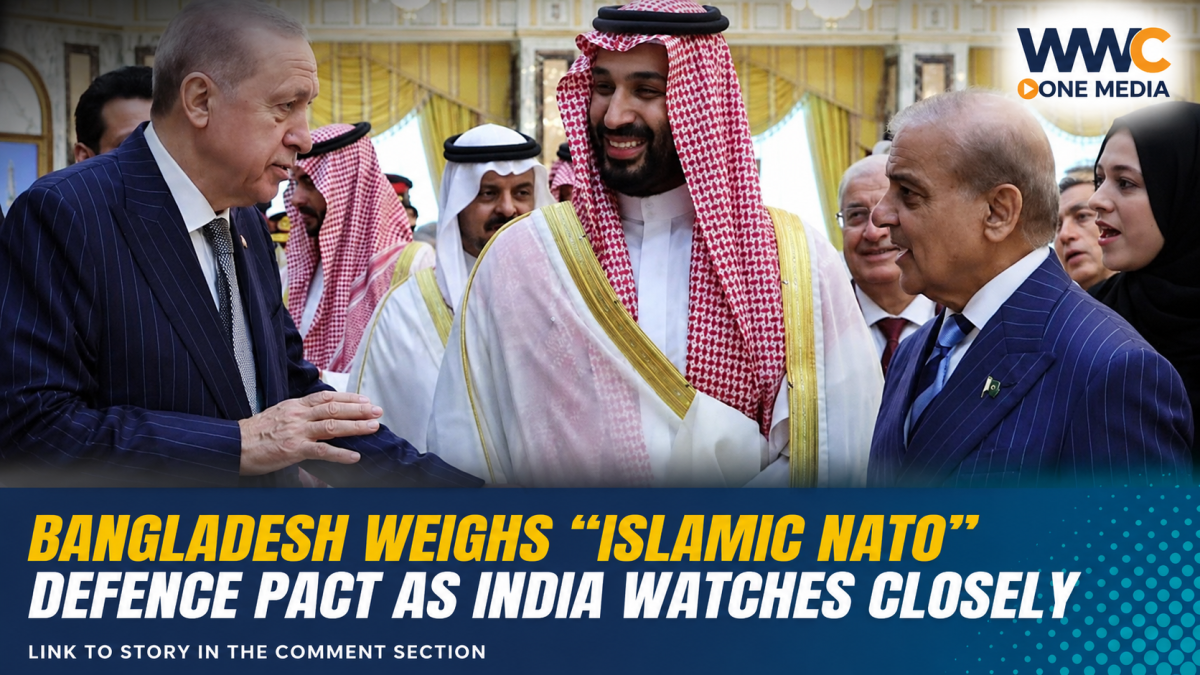
Bangladesh is weighing whether to join a new Makkah Joint Defence Agreement involving Saudi Arabia, Türkiye and Pakistan, a move that could significantly reshape Dhaka’s regional security strategy and put its already strained relationship with India under greater pressure.
But there is an important distinction: Bangladesh has not joined the pact. As of September 1, Dhaka was still assessing the proposal, and State Minister for Foreign Affairs Shama Obaed Islam said the country had not received a formal invitation. She said Bangladesh’s national interests would come first in any decision.
The debate has nevertheless attracted attention because the agreement is being informally compared with NATO’s collective-defence principle.
What is the Makkah defence pact?
Saudi Arabia, Türkiye and Pakistan signed the Makkah Joint Defence Agreement on August 7, 2026.
The agreement says an armed attack against any one of the three countries would be regarded as an attack against all three. It also calls for broader defence cooperation and stronger collective deterrence.
That provision has led commentators to label it an “Islamic NATO.” However, the comparison should not be taken literally: the Makkah pact is a new three-country defence arrangement and does not have NATO’s decades-old institutional structure.
The three founding countries have already begun building an organizational framework. On August 31, their foreign and defence ministers and military chiefs met in Istanbul and agreed to establish a permanent secretariat in Saudi Arabia. They also pledged deeper cooperation in defence industries, technology development and production.
Why is Bangladesh considering it?
Bangladesh’s government has signalled that it views the initiative positively, particularly as a potential avenue for greater security cooperation.
State Minister Humaiun Kobir said Bangladesh sees opportunities in the arrangement and argued that Dhaka can maintain balanced relations with its other international partners.
Foreign Minister Khalilur Rahman has also said Bangladesh would consider participation positively if invited, while stressing that the question of joining had not formally arisen.
That leaves Dhaka with considerable room to negotiate before making a final decision.
Why is India concerned?
The biggest geopolitical complication is Pakistan.
Pakistan is one of the founding members of the Makkah pact and remains India’s principal regional military rival. Any move by Bangladesh to enter a collective-defence arrangement alongside Pakistan would therefore receive close scrutiny in New Delhi.
India’s Foreign Ministry spokesperson Randhir Jaiswal said on August 28 that New Delhi was monitoring developments, particularly those affecting India’s security, and would take necessary measures to protect its interests.
The concern comes at a difficult moment in India-Bangladesh relations.
Dhaka is seeking the extradition of former Prime Minister Sheikh Hasina, who remains in India, while disputes over the shared border and other bilateral issues have added to tensions. Reuters reported that analysts believe joining a pact that includes Pakistan could further complicate India’s relationship with Bangladesh.
But Bangladesh says it does not want to choose sides
Dhaka’s position is more nuanced than simply moving toward Pakistan.
Bangladesh has repeatedly emphasized that it wants a balanced foreign and security policy.
Kobir said participation would not prevent Bangladesh from maintaining relationships with other countries, while Shama Obaed has stressed that national interests will determine the final decision.
That balancing act is important because Bangladesh maintains significant economic, diplomatic and security relationships with India, China, the United States, Japan, Gulf countries and others.
Reuters reported that analysts believe formal membership could make that balancing strategy more difficult because other countries could begin viewing Dhaka as part of a specific geopolitical bloc.
Bangladesh is also deepening ties with Pakistan
The Makkah debate comes as Bangladesh-Pakistan relations have been improving after years of limited engagement.
Earlier this year, Bangladesh sent senior civil servants to Pakistan for training, a development analysts described as another sign of Dhaka’s effort to create greater diplomatic space between India and Pakistan.
Bangladesh is also expanding defence-related contacts with other partners, including China.
That suggests the country’s strategy may be less about abandoning one partner for another and more about diversifying its strategic options.
What could Bangladesh gain?
Potential benefits include:
- expanded defence cooperation;
- access to new military technology and training;
- closer ties with Saudi Arabia and Türkiye;
- stronger defence-industry cooperation;
- greater diplomatic leverage; and
- another security partnership beyond its immediate neighbourhood.
Türkiye brings a significant defence-industrial base, while Pakistan provides extensive military experience and Saudi Arabia brings substantial economic and financial influence.
The three founding states have now agreed to strengthen joint defence capabilities, technology development and defence production.
For Bangladesh, joining could therefore provide additional options for military procurement and cooperation.
But the risks could be just as significant
The biggest unanswered question is what Bangladesh would actually be required to do if another member came under attack.
The Makkah agreement establishes the principle that an armed attack on one member is an attack on all, but publicly available details do not yet establish the precise military obligations of a future member.
That uncertainty matters enormously for Bangladesh.
If Dhaka joined, could it be expected to provide troops, intelligence, logistical support or other assistance during a conflict involving Saudi Arabia, Türkiye or Pakistan?
Those questions would need clear answers before membership.
Analysts cited by bdnews24 have also warned that the agreement could test Bangladesh’s longstanding effort to avoid being locked into competing geopolitical camps.
The bigger question: Is Bangladesh changing its foreign policy?
This may ultimately be more important than the pact itself.
For years, Bangladesh has attempted to maintain working relationships with competing powers rather than formally align with one side.
Now, Dhaka is simultaneously:
strengthening ties with China, improving relations with Pakistan, managing tensions with India and maintaining important connections with Western and Middle Eastern economies.
The Makkah pact could give Bangladesh additional strategic leverage—but it could also make that balancing act harder.
One recent analysis in The Daily Star argued that membership should be assessed carefully because entering a defence treaty could have consequences that extend well beyond the current political climate.
Bangladesh has not made the final call
For now, the headline should not be “Bangladesh joins the Islamic NATO.”
That would be inaccurate.
The more precise picture is this:
Bangladesh is seriously discussing the possibility of joining a new Saudi-Türkiye-Pakistan defence framework, while India is watching closely and Dhaka weighs the potential security benefits against the risk of losing strategic flexibility.
The decision could become one of the most consequential foreign-policy choices of Bangladesh’s new government.
And if Dhaka eventually says yes, the question will no longer be whether Bangladesh is balancing between regional powers.
It will be how far that balance has shifted.
WWC ONE MEDIA J.M.D


Leave a Reply