
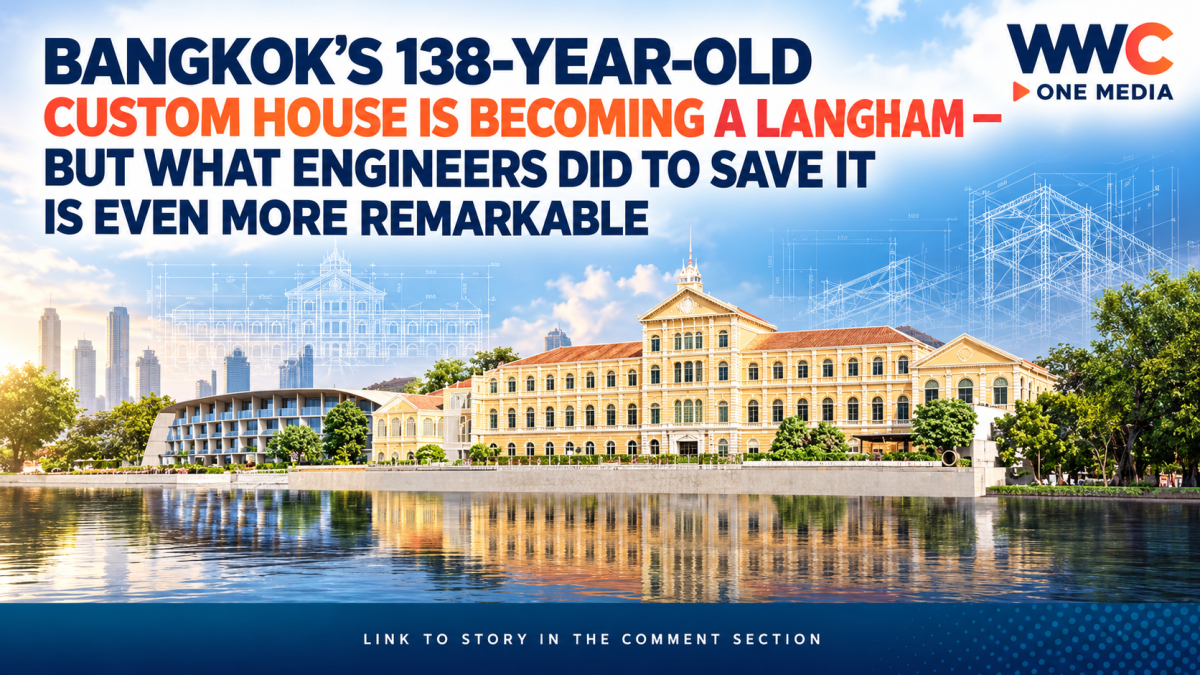
BANGKOK — One of Bangkok’s great riverfront landmarks is about to welcome guests again — but this time they will be checking into a luxury hotel rather than clearing goods through Siamese customs.
The Langham, Custom House, Bangkok is scheduled to open on December 20, 2026, transforming an 1888 landmark on the banks of the Chao Phraya River into an intimate 75-key luxury property following an unusually complex restoration. Reservations are already open.
The project brings together three restored heritage buildings and a newly constructed accommodation wing in Bangkok’s historic Bang Rak district. But instead of filling the old Custom House with hotel rooms, the developers have taken a more unusual approach: all 60 guestrooms and 15 suites are being placed in the contemporary building next door.
The historic structures themselves are being kept largely for restaurants, bars, events and public spaces.
That decision could be what ultimately separates The Langham from Bangkok’s increasingly crowded field of ultra-luxury hotels.
They didn’t just restore the Custom House. They lifted it.
The centrepiece dates to 1888, during the reign of King Rama V, when Bangkok’s Chao Phraya River functioned as the kingdom’s principal gateway to international trade.
Designed by Italian architect Joachim Grassi, the Custom House once received ships, merchants and travellers arriving in Siam. Over subsequent decades, however, its role disappeared. The site was repurposed — including use as a fire station — and eventually deteriorated badly.
Its condition created a problem far more complicated than redecorating an old building.
According to CNA Luxury, parts of the structure had collapsed and the central building had sunk below the modern river level as surrounding roads and flood infrastructure were raised.
The solution was remarkable.
Engineers placed 412 individual jacks underneath the historic structure and gradually raised it over approximately 18 months, moving it only around two to five millimetres at a time.
The restoration team also retained surviving timber and architectural elements wherever possible while using old photographs, historical records, archaeology and physical evidence to determine what could authentically be preserved.
Even the remains of the building’s original mechanical clock were discovered. CNA reports that surviving components traced to a Milanese manufacturer are being incorporated into an artwork for the hotel.
One discovery will literally be beneath guests’ feet
Raising the historic building created space for a new lower-level area known as The Gallery.
Sections of its floor will be made from glass, allowing visitors to see portions of the original foundations below. Ceramics, bottles and other artefacts recovered during excavation are also expected to be displayed there.
The result is meant to make the building’s history visible rather than disguise it beneath a polished hotel renovation.
And there is another important distinction: much of that history will not be hidden behind a room key.
Langham says the restored buildings will function as gathering spaces accessible to hotel guests and visitors, giving Bangkok residents a chance to enter a landmark that had effectively been closed off for years.
Why the hotel rooms are deliberately new
Rather than forcing modern plumbing, air-conditioning, elevators and hotel infrastructure through a fragile 19th-century structure, the property’s accommodation has been moved to a purpose-built wing.
Architect Smith Obayawat of The Office of Bangkok Architects has described the relationship between the old and new buildings as that of a “grandfather” and “grandson” — connected, but intentionally from different generations.
The modern building therefore does not imitate the historic Custom House.
Its curved silhouette responds to the Chao Phraya River, while its glass exterior is designed to capture reflections and changing light from the water. Inside, design references to Thailand’s past are more restrained, appearing in textiles, metals, patterns and furnishings rather than through a theatrical recreation of the 1800s.
Langham’s current materials confirm four broad accommodation categories, with rooms and suites looking towards the river, courtyards and Bangkok skyline.
A three-Michelin-starred Hong Kong restaurant is coming too
The architecture may attract the first wave of attention, but Langham is also placing food and beverage at the centre of the project.
T’ang Court, the Cantonese restaurant at The Langham, Hong Kong that holds three Michelin stars, will open a Bangkok outpost inside the former post and telegraph office.
CNA Luxury reports that additional restaurants are being developed with prominent Bangkok culinary figures, including a two-Michelin-starred chef and a well-known Thai chef whose identities had not yet been publicly announced at the time of publication.
Then there is Crowntail River Bar, named after a type of Siamese fighting fish.
Positioned directly beside the Chao Phraya and equipped with its own pier, the bar is being developed as a destination in its own right rather than simply another hotel lounge.
The property will also include Chuan Spa, Langham’s wellness concept inspired by principles of Traditional Chinese Medicine, as well as a fitness centre and private river experiences.
Want to be among the first guests? It won’t come cheap.
Langham has already launched its inaugural-season package, The Grand Arrival, covering stays from December 20, 2026 through March 31, 2027.
The current opening package starts at THB131,888++ for three nights in a Classic Room.
The package includes airport fast-track service for two, Mercedes-Maybach transfers, T’ang Court dining, afternoon tea, sunset cocktails, breakfast, spa treatments and a private heritage tour of the Custom House.
Suite packages start from THB248,888++ for three nights, with some categories rising above THB300,000 before taxes and service charges.
There is one number that needs context
CNA Luxury quotes hotel general manager Nick Downing as saying around US$250 million has been invested in the project.
Earlier Thai business reports, however, described the development as a roughly 6-billion-baht project. Bangkok Post reported that figure when Langham and Rabbit Holdings announced the hotel in 2024, while The Nation cited more than 6 billion baht again in August 2026.
Those figures may refer to different project scopes or stages of investment, so treating them as directly interchangeable would be misleading.
There has also been a room-count revision. Reports from 2024 frequently described the project as having 78 rooms, while Langham’s updated 2026 materials now consistently specify 75 keys: 60 guestrooms and 15 suites.
More than another Bangkok luxury hotel
Bangkok has no shortage of five-star openings, particularly along the Chao Phraya.
What makes The Langham, Custom House different is that the expensive part of the project may not ultimately be the marble, suites or chauffeured cars.
It is the decision to preserve a building that had already survived almost 140 years — and then design the hotel around it rather than force the landmark to fit the hotel.
Langham Hospitality Group first announced the development with Rabbit Holdings in 2024. Bangkok Post described the project as the hospitality group’s return to Thailand after more than 12 years, noting that it had previously managed a resort on Koh Samui. That makes descriptions of the Bangkok hotel as Langham’s absolute “Thailand debut” potentially misleading; it is more accurately the group’s return to the Thai market and a major new Bangkok flagship.
When the doors open on December 20, visitors will find contemporary suites, Michelin-starred dining and all the expected markers of modern luxury.
But the hotel’s biggest selling point may be something money could not simply build from scratch:
a piece of Bangkok that nearly disappeared — now preparing to face the river for another century.



Leave a Reply