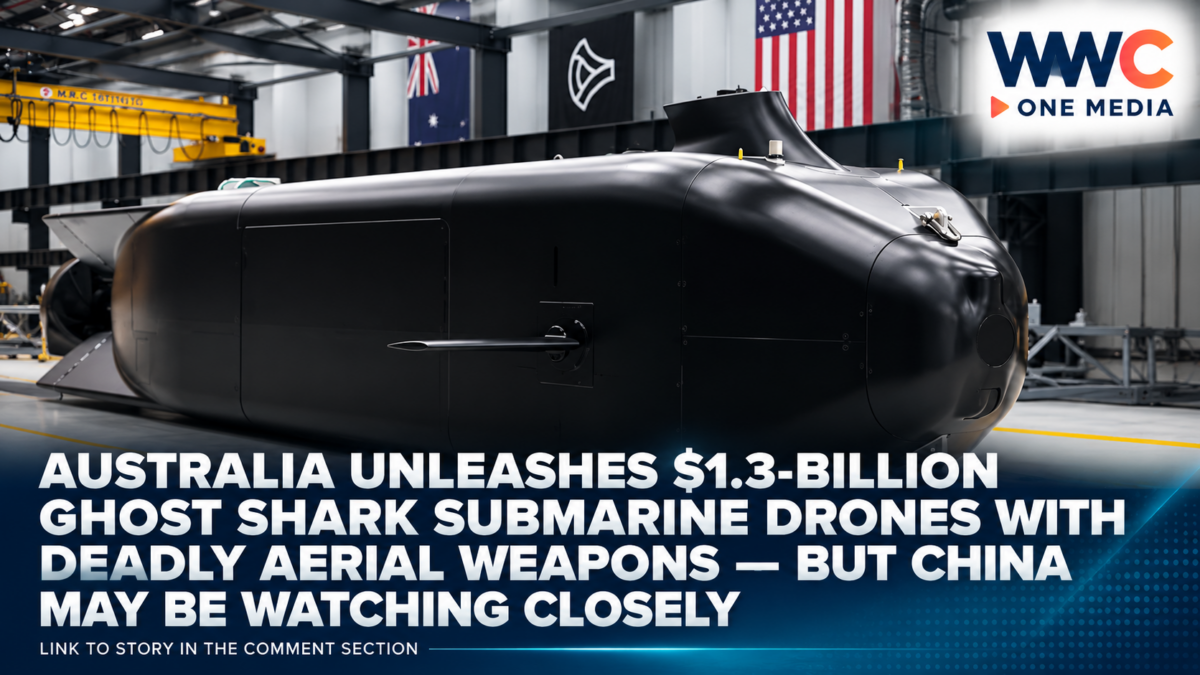
SYDNEY, AUSTRALIA — Australia has revealed new offensive capabilities for its futuristic Ghost Shark underwater drone fleet, confirming that the autonomous submarines can launch armed aerial drones, deploy naval mines and support special forces operations — a major step in Canberra’s push to transform warfare beneath the Indo-Pacific.
The announcement on October 19 marks a significant development in Australia’s military modernization strategy as regional powers invest heavily in artificial intelligence, unmanned weapons and advanced undersea surveillance.
Developed by American defense technology company Anduril Industries in partnership with Australia’s defense scientists, the Ghost Shark is an extra-large autonomous underwater vehicle designed to travel vast distances without a human crew.
Unlike conventional submarines, which depend on sailors operating onboard, Ghost Shark can undertake dangerous missions remotely or autonomously, allowing the Royal Australian Navy to extend its operational reach while reducing risks to personnel.
Ghost Shark Gets Teeth: A Submarine That Can Launch Drones
Australian Defence Industry Minister Pat Conroy disclosed that the military had approved three major mission payloads following previously classified trials.
These capabilities include launching Anduril’s Altius aerial drones for intelligence gathering and strikes, deploying up to 12 naval mines, and transporting specialized supply caches for military personnel operating in remote areas.
According to ABC News Australia, the aerial drones can carry explosive payloads weighing around four kilograms, giving the underwater platform an ability to support attacks beyond the sea itself.
The system is particularly significant because it combines underwater mobility with aerial operations. A Ghost Shark could approach an operational area beneath the surface before launching drones to conduct reconnaissance or strike designated targets.
Speaking at Anduril’s Australian manufacturing facility, Conroy declared:
“Those Ghost Sharks now have teeth.”
The statement reflects Australia’s effort to develop a more flexible deterrent against potential threats across the Indo-Pacific.
A$1.7 Billion Fleet Becomes Part of a Bigger Military Investment
Australia’s Department of Defence confirmed that the government is investing A$1.7 billion to acquire a fleet of Australian-designed and manufactured Ghost Shark vehicles.
The investment sits within a broader allocation of up to A$5.8 billion over a decade for autonomous and uncrewed undersea warfare systems.
The first Ghost Shark under the fleet program was delivered in January 2026, according to ABC News, with further deliveries expected over the coming years.
The Australian government has not publicly disclosed the final fleet size, although officials have indicated that dozens of systems are planned.
The submarine drones are designed to complement Australia’s crewed vessels rather than directly replace them, taking on hazardous surveillance, mine deployment and other missions while traditional submarines concentrate on operations requiring human crews.
AUKUS Partners Prepare for a New Era of Underwater Combat
The Ghost Shark program is also becoming an important part of the AUKUS security partnership involving Australia, the United States and the United Kingdom.
Under AUKUS Pillar II, the three countries are cooperating on advanced defense technologies, including autonomous systems and interchangeable underwater payloads.
Australia’s latest developments are being demonstrated during Exercise Maritime Big Play Pacific in San Diego, where allied militaries are testing how different underwater systems can support coordinated operations.
This cooperation is separate from AUKUS Pillar I, the initiative intended to equip Australia with conventionally armed, nuclear-powered submarines.
The distinction matters: autonomous underwater drones could provide additional military capabilities while Australia continues the much longer process of building its nuclear-powered submarine force.
Australian officials have also indicated that the technologies could be shared with Washington and London, potentially strengthening interoperability among the three naval powers.
Why China’s Naval Expansion Is Part of the Bigger Story
Australia’s growing interest in autonomous undersea warfare comes amid heightened strategic competition in the Indo-Pacific, particularly as China expands its naval forces and develops increasingly sophisticated underwater technologies.
The South China Sea remains an area of serious security concern because of competing territorial claims, extensive shipping routes and recurring confrontations involving regional governments.
Australian military planners see autonomous underwater systems as a potentially valuable means of protecting maritime approaches, monitoring critical infrastructure and complicating an adversary’s operational planning.
Sea mines could help deny access to strategically important waterways, while long-range underwater drones could extend surveillance coverage without requiring a conventional submarine to remain in a dangerous location.
However, the new capabilities should not be interpreted as evidence that Australia is preparing an imminent military operation against China. Canberra has publicly framed its investment around deterrence, national defense and the protection of regional security interests.
Why the Philippines and Southeast Asia Should Pay Attention
For the Philippines and other Southeast Asian countries, Australia’s development of advanced underwater drones highlights how quickly maritime security technology is evolving.
The South China Sea’s disputed waters, vital commercial sea lanes and growing use of unmanned surveillance platforms make undersea capabilities increasingly relevant to regional defense planning.
Autonomous underwater vehicles could eventually play larger roles in monitoring submarine activity, surveying seabed infrastructure and protecting important maritime routes.
But there are also strategic questions.
As underwater military drones become more capable and potentially more affordable than conventional crewed platforms, more countries could seek similar systems, raising concerns about surveillance, escalation and the difficulty of detecting autonomous military activities at sea.
For the Philippines, the immediate significance is not a newly announced deployment in Philippine waters, but the broader possibility that advanced unmanned systems will reshape how Indo-Pacific navies operate.
The Bigger Question: Can Autonomous Submarines Change the Balance of Power?
Australia’s Ghost Shark represents more than a new military machine. It reflects a strategic shift toward combining conventional warships, crewed submarines and increasingly sophisticated autonomous platforms.
The technology promises to distribute military capabilities across more platforms, reduce risks to sailors and give commanders additional options for surveillance and deterrence.
Still, important questions remain about reliability, communications, operational effectiveness, human control over weapons and how these systems would perform in contested maritime environments.
Australia has demonstrated and announced significant progress, but the full combat effectiveness of the Ghost Shark fleet has yet to be established publicly.
For Canberra, the Ghost Shark could become a major addition to its naval defenses. For the wider Indo-Pacific, it signals something even more consequential: future maritime competition may increasingly be fought by machines operating far beneath the ocean surface.