
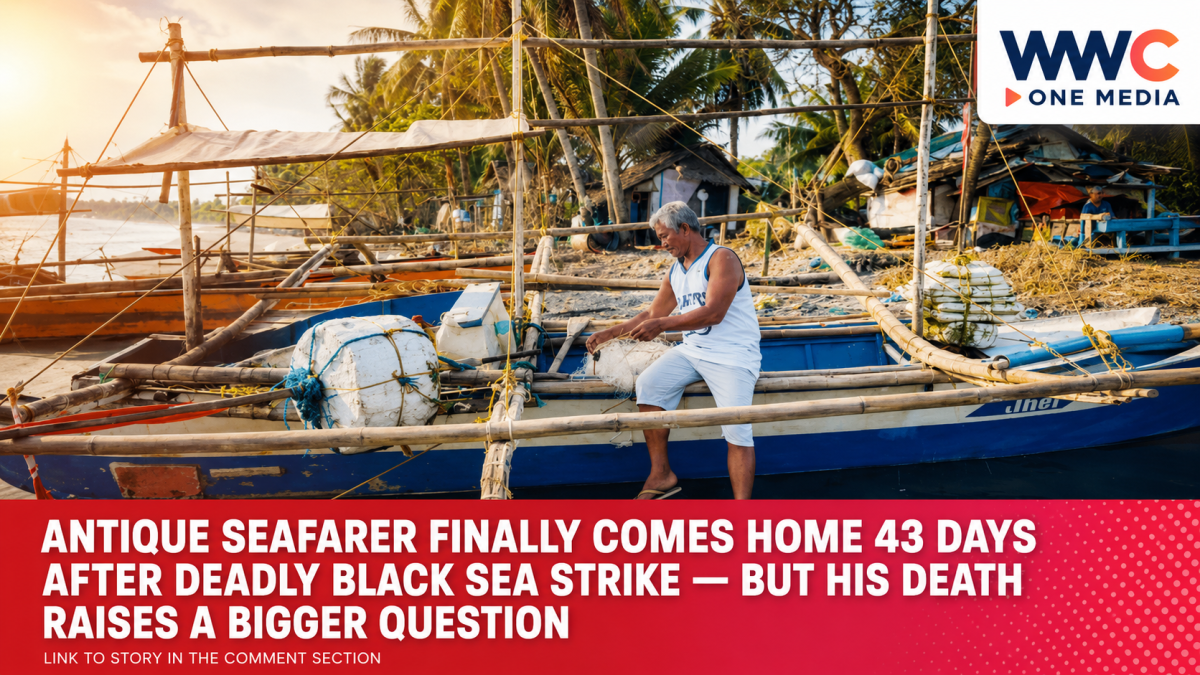
ANTIQUE, Philippines — After more than six weeks of uncertainty, appeals and painful waiting, Filipino seafarer Jude Prado Pagunsan has finally returned home to Antique.
But not in the homecoming his family had prayed for.
The remains of the 37-year-old seafarer from Sitio Wayang, Barangay Ubos in Valderrama, Antique arrived at Iloilo International Airport on August 30, more than a month after the commercial vessel he was serving aboard was caught in a deadly Russian attack in the Black Sea near southern Ukraine.
Pagunsan was an able seaman aboard the Antigua and Barbuda-flagged bulk carrier M/V Venturo when the vessel was struck in the Odesa region in July.
Ukrainian authorities reported that the Venturo was badly damaged and lost its ability to move after the Russian strike. One civilian crew member was killed, while Ukrainian Navy personnel launched a rescue operation despite the continuing threat of attacks and evacuated 17 Filipino seafarers to shore.
The rescue operation did not end there.
Ukrainian reports said another Filipino crew member, identified as the vessel’s electro-mechanical engineer, was later found drifting in a lifeboat in the Black Sea. Maritime border guards rescued him during a nighttime operation conducted under the threat of further drone strikes. He was later reported to be in satisfactory condition.
For Pagunsan’s family in Antique, however, the days after the attack became a different kind of ordeal.
Relatives publicly appealed for help in recovering and bringing his remains back to the Philippines. His family had been waiting for information as government agencies, the shipowner and the manning agency worked through the complicated process of retrieving and repatriating a Filipino worker from an active war zone.
Department of Migrant Workers Secretary Hans Leo Cacdac later visited Pagunsan’s family in Valderrama and assured them of government assistance. The DMW said support would include help with repatriation and employment-related benefits, while the Overseas Workers Welfare Administration was expected to assist with funeral arrangements. Assistance for the educational needs of Pagunsan’s children was also discussed.
The tragedy, however, extends far beyond one Filipino family.
By July 20, the DMW had recorded attacks involving nine commercial vessels carrying around 139 Filipino seafarers in the Black Sea. At that point, two Filipinos had been killed, 12 injured and one reported missing, while 124 were safe and unharmed.
Most of those incidents involved drone strikes on bulk carriers and tankers operating near Ukrainian and Russian ports, according to the DMW.
The figures worsened as attacks continued.
By August 1, the DMW said 17 commercial vessels carrying 236 Filipino seafarers had been affected by drone and missile strikes near Ukrainian ports. Three Filipinos had died, 15 had been injured and one remained missing. Eighty-nine affected Filipino seafarers had already returned home by then.
Among those eventually repatriated were survivors from the Venturo. Five Filipino crew members from the vessel arrived in Manila on July 31, with more members of the crew expected to follow. Returning seafarers were provided assistance and were directed to undergo appropriate medical and psychological assessments following their experience in the conflict zone.
A War Zone Filipino Seafarers Cannot Ignore
The escalating attacks have forced Philippine authorities to reinforce warnings about sending Filipino mariners into the northern Black Sea.
The DMW has classified the area as a high-risk or warlike zone and reminded shipping companies and licensed manning agencies about safety protocols covering Filipino crews.
Cacdac has also emphasized that Filipino seafarers have protections when asked to sail into designated dangerous areas. The DMW has said workers may exercise the right to refuse sailing into high-risk or warlike areas under applicable arrangements, with provisions covering compensation, repatriation and protection against employment discrimination.
That warning has become increasingly urgent.
The Black Sea remains one of the most important maritime corridors connecting Ukraine’s agricultural exports and other commodities to global markets. But as Russian attacks increasingly hit ports, anchorages, infrastructure and merchant vessels, civilian mariners can find themselves working only kilometers from an active battlefield.
An analysis by the Centre for Eastern Studies reported that attacks on Ukrainian maritime infrastructure intensified sharply in July, with ships in ports and at sea repeatedly damaged and crew members killed or wounded.
A Family’s Long Wait Ends
Pagunsan’s remains were received at Iloilo International Airport by his family along with representatives from the DMW, OWWA and the Antique provincial government.
His wake is being held at the family’s residence in Barangay Ubos.
The family has scheduled his funeral Mass for September 5 at St. Luke the Evangelist Parish Church in Valderrama, followed by his interment at the Roman Catholic Cemetery.
There may also be longer-term assistance for the family left behind. The Philippine News Agency reported on September 1 that Antique provincial officials were being urged to consider Pagunsan’s partner for a locally funded teaching position.
For his loved ones, the repatriation brings an end to one agonizing chapter.
For thousands of Filipino seafarers whose livelihoods take them through some of the world’s most dangerous waters, Pagunsan’s death leaves a harder question unanswered:
How much risk should a worker be expected to accept simply to earn a living at sea?
WWC ONE MEDIA MJE




Leave a Reply