
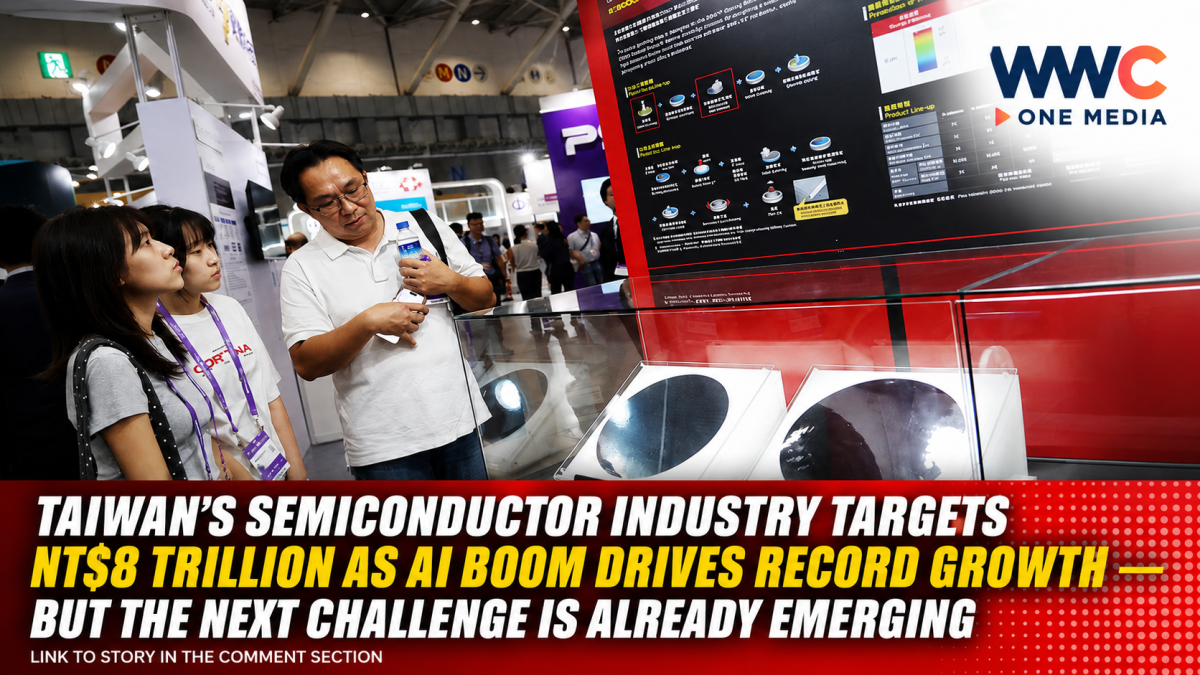
TAIPEI — Taiwan is setting its sights on another major semiconductor milestone, with the government pushing to lift the industry’s total output above NT$8 trillion (about US$251.8 billion) in 2026 as artificial intelligence and high-performance computing continue to reshape global chip demand.
The ambitious target underscores Taiwan’s critical position at the heart of the global semiconductor supply chain, particularly as demand accelerates for advanced processors, high-bandwidth memory, advanced packaging and other technologies needed to power AI systems.
According to Taiwan News, citing UDN Money, Taiwan’s semiconductor industry has expanded rapidly in recent years, with total output rising from approximately NT$4.3 trillion in 2023 to NT$5.3 trillion in 2024 and about NT$6.5 trillion in 2025.
The figure reported by Taiwan’s premier is slightly higher for 2025 at approximately NT$6.7 trillion, equivalent to US$209.1 billion, representing a 22.7% increase from the previous year.
AI is becoming Taiwan’s biggest growth engine
Taiwan’s semiconductor expansion is increasingly being powered by the worldwide AI boom.
As companies race to build increasingly powerful AI models and data centers, demand is growing for high-performance computing chips and the sophisticated manufacturing and packaging technologies required to assemble them.
Premier Cho Jung-tai said at SEMICON Taiwan 2026 that Taiwan remains central to the global AI revolution and that the government intends to provide the land, energy, talent and financing needed to support continued semiconductor expansion.
The scale of the industry’s importance was also reflected at SEMICON Taiwan, where more than 1,300 exhibitors and 4,300 booths from more than 60 countries and regions are participating.
Taiwan wants more than just chipmaking
The government’s strategy goes beyond wafer manufacturing.
Taiwan’s Industrial Development Administration says it has already supported 84 chip-design and semiconductor-equipment companies as part of an effort to strengthen the domestic ecosystem.
Of those, 29 equipment suppliers have worked with major chipmakers and packaging companies, including TSMC and ASE, to develop and validate new equipment on production lines.
Officials expect domestic semiconductor-equipment production to exceed NT$270 billion in 2026, strengthening Taiwan’s ability to supply more of the technology required by its own chip industry.
That shift is strategically important.
Taiwan is already one of the world’s most important semiconductor manufacturing centers, but increasing domestic capabilities in chip design, equipment, materials and packaging could make its supply chain more resilient while creating new opportunities for smaller Taiwanese technology companies.
Advanced packaging becomes the next battleground
One of the most important developments is taking place after the chips are manufactured.
As AI processors become larger and incorporate more components, advanced packaging is becoming increasingly important to performance and manufacturing yields.
Taiwanese authorities say domestic companies are developing equipment capable of handling different chip sizes and orientations while using image-based alignment technology to improve precision.
One government-supported system developed by Gallant Micro Machining is reported to reduce processing time by 50% by allowing different chips to be processed on a single machine rather than transferred between multiple machines.
The importance of advanced packaging is also reflected in TSMC’s expansion plans.
TSMC is working with Taiwan’s Ministry of Economic Affairs and Kaohsiung authorities to develop the Baipu Industrial Park into a hub for packaging materials and applications. TSMC said demand for its Chip-on-Wafer-on-Substrate (CoWoS) advanced packaging technology is expected to grow at a compound annual rate of more than 80% from 2027 through 2029.
That matters because AI chips increasingly depend not only on cutting-edge transistor technology, but also on how multiple components can be connected and packaged together efficiently.
Taiwan is also preparing for the infrastructure crunch
The semiconductor boom comes with another challenge: expansion requires enormous amounts of land, electricity, factories, workers and supporting infrastructure.
Premier Cho has said the government plans to prepare ready-to-use industrial sites and factory facilities so semiconductor and technology companies can begin operations more quickly instead of facing lengthy development delays.
The government is also assessing the additional electricity demand that will come with AI-related industrial expansion.
This could become one of the most closely watched issues as Taiwan attempts to grow its semiconductor industry while maintaining reliable power supplies for increasingly energy-intensive manufacturing operations.
Taiwan’s chip dominance faces a changing global landscape
Taiwan’s semiconductor strength is also attracting greater international attention.
President Lai Ching-te recently emphasized Taiwan’s role as a reliable global technology partner, arguing that its semiconductor advantage is supported by democratic governance and the rule of law.
At the same time, major semiconductor companies are expanding internationally as governments seek to diversify supply chains.
TSMC, the world’s largest contract chipmaker, is expanding its manufacturing footprint outside Taiwan, including a major investment in the United States. Reuters reported that TSMC has committed $265 billion to its Arizona expansion, while also pursuing a factory project in Germany.
But Taiwan is simultaneously increasing investment at home.
The Executive Yuan says Taiwan’s semiconductor industry could reach approximately NT$8.4 trillion in 2026, based on industry research estimates, while TSMC is continuing construction of advanced manufacturing and packaging facilities in Taiwan.
The bigger story
The NT$8 trillion target is therefore about more than a single industry milestone.
It reflects Taiwan’s attempt to maintain its position at the center of the global AI economy while strengthening the domestic ecosystem that supports semiconductor production.
The race is no longer simply about who can manufacture the smallest chips.
It is increasingly about who can provide the advanced packaging, equipment, energy, talent and supply-chain infrastructure needed to turn increasingly complex AI processors into commercially viable products.
And with AI demand still expanding, Taiwan appears determined to remain at the center of that race.
The question now is whether Taiwan can expand fast enough to capture the next wave of AI demand — without allowing power, talent, equipment and advanced-packaging constraints to become the very bottlenecks that limit its growth.
WWC ONE MEDIA G.A




Leave a Reply