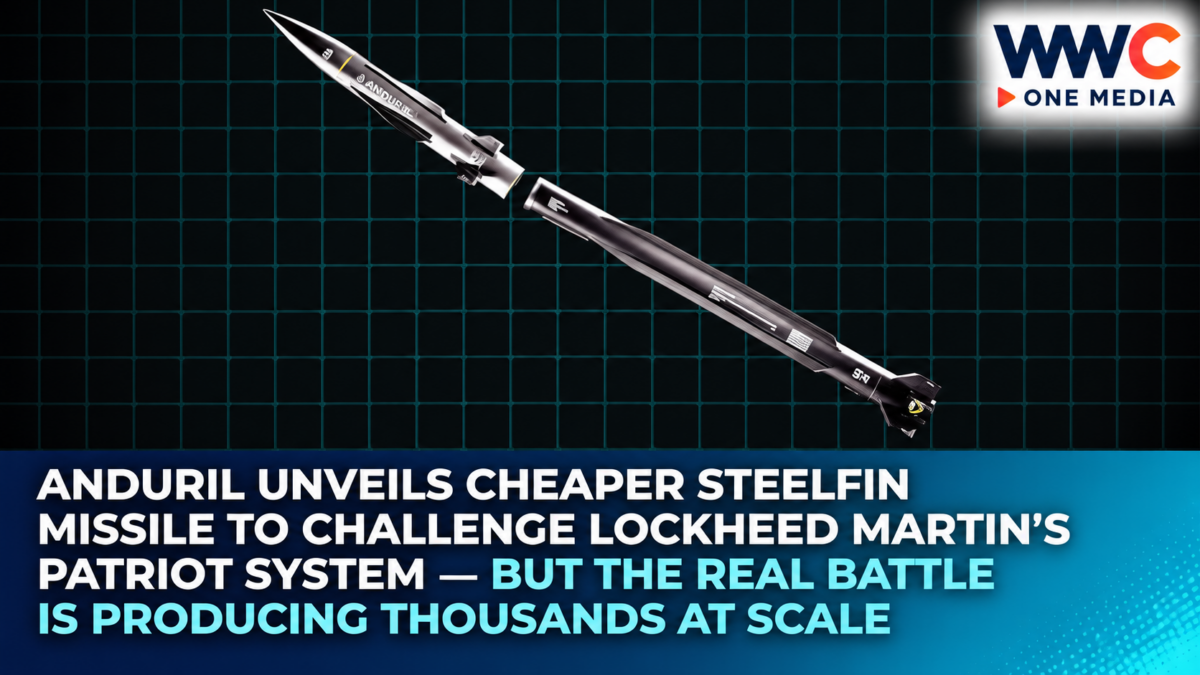
WASHINGTON, United States — American defense technology company Anduril Industries is challenging the dominance of traditional military contractors with a new family of lower-cost missile interceptors designed to counter drones, cruise missiles and other increasingly sophisticated aerial threats.
The company unveiled its Steelfin interceptor family on October 12, 2026, introducing a modular missile architecture intended to make advanced air defense more affordable and easier to manufacture in large quantities.
According to reporting from Bloomberg, Reuters and Breaking Defense, Anduril is targeting a version of Steelfin priced at approximately one-third the cost of Lockheed Martin’s Patriot Advanced Capability-3 Missile Segment Enhancement, commonly known as PAC-3 MSE.
But the proposed price advantage has not yet been demonstrated through large-scale production or a publicly verified procurement contract.
For the Pentagon and American allies, the announcement addresses an increasingly urgent problem: expensive defensive missiles are being consumed at a rapid pace as modern conflicts involve large numbers of comparatively inexpensive drones and other aerial weapons.
The bigger question is whether Anduril can translate its promised cost savings into proven battlefield performance while producing enough interceptors to meet rapidly expanding global demand.
Anduril Challenges the Economics of Modern Missile Defense
The rise of relatively inexpensive attack drones has exposed a fundamental weakness in traditional air defense economics.
Countries may be forced to use costly interceptor missiles against threats that are substantially cheaper to manufacture.
This creates a potentially unsustainable imbalance during prolonged conflicts, especially when attackers can launch large numbers of weapons.
Advanced systems such as Patriot remain important for defending against dangerous threats, including ballistic missiles.
However, their sophisticated interceptors can cost several million dollars each, depending on the variant, contract and procurement arrangements.
Anduril believes a more flexible missile design could help close the gap between defensive costs and incoming threats.
Its Steelfin family is intended to provide different configurations for different threat categories, allowing military operators to select an appropriate interceptor without relying on the most expensive option for every engagement.
The strategy reflects a growing shift in the defense industry toward affordable mass, modular systems and faster manufacturing.
But lower prices alone will not determine whether the new weapon succeeds.
Reliability, accuracy, integration and actual combat effectiveness will remain essential.
How the Steelfin Missile System Works
Anduril designed Steelfin around a two-stage architecture intended to support multiple interceptor variants.
The first stage uses a booster to provide the required launch performance and range.
The second stage contains a common terminal interceptor architecture incorporating critical components such as the airframe, avionics and flight-control systems.
The modular approach allows the company to adapt different elements of the interceptor without designing a completely separate missile for every mission.
According to Aviation Week, Anduril has described booster configurations with diameters of approximately 10, 18 and 21 inches.
The company is also pursuing compatibility with different seekers and launch platforms.
This design philosophy aims to simplify manufacturing, shorten development cycles and reduce supply-chain complexity.
For military customers, the concept could offer more flexibility in responding to aerial threats.
However, the capability of each configuration will need to be established through testing.
No publicly verified evidence available on October 12 establishes that the entire Steelfin family has completed all required operational qualification trials.
Targets Range From Low-Cost Drones to Advanced Missiles
Anduril is positioning Steelfin to address a broad spectrum of aerial threats.
These include one-way attack drones, cruise missiles, ballistic missiles and potentially certain high-speed threats.
The company has highlighted the need to defend against weapons similar to Iran’s Shahed drones, which have become prominent in modern conflicts.
These relatively inexpensive systems can be deployed in large numbers, placing pressure on air defenses and interceptor inventories.
At the other end of the spectrum, advanced cruise and ballistic missiles require more sophisticated defensive capabilities.
Anduril’s modular design is intended to allow different interceptor configurations to address different missions.
But this does not mean a single Steelfin variant has been proven capable of defeating every threat category.
Actual performance will depend on configuration, sensors, guidance, propulsion and operational testing.
The company’s challenge is to demonstrate that its family of missiles can deliver sufficient performance across different defensive roles without losing the cost advantages it promises.
A Direct Challenge to Lockheed Martin’s PAC-3 Business
Steelfin’s introduction places Anduril in closer competition with established defense companies.
Lockheed Martin’s PAC-3 MSE is an important element of the US Army’s air and missile defense capabilities and is used by several American allies.
The Patriot system has become particularly relevant during periods of intensified missile attacks and heightened concerns over interceptor availability.
Anduril is attempting to offer the military a lower-cost alternative for selected missions.
Breaking Defense reported that the company is targeting approximately one-third of the PAC-3 MSE’s cost.
That is an ambitious target, not a confirmed market price.
The two systems also should not be treated as interchangeable until testing establishes their respective capabilities and operational requirements.
Legacy interceptors have extensive development, testing and operational histories.
New entrants must satisfy demanding military performance and reliability standards before procurement decisions can be made.
Still, Anduril’s entrance increases competitive pressure in a market traditionally dominated by a small number of large contractors.
Pentagon Searches for Affordable Missile Interceptors
The US Army is expanding efforts to identify lower-cost interceptor technologies.
Anduril is participating in the Army’s efforts to find more affordable defensive missiles and was selected to proceed with testing and demonstrations following the xTech Apex Intercept competition.
The initiative is intended to encourage companies to offer innovative solutions that could strengthen air defense capacity.
Anduril has also described Steelfin as a potential fit for the Army’s Future Interceptor requirements.
However, the company did not confirm that Steelfin had secured a selection under that separate program.
This distinction matters.
Participation in research, evaluation or competitive demonstrations does not equal an awarded production contract.
The US military must still determine whether proposed technologies meet its operational requirements and provide adequate value for money.
Anduril Targets Thousands of Missiles Annually
Manufacturing scale is one of Anduril’s central selling points.
Company executives said they intend to reach full-rate Steelfin production around late 2028 or early 2029.
Their near-term production ambitions involve multiple thousands of missiles annually, subject to market demand and procurement decisions.
Anduril has also discussed the possibility of much greater output if customers require it.
These figures represent manufacturing ambitions rather than current production achievements.
The company plans to manufacture many missile subassemblies at its Arsenal-1 facility in Ohio and conduct final integration with selected partners.
A common architecture could allow multiple missile variants to share production infrastructure.
This may reduce duplication and make it easier to adjust production according to military requirements.
However, large-scale manufacturing still depends on access to components, skilled employees, specialized equipment, testing infrastructure and reliable suppliers.
Anduril must demonstrate that its proposed production model can consistently deliver qualified weapons.
Flight Testing Expected in 2027
Steelfin remains under development.
Reuters reported on October 12 that Anduril had completed initial ballistic testing and intended to begin flight testing in 2027.
This is a significant development milestone, but it is not the same as completing operational qualification.
Flight testing will help assess whether the interceptor performs as intended under realistic conditions.
Additional evaluations may be necessary before the missile can be considered ready for operational deployment.
The timeline creates an important distinction between Anduril’s announcement and established missile-defense products already in service.
For investors and defense customers, the coming testing program will be an important indicator of whether the company’s affordability and performance objectives can be achieved simultaneously.
Iran Conflict Intensifies Demand for Air Defense
Anduril’s missile announcement comes as military conflicts expose growing pressure on interceptor inventories.
The war involving Iran has increased concerns about attacks using drones and missiles, while Russia’s continuing war against Ukraine has demonstrated the challenges of sustaining air defenses during prolonged hostilities.
Reuters has reported growing interest in expanding interceptor production as the United States and its allies seek to rebuild stockpiles.
The problem is not simply the unit cost of individual missiles.
It is also the time required to produce replacements.
A defensive system can become less effective if its interceptors are exhausted faster than manufacturers can replenish them.
This creates strong incentives for weapons that are both technically capable and practical to manufacture in larger quantities.
For governments, a more diverse industrial supplier base could also reduce dependence on a limited number of manufacturers.
But expanding the supplier base must not come at the expense of reliability or battlefield performance.
Lockheed Martin and Other Defense Giants Are Fighting Back
Traditional defense contractors are not standing still.
Lockheed Martin, Boeing, RTX’s Raytheon and Northrop Grumman are pursuing their own approaches to increasing missile production and lowering costs.
Bloomberg reported in August that major contractors were adjusting designs and manufacturing strategies as the Pentagon looked for more affordable interceptors.
Lockheed Martin has also introduced new concepts intended to improve the economics and availability of missile defense.
The emergence of companies such as Anduril is therefore intensifying competition rather than guaranteeing that established manufacturers will lose market share.
Large defense contractors retain important advantages, including established production facilities, technical expertise, military relationships and operationally proven products.
Newer companies may offer greater design flexibility and different manufacturing approaches.
The outcome will depend on procurement competitions, testing results and actual delivery performance.
Anduril’s Wider Expansion Includes a $6.6-Billion Submarine Project
Steelfin is part of a broader expansion by Anduril into major defense manufacturing programs.
On October 6, the company announced a large submarine industrial project in Sparrows Point, Maryland.
The initiative involves approximately $3.7 billion in private investment from Anduril and $2.9 billion in US Navy procurement commitments, for a combined figure of roughly $6.6 billion.
The planned Arsenal-2 facility would manufacture components supporting the Navy’s Virginia-class nuclear-powered submarines.
Anduril has described the project as an opportunity to modernize shipbuilding through automation, software and new production techniques.
The facility is expected to begin production around 2030, subject to execution of the development plans.
The submarine project illustrates how Anduril is attempting to move beyond its original reputation as a defense technology startup.
It is increasingly competing for programs involving large-scale industrial production and long-term military procurement.
However, submarine manufacturing and missile production present different technical requirements and should not be treated as equivalent capabilities.
Boeing Partnership Shows Anduril Can Also Work With Defense Giants
Despite its growing competition with traditional contractors, Anduril is also collaborating with them.
In September 2026, Boeing announced that its interceptor proposal developed with Anduril had advanced in the US Army’s Integrated Fires Protection Capability competition.
The proposal uses Boeing’s missile technologies alongside propulsion capabilities from Anduril.
The program is designed to improve protection against cruise missiles, hostile drones and other aerial threats.
That partnership is separate from Anduril’s newly unveiled Steelfin family.
The collaboration demonstrates that the evolving defense market is not simply a battle between startups and established manufacturers.
Instead, companies are forming combinations that bring together proven expertise and newer production technologies.
For Anduril, such partnerships may also provide opportunities to demonstrate its manufacturing capabilities before expanding independently into additional military programs.
Why the Missile Industry’s Economics Are Changing
Modern military strategy increasingly emphasizes the ability to maintain operations during prolonged conflicts.
A country may possess advanced weapons, but its defensive capabilities can become strained if inventory levels cannot be restored quickly.
This is especially important when attackers use large numbers of inexpensive weapons.
An effective response may involve several layers of defense, including electronic warfare, guns, short-range interceptors and more advanced missile systems.
No single weapon is likely to provide the most economical solution against every threat.
Anduril’s strategy is based on making missile defense more adaptable to the cost and complexity of different attacks.
If the company achieves its targets, it could help military customers increase the number of available interceptors without raising spending at the same rate.
But affordability must be evaluated alongside total operating costs, integration expenses, maintenance, training and proven effectiveness.
A missile that costs less to purchase is not necessarily more economical if it performs less reliably or requires additional supporting infrastructure.
The Bigger Question: Can Anduril Reshape the Defense Industry?
Steelfin’s introduction marks another attempt by Anduril to challenge established defense procurement practices.
The company is betting that modular engineering, standardized components and high-volume manufacturing can improve the economics of advanced weapons.
Its ambitions reflect growing demand among the United States and allied governments for weapons that can be produced more quickly and in larger quantities.
However, the gap between announcing an innovative design and delivering an operational missile system remains substantial.
Anduril must complete flight testing, secure procurement contracts, qualify manufacturing processes and demonstrate reliable performance.
It must also show that the proposed cost advantages remain achievable when missiles are produced and delivered at scale.
The company has unveiled a potentially important competitor in the missile-defense market, but its promised affordability has yet to be demonstrated in operational service.
For established contractors such as Lockheed Martin, the emergence of lower-cost alternatives could intensify pressure to improve manufacturing efficiency and pricing.
For the Pentagon, increased competition could create opportunities to build larger and more flexible interceptor inventories.
And for Anduril, Steelfin represents a test of whether its industrial ambitions can translate into a durable position in one of the world’s most demanding defense markets.
Anduril wants to prove that advanced missile defense no longer has to depend exclusively on expensive weapons from traditional contractors — but the real test begins when its cheaper Steelfin design must deliver performance, affordability and thousands of missiles on schedule.