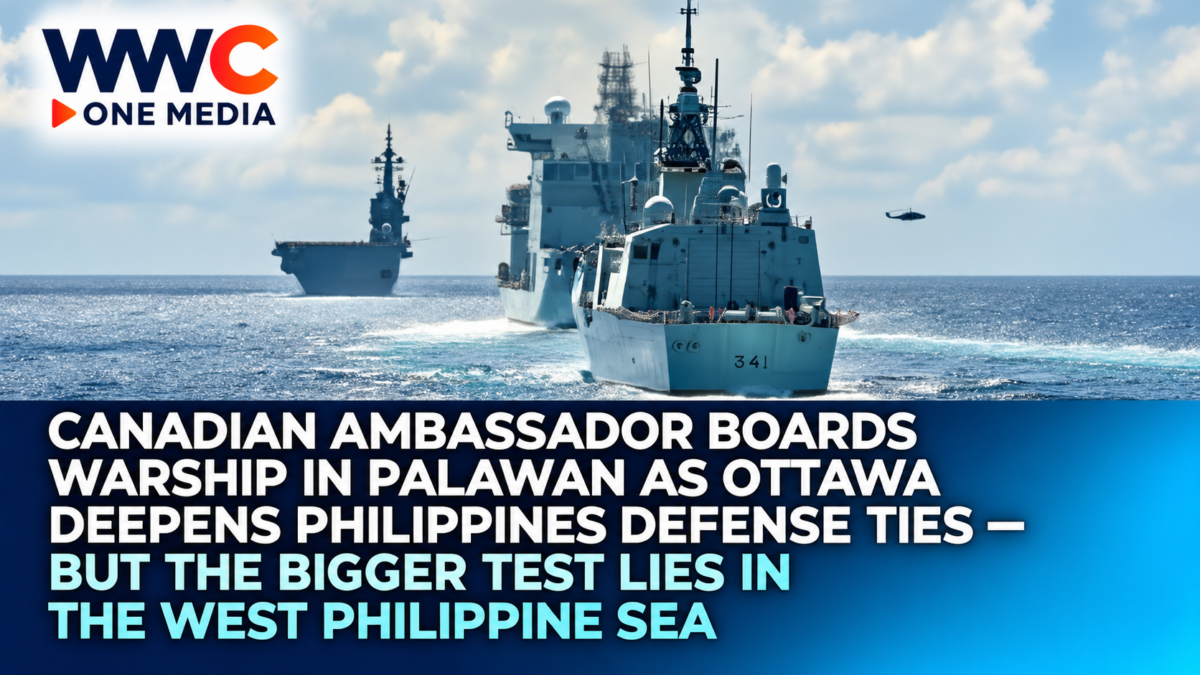
PUERTO PRINCESA, Philippines — October 12, 2026 — Canadian Ambassador to the Philippines David Hartman visited the Royal Canadian Navy frigate HMCS Regina during its port stop in Puerto Princesa, Palawan, highlighting Canada’s growing military presence and defense cooperation with Manila amid continuing maritime security concerns in the Indo-Pacific.
The visit offered Hartman an opportunity to meet Canadian sailors, learn about the vessel’s mission and gain firsthand insight into Ottawa’s expanding naval activities in the region.
According to Bilyonaryo, the warship was visiting the Philippines as part of Operation HORIZON, Canada’s continuing military deployment focused on strengthening partnerships, maritime cooperation and regional security.
The stop also carries broader strategic significance.
Palawan is a key Philippine maritime province facing the West Philippine Sea, where Manila has repeatedly confronted Chinese vessels over disputed maritime rights.
Canada has become an increasingly visible security partner of the Philippines through joint maritime activities, defense exchanges and naval deployments.
But the bigger question is whether Ottawa’s growing presence can translate into stronger Philippine maritime security as competition intensifies across the South China Sea.
Canadian Ambassador Hartman Visits HMCS Regina
Hartman’s visit aboard HMCS Regina was reported by Bilyonaryo on October 12.
During the stop in Puerto Princesa, the Canadian envoy met members of the ship’s crew and learned more about the Royal Canadian Navy’s operations in Southeast Asia.
The engagement focused on Canada’s military presence and cooperation with regional partners.
HMCS Regina is a Halifax-class frigate operated by the Royal Canadian Navy.
Vessels of this class are designed for a range of naval missions, including maritime surveillance, patrol operations and participation in multinational exercises.
The ship’s presence in Palawan underscores Canada’s ability to deploy naval assets far from its home waters.
It also creates opportunities for diplomatic engagement with Philippine authorities and cooperation between the two countries’ armed forces.
However, the reported port visit was not described as a combat operation or a response to a specific maritime confrontation.
Operation HORIZON Expands Canada’s Presence in Asia
HMCS Regina’s visit forms part of Operation HORIZON, Canada’s ongoing effort to maintain a more consistent military presence in the Indo-Pacific.
The operation supports Ottawa’s broader Indo-Pacific Strategy, which places greater emphasis on maritime security, partnerships and cooperation with regional countries.
Canadian naval deployments under the operation have included port visits, military exercises, maritime surveillance and coordinated activities with allies.
The Canadian government says the objective is to support regional stability and respect for international law.
For the Philippines, the operation provides additional opportunities to train alongside a military partner with established experience in naval operations.
Canada’s participation also illustrates how security relationships in Southeast Asia are expanding beyond traditional regional partners.
Canada, Philippines and US Conduct Joint Maritime Activity
The Puerto Princesa visit follows a separate multinational maritime engagement involving HMCS Regina.
On September 11, 2026, Canadian, Philippine and American forces conducted a Multilateral Maritime Cooperative Activity within the Philippines’ exclusive economic zone.
Canada’s Department of National Defence officially confirmed the activity in a September 14 statement.
HMCS Regina participated alongside Philippine Navy, Philippine Coast Guard, Philippine Air Force and United States Navy assets.
The Canadian frigate also carried an embarked CH-148 Cyclone helicopter.
The exercise focused on cooperation and interoperability among the participating forces.
Canada said the activity was conducted consistently with international law and with respect for maritime rights under the United Nations Convention on the Law of the Sea.
The operation demonstrates that Canada’s role extends beyond symbolic diplomatic visits.
Its naval personnel are participating in practical coordination with Philippine and American forces.
Why Palawan Matters to Maritime Security
Puerto Princesa is an important location for Philippine maritime operations.
Palawan faces the West Philippine Sea and provides access to areas where Philippine authorities maintain maritime patrols and support operations.
The province is strategically relevant because of its proximity to disputed features and important shipping routes in the South China Sea.
The Philippines and China have competing maritime claims in parts of these waters.
Manila maintains that its maritime entitlements are supported by the United Nations Convention on the Law of the Sea and the 2016 arbitral award concerning the South China Sea.
That tribunal rejected the legal basis for China’s claims to historic rights within the so-called nine-dash line insofar as they exceed the maritime entitlements permitted by UNCLOS.
China rejects the ruling and continues to assert its own claims.
Foreign naval visits to Palawan therefore attract attention because of the province’s role in Philippine maritime defense and security.
However, HMCS Regina’s port call does not by itself establish that Canada has entered into a new security commitment concerning any specific disputed feature.
Canada Strengthens Defense Ties With the Philippines
Canadian-Philippine defense relations have expanded significantly in recent years.
The countries have strengthened cooperation through military exchanges, maritime exercises and defense consultations.
In August 2026, Canada’s Department of National Defence described the two countries’ Status of Visiting Forces Agreement as a milestone in their defense partnership.
The agreement provides a legal framework for cooperative activities involving Canadian and Philippine forces.
It supports joint training, exercises and operational coordination.
Canadian officials have emphasized the importance of improving interoperability, allowing personnel from different armed forces to communicate and operate effectively together.
The agreement does not automatically create a mutual-defense treaty requiring either country to enter a war on behalf of the other.
Its importance lies in facilitating practical defense cooperation under agreed legal arrangements.
Canadian Forces Have Participated in Balikatan
Canada’s military engagement with the Philippines extends to major multinational exercises.
In April 2026, Canadian personnel participated in Exercise Balikatan, the annual Philippine-US military exercise.
Canada’s Department of National Defence reported that Canadian Armed Forces personnel contributed to operational planning activities alongside regional partners.
The Royal Canadian Navy frigate HMCS Charlottetown also participated in the wider regional deployment.
Canadian officials visited the ship during Balikatan to better understand its maritime capabilities and the work of personnel operating in the Indo-Pacific.
The involvement of Canadian units demonstrates how Ottawa is increasing practical cooperation with the Philippines.
It also reflects the growing importance of multinational exercises as governments seek to improve communication and preparedness.
Why Canada Is Increasing Its Indo-Pacific Engagement
Canada’s Indo-Pacific Strategy identifies the region as important to its economic, diplomatic and security interests.
The region contains major international trade routes and some of the world’s most significant manufacturing and technology centers.
Canada has also emphasized respect for international law and freedom of navigation.
Its government argues that maritime security contributes to regional stability and reliable international trade.
For the Philippines, greater Canadian involvement provides another avenue for defense cooperation.
It can support training, military exchanges and shared maritime awareness.
For Canada, cooperation with Manila strengthens its relationship with a Southeast Asian partner located near strategically important waterways.
However, the benefits depend on the consistency of deployments and the practical capabilities developed through cooperation.
West Philippine Sea Tensions Remain a Major Challenge
The maritime security environment remains complicated by disagreements between China and the Philippines.
Philippine authorities have repeatedly reported encounters involving Chinese vessels near contested maritime areas.
These incidents have raised concerns about vessel safety, access to maritime resources and the rights of Philippine personnel operating within areas Manila considers part of its exclusive economic zone.
China disputes several Philippine claims and asserts its own interpretation of sovereignty and maritime jurisdiction.
Canada has publicly expressed support for a rules-based maritime order and has criticized actions it considers inconsistent with international law.
But diplomatic statements and naval visits are different from direct intervention in a maritime dispute.
The extent of Canada’s future operational involvement will depend on its policies, available military resources and agreements with regional partners.
What the Visit Means for Philippine Defense
HMCS Regina’s presence highlights the growing number of countries participating in maritime cooperation with the Philippines.
The most immediate benefits can include increased familiarity among military personnel, improved communication and opportunities to share operational experience.
Joint exercises can help participating forces coordinate navigation, surveillance and maritime safety procedures.
However, a port visit alone does not provide new ships or permanently increase Philippine naval strength.
Long-term improvements to defense capabilities require continued investment in equipment, personnel, maintenance, training and infrastructure.
The Philippines has been pursuing a broader military modernization effort to improve its ability to monitor and protect maritime interests.
International partnerships can complement that effort, but they cannot substitute entirely for domestic capability development.
Canada and the Philippines Are Deepening Their Wider Partnership
The relationship is not limited to defense.
Canadian Ambassador David Hartman has repeatedly emphasized the importance of stronger bilateral cooperation.
In June 2026, GMA News reported Hartman’s remarks describing Canada-Philippines relations as entering a particularly promising period.
He pointed to growing trust and collaboration between the two countries.
The countries also maintain significant people-to-people relationships.
A large Filipino-Canadian community connects the two societies through families, education, business and migration.
The expansion of defense cooperation therefore forms part of a broader diplomatic relationship.
For Manila, maintaining diverse international partnerships can support economic cooperation as well as maritime security.
The Bigger Question: Can Stronger Partnerships Improve Maritime Stability?
The visit of Ambassador Hartman to HMCS Regina is a relatively small diplomatic event with wider strategic context.
Canada is maintaining a more visible naval presence in the Indo-Pacific.
The Philippines is strengthening cooperation with multiple international partners.
And both governments have emphasized the importance of maritime security and international law.
But the effectiveness of that cooperation will be measured by more than ship visits and public statements.
Practical results could include better coordination during exercises, stronger information sharing and improved capacity to operate safely at sea.
The challenge is achieving those objectives while avoiding unnecessary escalation in an already sensitive maritime environment.
For the Philippines, stronger security partnerships may improve preparedness and diplomatic support, but they do not eliminate the risks posed by competing maritime claims.
For Canada, sustained engagement requires continued naval deployments, training commitments and resources.
For the wider region, the objective should be improved stability and respect for international law.
Canadian Ambassador David Hartman’s visit aboard HMCS Regina in Palawan signals Ottawa’s growing defense ties with Manila — but the bigger test is whether that partnership can deliver lasting maritime security benefits as tensions persist in the West Philippine Sea.