
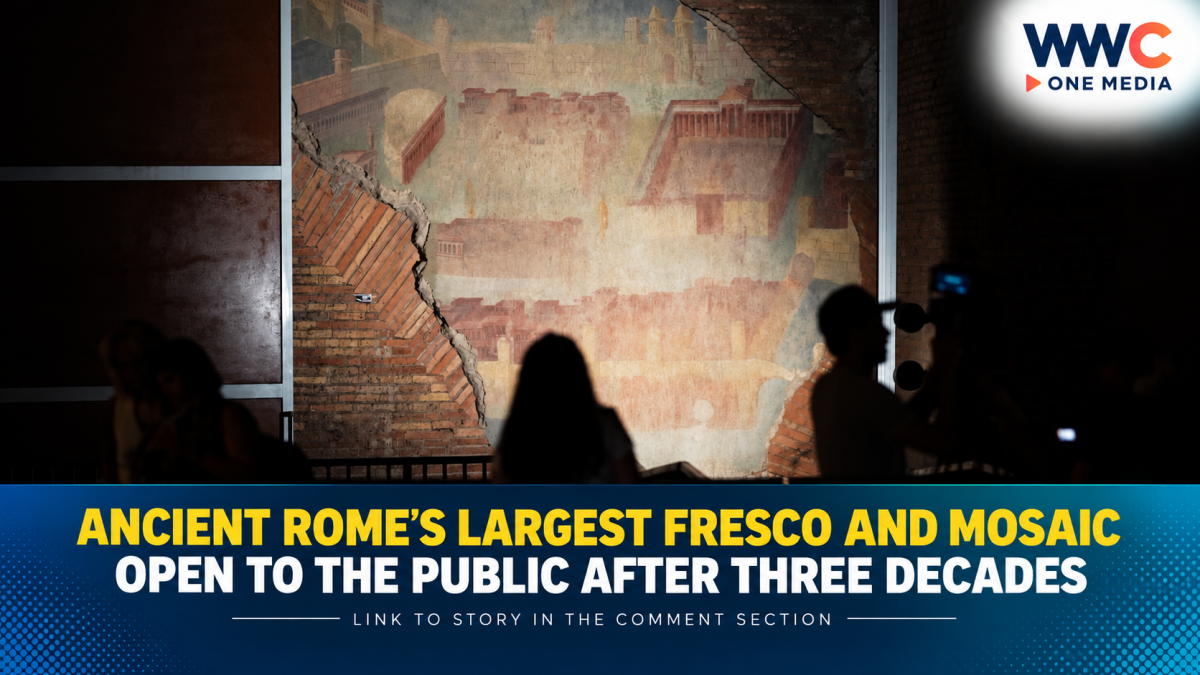
A remarkable piece of ancient Roman history is finally being shown to the public, more than three decades after archaeologists first discovered it beneath Rome’s Oppian Hill.
The recently restored “Painted City” fresco and “Great Mosaic” were uncovered in the 1990s during excavations of the Baths of Trajan, near the Colosseum. Dating to the first century AD, the artworks are believed to form the largest fresco and mosaic complex of ancient Rome.
The Painted City fresco depicts a sprawling walled maritime settlement from a bird’s-eye perspective. Its detailed scenes include buildings, a theatre, a temple, public squares and towers, giving researchers a rare glimpse into how Romans imagined or represented an important port city.
However, archaeologists have not yet determined which real city is shown. Rome’s cultural superintendent Claudio Parisi Presicce said the scale and detail suggest that it was likely a particularly well-known city at the time.
The Great Mosaic is even more imposing. Measuring about 15 metres high, it features richly decorated columns, architectural elements and human figures spread across several levels. Some sections resemble theatrical scenes, including figures such as a philosopher, a centaur and a poet being crowned with a laurel wreath. Other sections show an aerial view of a port city.
Archaeologists believe the artworks may have originally belonged to an earlier structure that stood on the site before Emperor Trajan’s enormous bath complex was built. The Baths of Trajan were dedicated in AD 109 and covered around 15 acres, making them the largest bath complex in the world at the time.
The artworks were eventually buried and remained hidden for centuries. Despite spending so long underground, their blue and terracotta colours have survived, although they have naturally faded over time.
Extensive restoration work has been carried out to improve the visibility of the paintings and mosaic while protecting their fragile surfaces. Conservators removed surface deposits and strengthened the materials holding the decorated sections together.
Their public debut is being handled cautiously. Access is initially limited to small groups of around 15 people during weekend trial openings. Officials want to monitor how the ancient artworks respond to increased humidity and other environmental changes caused by visitors before allowing wider access.
The discovery also highlights how much remains hidden beneath modern Rome. The Great Mosaic has not been completely excavated, with archaeologists continuing to investigate where the enormous artwork ends.
Above the underground gallery, visitors can also explore parts of the Baths of Trajan, including a large semicircular structure believed to have served as a library. The space suggests that the ancient bath complex was more than a place for bathing and exercise, also serving as a venue for cultural and intellectual activities.
For Rome, the unveiling offers a rare opportunity to reconnect a spectacular piece of its ancient past with the public. For archaeologists, the artworks could provide valuable clues about Roman architecture, urban planning and the way important cities were represented nearly 2,000 years ago.




Leave a Reply