
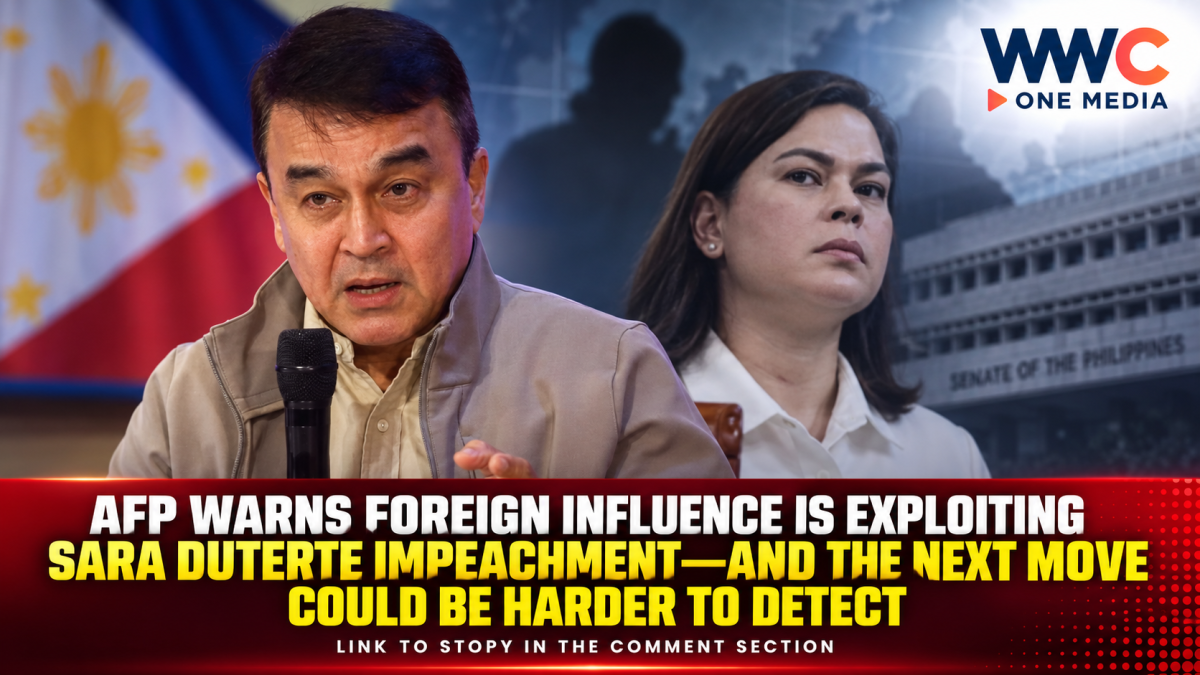
MANILA, Philippines — The impeachment trial of Vice President Sara Duterte is facing another challenge beyond the courtroom: the growing threat of disinformation and alleged foreign malign influence operations that Philippine security officials say are increasingly exploiting divisive domestic issues.
House prosecution panel adviser and spokesman Ace Barbers warned that foreign actors could use the impeachment proceedings to deepen political divisions among Filipinos by manipulating online narratives and amplifying misleading or fabricated content.
The warning comes as the Armed Forces of the Philippines (AFP) says foreign malign influence operations have increasingly shifted from traditional narratives surrounding the West Philippine Sea to highly sensitive domestic controversies.
Among the issues reportedly being exploited are Duterte’s impeachment, the controversy surrounding flood-control projects, criticism of the administration of President Ferdinand Marcos Jr., and other politically charged disputes.
The AFP’s warning was reported by The Manila Times and echoed in separate reports by GMA News, ABS-CBN News, Philippine Star and the Philippine News Agency.
From West Philippine Sea narratives to local political battles
AFP West Philippine Sea spokesman Rear Adm. Roy Vincent Trinidad said the approach to foreign malign influence has changed significantly in 2026.
Instead of relying primarily on narratives connected to the West Philippine Sea or overtly pro-China messaging, influence campaigns are increasingly attaching themselves to issues already generating strong emotions among Filipinos.
Trinidad previously described the emerging strategy as more difficult to detect because the messaging is embedded in genuine local controversies.
GMA News reported that the AFP observed the trend over the previous four to six months, with influence messaging increasingly riding on issues such as the impeachment, the flood-control controversy and the Sanjia Steel controversy.
Philippine Star likewise reported that the AFP had detected what officials described as Chinese-linked influence activity surrounding the impeachment and flood-control controversy.
Importantly, these are assessments and allegations from Philippine officials. They should not be interpreted as proof that every controversial social-media post or criticism of the government originates from a foreign government.
How the alleged strategy works
Barbers warned that the danger goes beyond simply spreading an obviously false story.
According to the Manila Times report, influence operations can create fake personas, recycle or manufacture content, coordinate accounts and repeatedly amplify particular narratives until they appear to be coming from ordinary users.
This type of activity is often associated with so-called “spamouflage” campaigns, in which large volumes of coordinated material are used to overwhelm online discussions and make artificial narratives appear organic.
Barbers said one China-linked operation previously identified as targeting Philippine audiences involved 155 accounts with about 130,000 followers and millions of interactions, citing information from Meta and open-source research.
The objective, he warned, does not necessarily have to be convincing Filipinos to support a particular foreign position.
It can also involve making Filipinos distrust one another, government institutions, political leaders and even the information they encounter online.
That distinction is important.
An influence operation can potentially be successful even when people do not believe the original propaganda if it succeeds in creating confusion, anger and distrust.
Duterte impeachment becomes a particularly sensitive target
The impeachment trial provides fertile ground for such activity because it involves one of the country’s most politically divisive figures and comes amid a wider breakdown of the political alliance that helped bring the Marcos and Duterte camps to power.
House prosecutors have repeatedly warned about false information surrounding the proceedings.
In June, House prosecutors cautioned the public that misinformation, factual distortions and fabricated narratives could intensify as the impeachment process progressed.
By August, the House prosecution panel said it was coordinating with the Cybercrime Investigation and Coordinating Center (CICC) to help identify individuals behind fabricated statements and fake quotations circulating online.
The prosecution team has also warned that lawmakers who supported Duterte’s impeachment have themselves become targets of online misinformation and personal attacks.
The warning comes as Duterte faces mounting legal pressure
The concern over information manipulation comes at an especially sensitive moment for Duterte.
On September 4, a Philippine trial court issued an arrest warrant for the vice president over three counts of alleged grave threats involving President Ferdinand Marcos Jr., First Lady Liza Araneta Marcos and former House Speaker Martin Romualdez.
Duterte has denied the allegations and said she would pursue available legal remedies. The court set bail at ₱120,000 for each charge.
Reuters reported on September 5 that Duterte subsequently posted bail.
The criminal case is separate from the impeachment proceedings, although the two developments have intensified the political spotlight surrounding the vice president.
That overlap creates an environment where genuine developments, political commentary, speculation and fabricated content can quickly become mixed together online.
Why social-media users are being urged to slow down
Philippine officials are not telling the public to avoid political discussion.
Instead, the central warning is to verify information before sharing it.
The AFP has urged Filipinos to examine the source of political claims, particularly material that provokes an immediate emotional reaction.
That means checking whether a quotation actually came from the person being quoted, whether a video has been altered or generated using artificial intelligence, whether an account has a history of coordinated posting, and whether the claim is supported by established news organizations or official documents.
The problem has already surfaced in the impeachment debate.
Malacañang recently criticized the circulation of an AI-generated video that appeared to depict students criticizing Duterte’s impeachment. The incident underscored how synthetic media can further complicate an already polarized information environment.
The bigger concern: 2028
According to AFP officials cited by GMA News and Philippine Star, the shift toward domestic issues could continue through the period leading to the 2028 Philippine elections.
That makes the current impeachment controversy more than a single political dispute.
It could also serve as a preview of how future political battles are fought online—through viral posts, anonymous accounts, manipulated videos, fake quotations and narratives designed to provoke one political camp against another.
For Barbers, the answer is straightforward: the impeachment should ultimately be judged on evidence and constitutional procedures rather than the loudest social-media campaign.
The public, meanwhile, faces a more difficult responsibility.
Before clicking, sharing or forwarding a post, Filipinos may have to ask a basic question:
Is this information designed to inform me—or designed to make me angry?
Because if foreign influence operations can successfully turn an authentic political controversy into a manufactured online war, the damage may extend far beyond the impeachment trial itself.
WWC ONE MEDIA J.M.D

Leave a Reply